15 Small Living Room Ideas Under 150 Square Feet That Never Feel Cramped
A living room under 150 square feet is a design challenge, not a design defeat. The right sofa, the right rug placement, the right amount of vertical storage, and the right lighting together can make a tiny room feel like it belongs on the cover of a design magazine—and photograph beautifully to prove it.
The rule for small living rooms is that every piece must earn its floor space. Every table stores something inside it. Every wall does double duty for art and storage. Every light source layers with two or three others. The room can’t handle a single piece of furniture that only sits there looking nice—there’s no room for pure decoration.
Here are fifteen ideas that consistently make small living rooms feel bigger, more designed, and more comfortable to actually live in. They range from layout decisions (before you buy anything) to styling touches (after everything’s in place). Pick the ones that fix your room’s specific problems.
1. Choose a compact-scale sofa (72-84 inches)
The single biggest mistake in small living rooms is buying a sofa designed for suburban houses. Look for “apartment-scale” or “compact” sofas: 72-84 inches long, with a depth of 32-36 inches. West Elm, Article, IKEA, and Wayfair all carry proper apartment-scale lines.
A shorter sofa doesn’t just fit better—it changes the whole room’s proportions. A 96-inch sofa in a 12-foot room looks crammed against both walls; a 78-inch sofa in the same space leaves visual breathing room and lets other pieces (side table, floor lamp, plant) actually fit.
Choose a sofa with tapered wooden legs that lift it off the floor. Visible floor underneath makes the sofa feel lighter. Skirt-to-floor upholstered sofas visually anchor to the ground and shrink the room.
2. Float the sofa away from the wall
Instead of pushing the sofa flush against a wall, pull it 12-18 inches away and add a slim console behind it. The negative space between sofa and wall reads as a corridor, and the room feels bigger.
The console behind the sofa doubles as a landing zone for keys and mail, a bar for drinks, or a desk. Slim consoles at 8-10 inches deep barely eat any floor space and turn wasted wall into functional design.
This trick works even in tight rooms. As long as you have 3-4 feet of clearance in front of the sofa for coffee-table and traffic, floating it off the wall creates depth that pushed-against-the-wall arrangements never have.
3. Use a soft storage ottoman instead of a coffee table
A fixed rectangular coffee table blocks traffic through a small living room. A soft storage ottoman with a tray on top does the same job—somewhere to set drinks, magazines, and a candle—but can be pushed under the sofa or moved as extra seating.
Buy the ottoman in a neutral fabric that coordinates with your sofa. Cream boucle, oatmeal linen, and cognac leather all work in most rooms. Always add a wood or brass tray on top so drinks have a solid surface.
Two smaller ottomans work better than one big one. They can split to become footrests, extra seating, or pushed against opposite walls when the room needs to be cleared. Modular is the small-room superpower.
4. Layer three light sources at three heights
One overhead ceiling light in a small living room reads as institutional. Add a floor lamp in a back corner, a table lamp on the side table at seated eye level, and a small task lamp on the console behind the sofa. Three points of warm light at three heights transform the mood entirely.
Buy lamps in a mix of materials for texture: one brass, one wood, one ceramic or rattan. Keep the lampshades consistent (all cream or all oatmeal linen) so the overall glow reads as coherent. Skip pure white shades; they read cold when the bulb is on.
Use warm-white 2700K bulbs in every lamp. Cool bulbs make a small room feel like a doctor’s office; warm bulbs make it feel like a home. This single change costs $20 and changes the whole room.
5. Choose furniture with visible legs
Sofas, chairs, side tables, and consoles with visible legs make a small room feel bigger. When you can see the floor continuing under every piece, the eye reads more floor space and the room breathes.
Look for mid-century modern silhouettes, Scandinavian designs, and anything with tapered or splayed wooden legs. Skip overstuffed “sink into it” sofas with skirts, big storage ottomans with box bases, and bulky console tables that sit flush on the floor.
The principle applies to every piece. A slim brass side table with three thin legs takes visually less space than a solid wood cube of the same footprint. Every leg-based piece adds visual air.
6. Hang the TV instead of using a media console
A TV on a media stand eats floor space and forces you to keep a big piece of furniture. A wall-mounted TV takes zero floor space and gives you back the wall as design real estate. Even in a rental, command-mount TV brackets exist for TVs up to 50 pounds.
Mount the TV at seated eye level from the sofa—typically 42-48 inches from floor to center of screen. Sit on the sofa and mark the wall before you drill or command-strip.
Add a small floating shelf below the TV to hold the streaming box, remote, and one small plant. The whole TV area becomes a wall vignette rather than furniture.
7. Use one big rug that anchors the whole zone
A rug too small for the room shrinks the room. A rug that extends at least six inches past the front of every seating piece anchors the room and makes it read as unified. In small living rooms, choose the biggest rug that will fit—usually 5×8 or 6×9 feet.
Choose flat-weave jute, low-pile wool, or a natural fiber like sisal. Skip high-pile shag; it eats visual space and hides dirt. Warm cream, oat, warm gray, and honey tones all work with most sofa colors.
For patterned rugs, keep the pattern small-scale (subtle diamond, herringbone, or delicate botanical). Big bold patterns compete with the sofa and other room elements in a small space.
8. Add tall vertical storage on the wall
Small living rooms have limited floor space but often have full-height walls. Add a tall bookcase (7-8 feet) that runs floor to near-ceiling. The vertical storage frees the floor for seating and reads as intentional architecture.
IKEA’s Billy bookcases, tall Kallax stacks, and West Elm’s tall shelving units all work. Position the bookcase on the wall opposite the sofa, in a corner, or beside the TV. Fill the shelves with books, plants, small ceramic pieces, and photos.
Anchor the bookcase to the wall with the included wall bracket (or a simple L-bracket in a rental) so tall books stay standing when the room shakes. Style shelves with negative space—one-third full is the design rule, not fully packed.
9. Add a large mirror opposite the biggest window
A large mirror hung directly across from the biggest window doubles the natural light entering the room and visually doubles the room’s depth. This is optical physics, not decorating opinion.
Choose one big mirror—4-6 feet tall—rather than a gallery of small mirrors. Rattan-framed, brass-framed, or slim black-framed round mirrors all work. Skip ornate baroque frames in tight rooms; they read as busy.
Position the mirror at eye level or slightly above. During daylight it reflects light into the room; at night with warm lamps it reflects the glow and doubles the coziness. One mirror is the highest-ROI wall decoration in any small room.
10. Use a narrow console instead of a coffee table
For truly tight rooms where even an ottoman blocks traffic, a narrow console table (12-18 inches deep) positioned parallel to the sofa gives you a surface for drinks and books without the traffic-blocking footprint of a coffee table.
Place the console behind the sofa (if the sofa is floated) or in front of it, running along the length. Style with a small stack of books, a small plant, and a small candle. The console reads as a designed piece rather than a coffee-table compromise.
This works particularly well in narrow long living rooms where a proper coffee table would block the middle. The console runs parallel to the traffic flow rather than perpendicular.
11. Stack picture ledges instead of framing individually
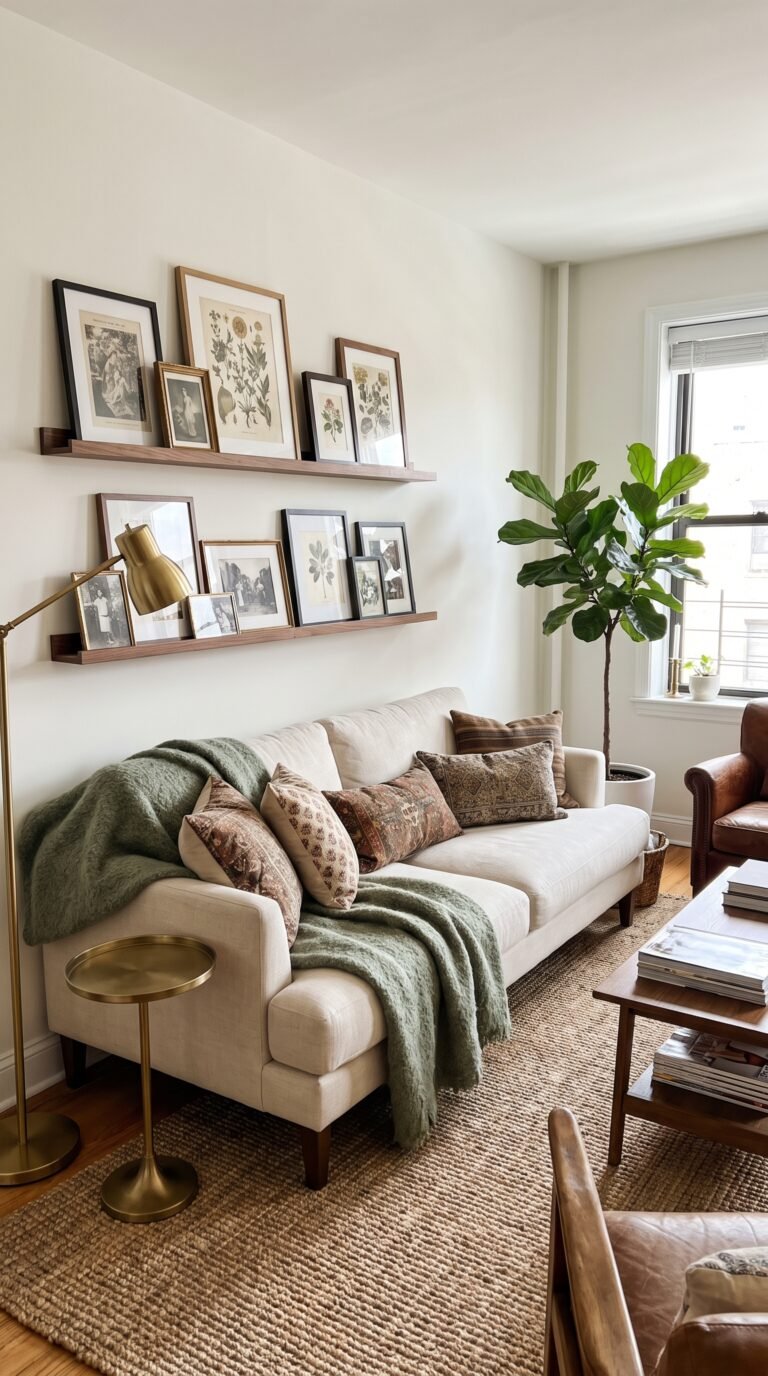
Instead of nailing individual frames to the wall, mount two or three horizontal picture ledges above the sofa and layer art on them. This creates a gallery-wall effect that costs less, damages less, and lets you rearrange art anytime.
IKEA Mosslanda ledges are the classic choice. Mount three ledges stacked vertically (with 12-15 inches between them) above the sofa. Fill with 8-15 pieces of art at varying sizes—stacked, layered, overlapping.
The ledges themselves become part of the design—choose warm-oak or matte-black to coordinate with your palette. The layered art can rotate with seasons or moods without you touching the wall at all.
12. Choose a coffee table with visible negative space
If you must have a coffee table (many people do), choose one with visible negative space rather than a solid box. Glass tops, open bases, wire frames, and hollow silhouettes all keep the room feeling airy.
A brass or matte-black wire coffee table with a small round wood top eats less visual space than a solid oak block of the same footprint. Round tables are safer for tight rooms—no sharp corners to bump.
Style the coffee table minimally: a stack of two design books, a small ceramic vessel, a small candle in a warm amber jar. Three objects total, no more. Small rooms need clear tables, not styled-heavy ones.
13. Add one plant taller than the sofa
One large plant (5-6 feet tall) in the corner behind or beside the sofa transforms the whole room. Fiddle-leaf fig, monstera, bird of paradise, or a tall snake plant all work. The vertical greenery softens the boxy geometry of the room.
The plant sits in a warm-toned woven basket or ceramic pot—never the plastic nursery pot. Even in low light, snake plants and ZZ plants survive; in brighter rooms, fiddle-leaf figs and monsteras thrive.
A single big plant does more visual work than three small ones. Scale matters more than variety. One statement plant per room is the rule.
14. Use one bold pillow for a color moment
Instead of loading the sofa with five or six pillows (which shrinks the sofa visually), use two neutral pillows plus one bold pillow in a warm accent color. The one loud pillow creates a color moment; the two neutrals frame it.
The bold pillow should match one other object in the room—the throw over the sofa arm, a piece of art, or the accent color in the rug. Repetition of the accent across the room ties everything together.
Change out the bold pillow seasonally—rust for fall, warm cream for winter, sage for spring, terracotta for summer. The rest of the room stays consistent while the room feels refreshed four times a year.
15. Add hidden storage under every possible surface
The ottoman opens for extra throws. The console behind the sofa has drawers or baskets underneath. The bookcase has closed cabinet doors at the bottom for hidden storage. Every surface in a small living room should hide something.
For rentals or lease-to-move places, use furniture with storage built in from the start (rather than adding storage bins that clutter). Article, IKEA, and West Elm all sell coffee tables, ottomans, and consoles with hidden storage.
Store the things you use daily but don’t want visible: extra blankets, remotes, chargers, magazines, notebooks, small tools. Rooms with hidden storage read as calm; rooms with everything visible read as cluttered.
A small living room done well is more impressive than a big one done poorly. When every piece earns its floor space, every wall does double duty, and every light source layers with others, a 150-square-foot room can genuinely feel like a design magazine spread. The trick is that constraints force better choices—you can’t hide a bad decision in a small room, so every decision has to be good.
Start with the sofa scale, the rug size, and the lighting layers. Those three foundational choices shape everything else. Once the bones are right, add vertical storage, one big mirror, and one big plant. Layer in the styling touches last. Small living rooms should feel like small hotels: intentional, warm, and better than they should be for their size.