25 Ways to Style a Rental Living Room With Bad Beige Walls
Twenty-five tested ways to style a rental living room with bad beige walls — without painting, without fighting the color, and without a decorator. Warm brass lamps, ceiling-height linen curtains, olive trees in terracotta, cream boucle textures, layered vintage rugs, and the mindset shift that turns “ugly beige” into “warm European neutral.”
Beige walls get a bad reputation — but the problem is almost never the beige itself. It is that most renters try to decorate AROUND the beige with cool colors (gray, white, blue) that fight the yellow undertones and make the room feel dated. The fix is simpler than it sounds: stop fighting the beige and start embracing warm neutrals that live in the same tonal family.
This guide is twenty-five specific ideas — furniture, lighting, textiles, plants, art — that make a beige-walled rental living room read sophisticated and intentional. Every idea is landlord-friendly, every one travels with you to the next place, and the whole look costs less than painting the walls would.
1. Lean into the warm palette — do not fight the beige

The biggest mistake renters make with beige walls is painting around them with cool tones (blue, gray, stark white) that fight the yellow undertones. Beige fights back and wins every time — the room ends up looking muddy and dated.
Instead, lean warm. Pair beige with cream, oatmeal, warm terracotta, soft sage, aged brass, and warm oak. Suddenly the “ugly beige” reads as sophisticated European neutrals.
A cream linen sofa against a beige wall reads timeless. A gray velvet sofa against the same beige wall reads cold and competing.
Study your beige closely — is it yellow-beige, pink-beige, or green-beige? Match accents in the same undertone family. Yellow-beige loves warm oak and terracotta; pink-beige loves rose terracotta and cream; green-beige loves sage and olive.
This one mindset shift — stop fighting, start harmonizing — transforms rental living room design from frustrating to easy.
2. Add a warm brass floor lamp to shift the color
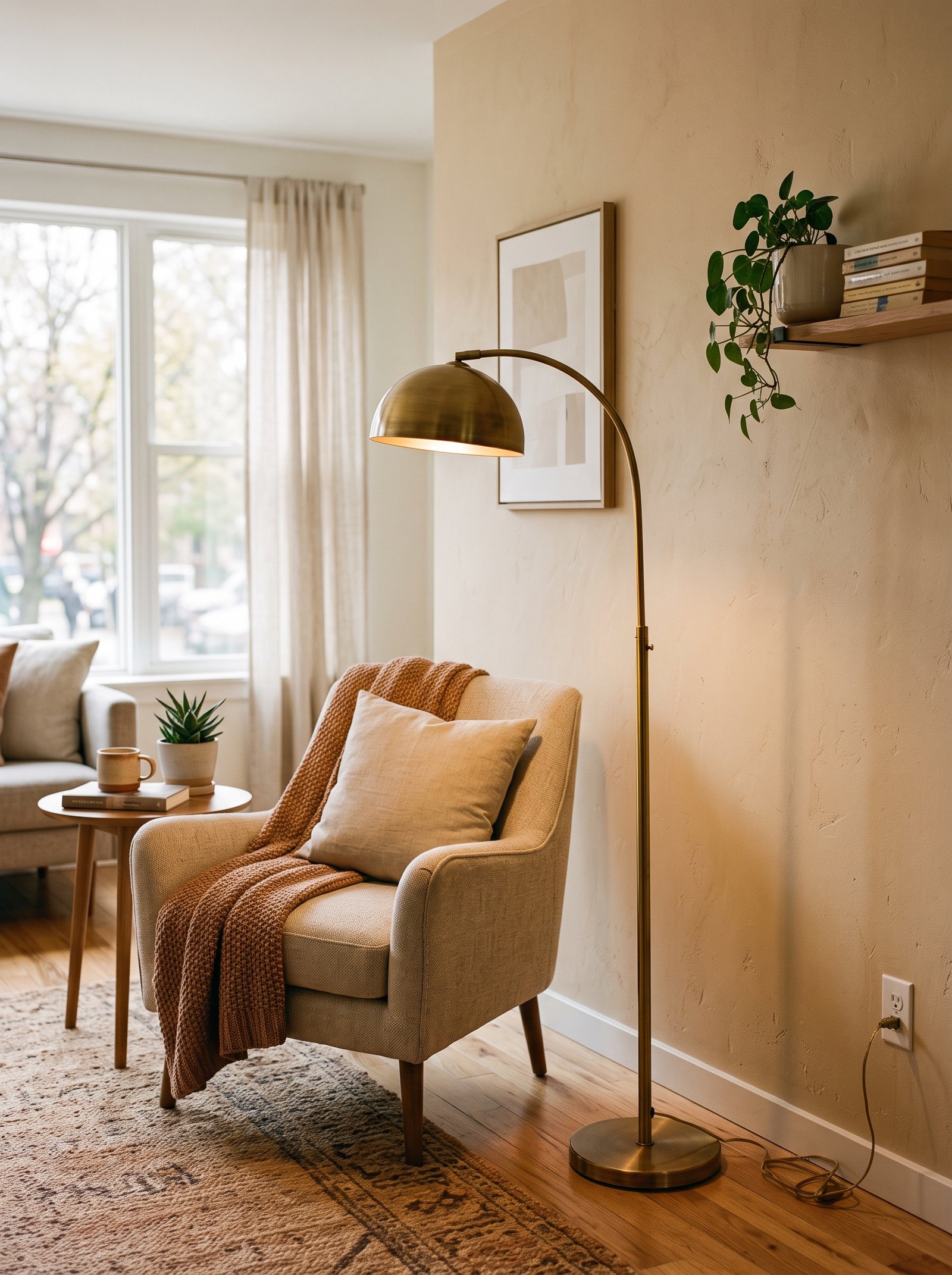
Beige walls under harsh overhead light read dingy. Under warm 2700K brass floor lamps, the same beige reads sun-washed and expensive — like a Provençal villa at golden hour.
Buy a floor lamp with an aged brass or warm brushed-gold finish. West Elm, Target Studio McGee, and Wayfair all sell them in the $80-250 range.
Position in the corner behind the sofa or beside the main seating area. The brass warms the entire wall color visually.
Use a 2700K warm-white LED bulb inside — never cool white, never daylight. The bulb color temperature is the whole point.
One brass floor lamp changes how a beige room photographs by about 300%. Smallest-cost, highest-impact single upgrade.
3. Layer warm textures — jute, boucle, terracotta
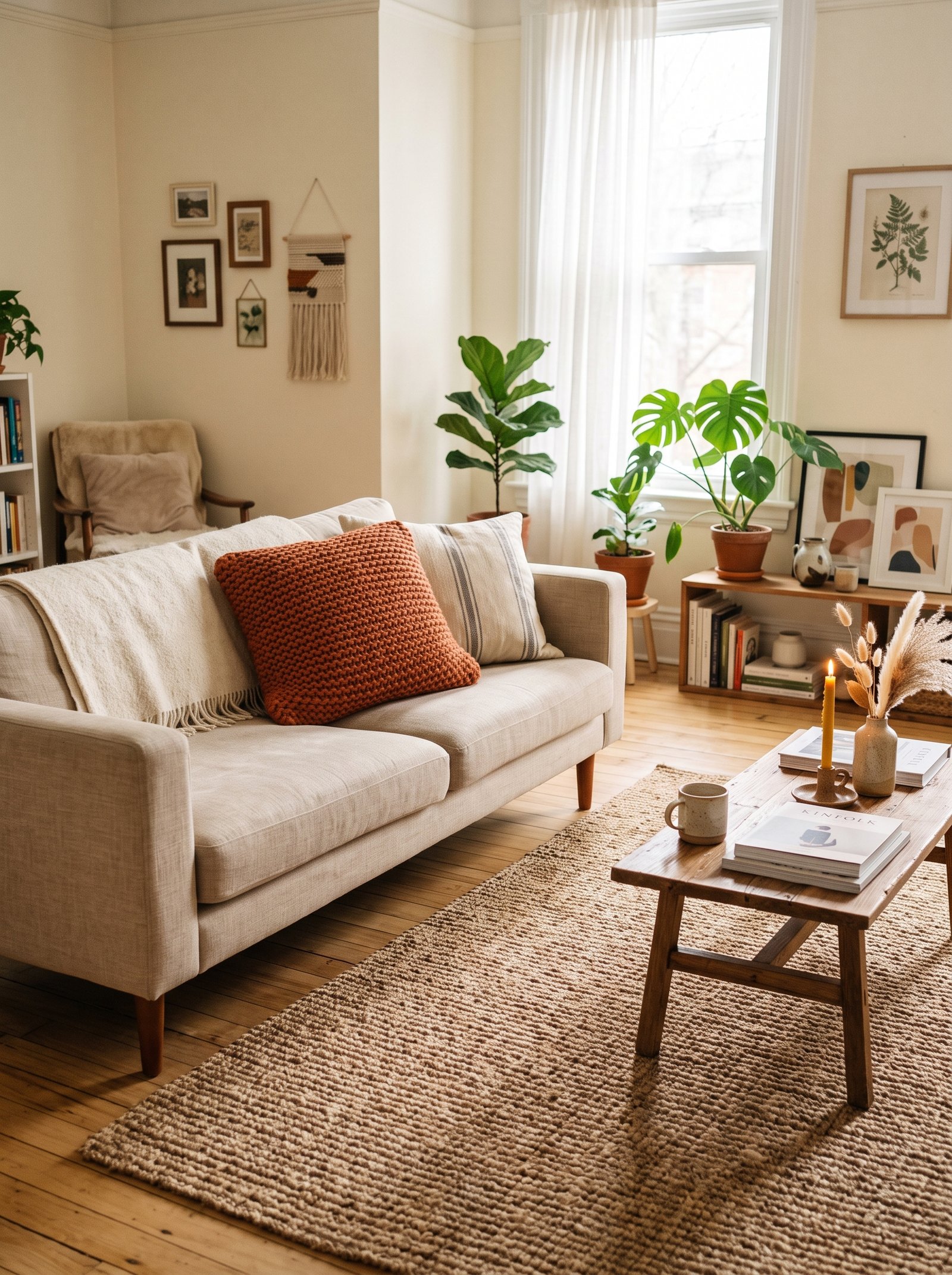
Beige walls become beautiful when the room has layered texture. A flat beige wall + a flat beige sofa + flat beige everything = sadness. Beige wall + jute rug + cream boucle + terracotta throw pillow + oak coffee table = magazine.
Start with the big piece: a 8×10 or 9×12 jute or sisal rug covers most of the floor and anchors the warm palette.
Add texture on top: cream boucle throw pillows, a soft knit blanket, one small terracotta accent pillow or vase.
The variety of textures (woven, soft, matte, glossy) creates visual richness that pulls the eye away from the wall and toward the room.
Three well-chosen textures beat one perfect wall color every time.
4. Hang ceiling-height curtains to cover the walls
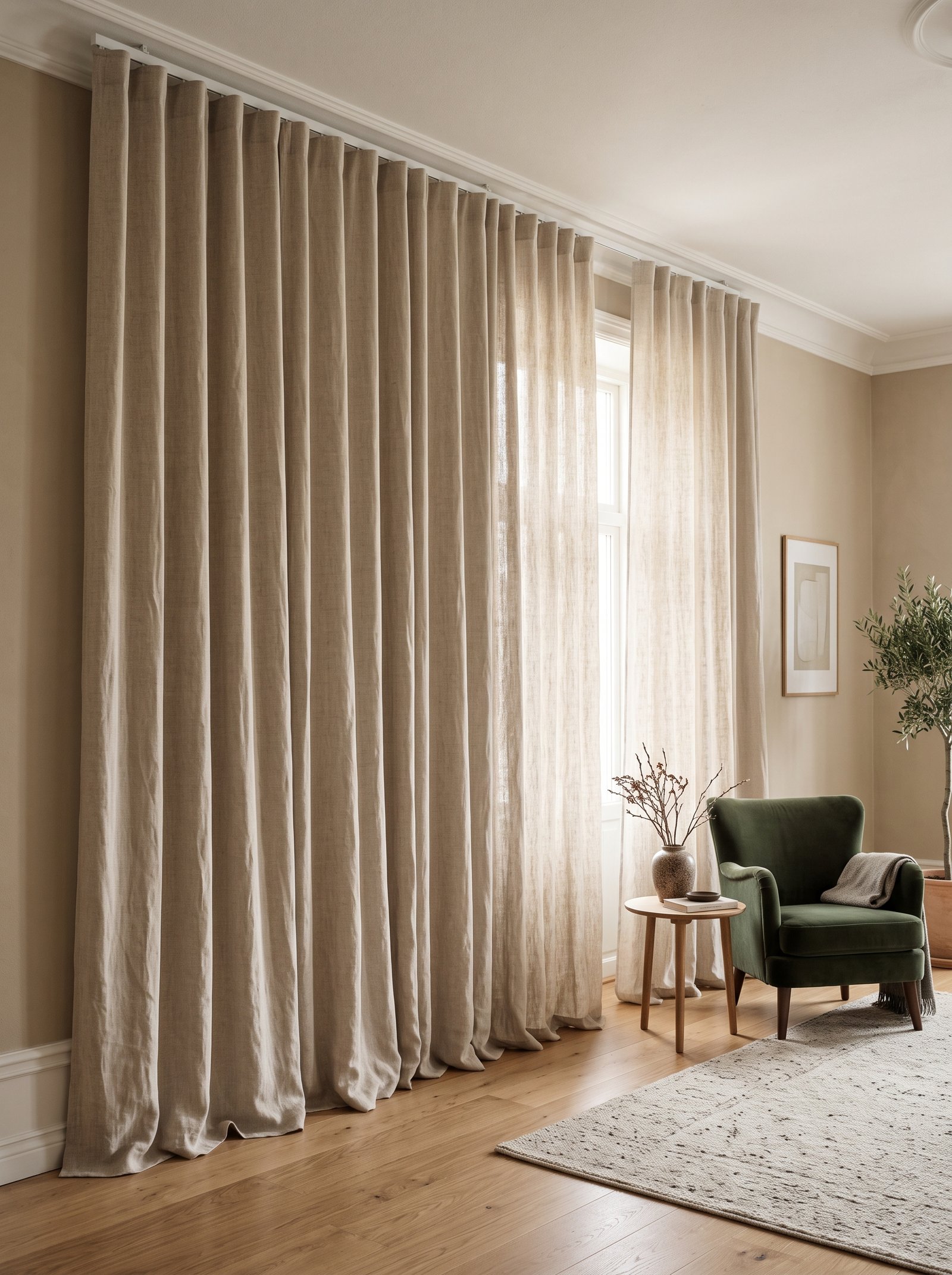
The single most effective way to hide beige walls is to mount curtain rods at ceiling height and let floor-length linen curtains cover the walls on both sides of the window.
Mount the rod 4-6 inches above the top of the window frame, or all the way to within an inch of the ceiling. Extend the rod 12-18 inches past each side of the window.
When open, the curtains stack off the window glass and cover the beige wall segments on either side. When closed, they cover even more wall.
Use cream, oatmeal, or warm flax linen — never pure white. Natural linen tones blend with the beige and expand the wall visually.
This trick alone can hide 40-50% of the visible beige wall surface in a typical rental living room.
5. Lean oversized art against the beige wall
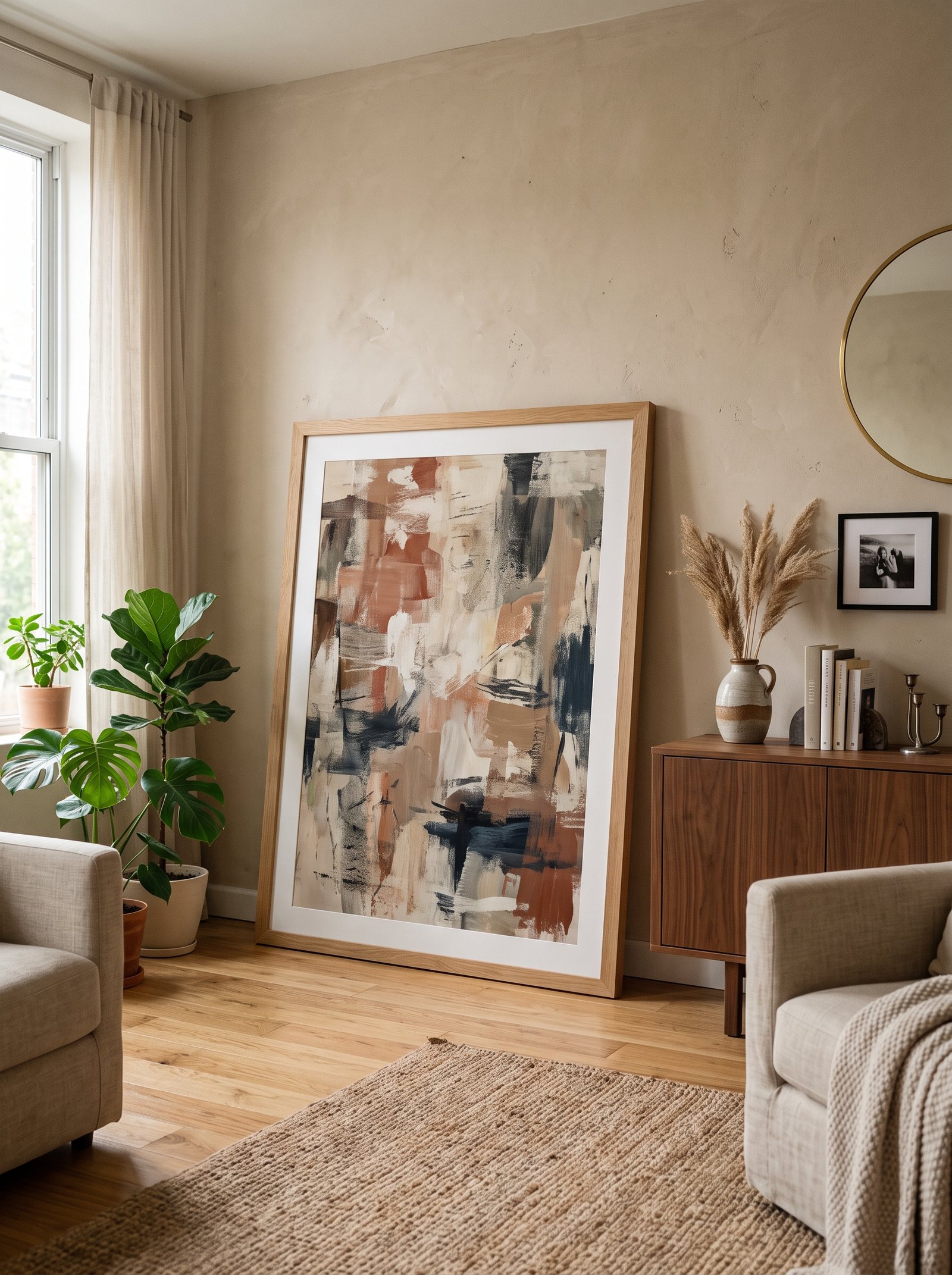
One oversized leaning piece (36×48 inches or larger) against a beige wall hides a huge amount of beige surface while adding immediate character.
Shop Minted, Juniper Print Shop, or Etsy for large-format prints. Order unframed and buy a floor-standing frame from Pottery Barn or IKEA.
Choose art with warm cream, oatmeal, and terracotta tones that complement the beige wall rather than fight it.
Lean behind the sofa, in the corner of the room, or in the dining area. The casual lean reads intentional.
One large piece replaces a dozen small frames and covers more wall faster.
6. Install a tall bookshelf to cover a wall
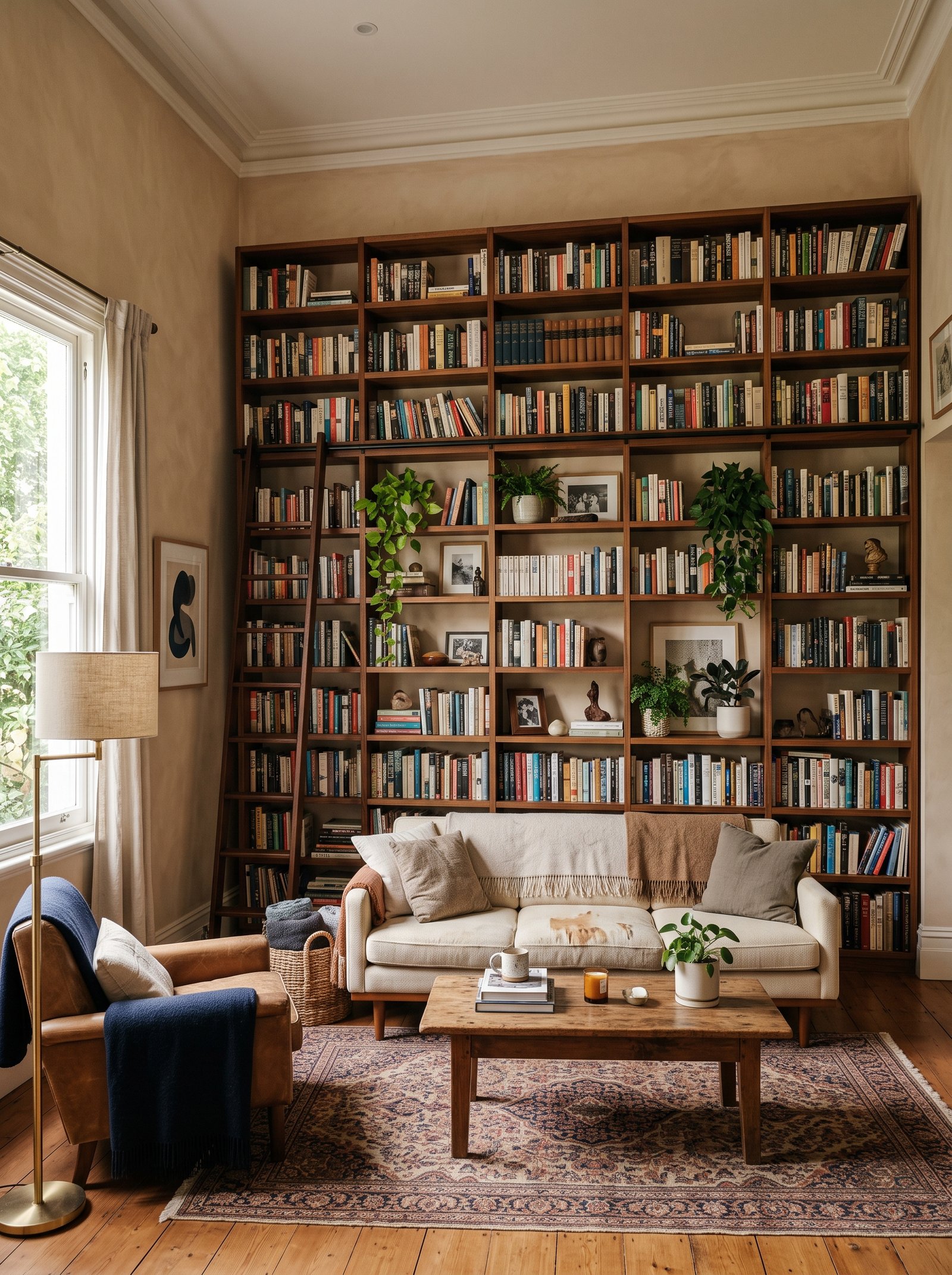
A floor-to-ceiling bookshelf against a bad beige wall essentially replaces that wall with a styled display surface. The books, pottery, and plants become the “wall.”
IKEA BILLY ($70-150), West Elm, and Article all make tall bookshelves 72-90 inches high. Floor-to-ceiling is the goal.
Fill with books, ceramics, baskets, and plants. The goal is 70% books / 20% objects / 10% plants.
The entire visible beige wall disappears behind a layered styled surface that reads intellectual and curated.
On move-out, disassemble and take with you. The wall underneath is exactly as the landlord left it.
7. Swap every bulb to 2700K warm white
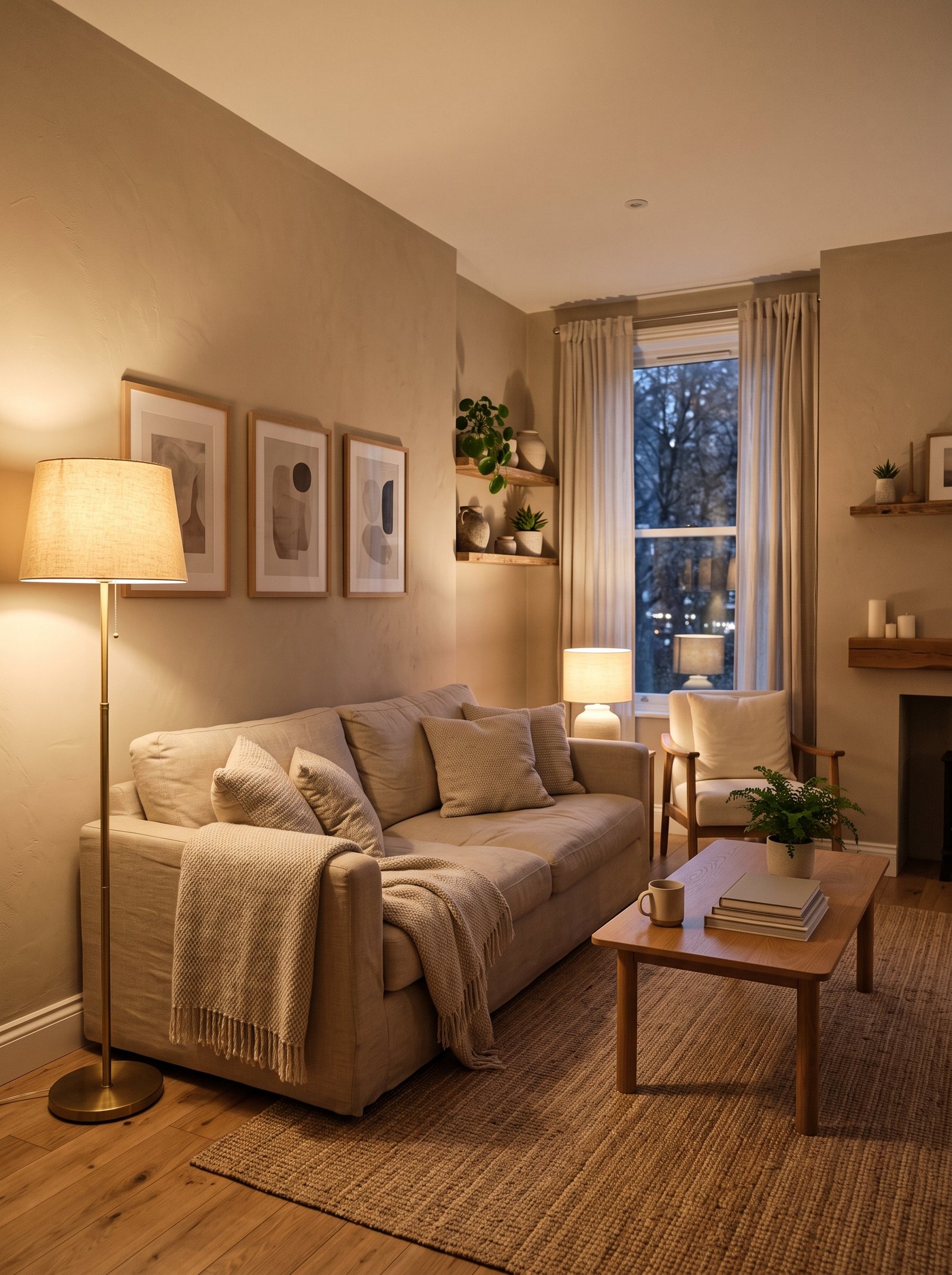
Cool overhead light makes beige walls read dingy. Warm 2700K LED bulbs make the same walls read sunset-golden. $15 change, massive impact.
Replace every bulb in the living room — overhead, lamps, closet, everything — with Philips Warm Glow, Cree, or GE Relax LEDs rated 2700K.
Under warm light, the yellow undertones in beige read as sunlight. Under cool light, those same undertones read as dirty.
Combine with brass floor lamps (idea 2) for layered warm lighting throughout the room.
Take the warm bulbs with you when you move. Put the ugly cold ones back. Never see cold light in your own home again.
8. Add an olive tree in a terracotta pot
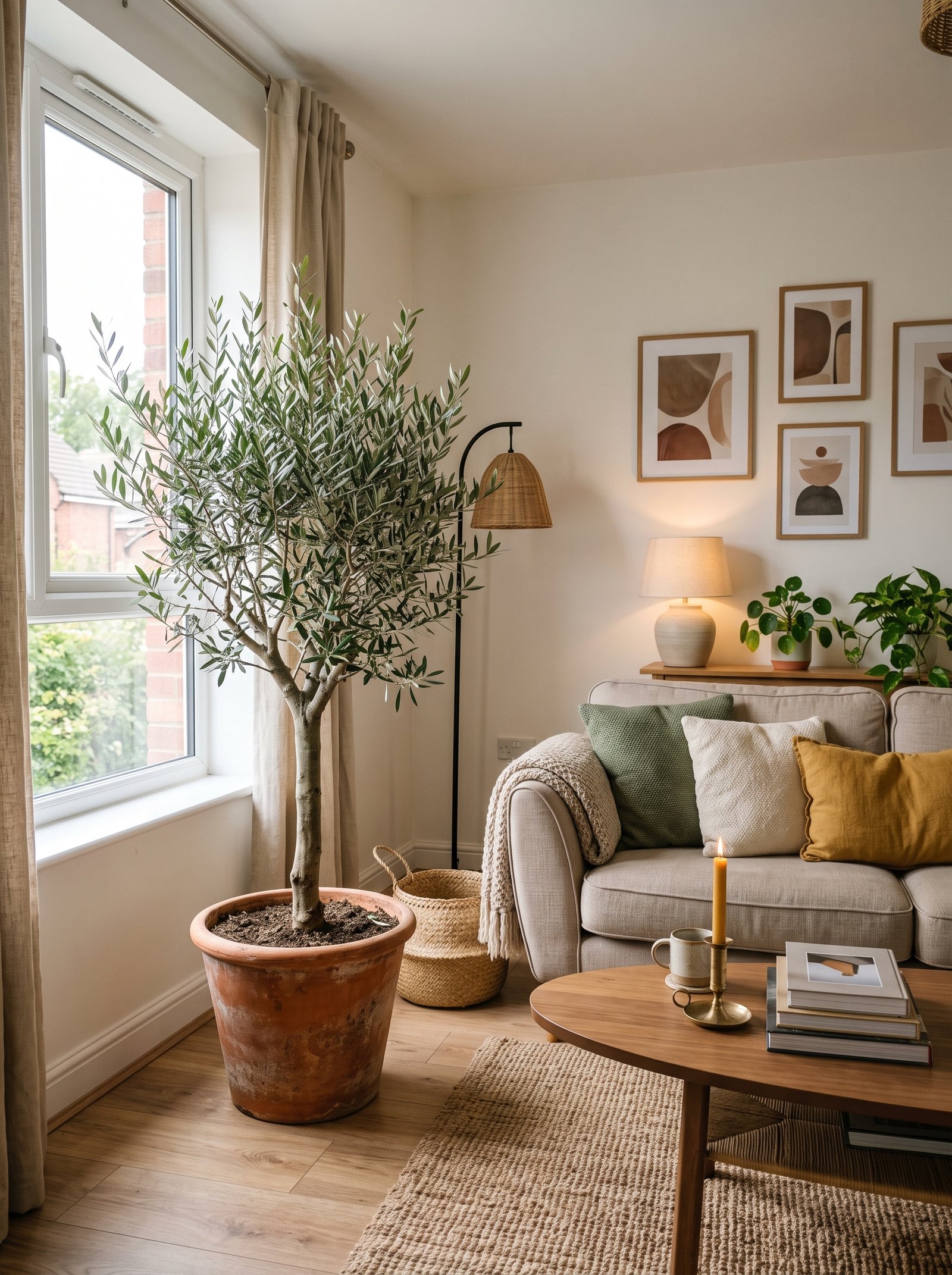
A tall potted olive tree (or fiddle leaf, or rubber tree) in a terracotta or warm stoneware pot adds vertical greenery that distracts the eye from flat beige walls.
Home Depot sells olive trees for $30-80. Larger specialty olive trees run $100-300. Any size works.
Place the pot in a corner of the room, away from the main seating. The tree becomes a vertical visual anchor.
One living element completely changes how a room feels. The green against beige reads Mediterranean rather than dated.
Water once every 10-14 days. Rotate quarterly. In 1-2 years the tree doubles in size and becomes a permanent room feature.
9. Add one dark accent chair for contrast
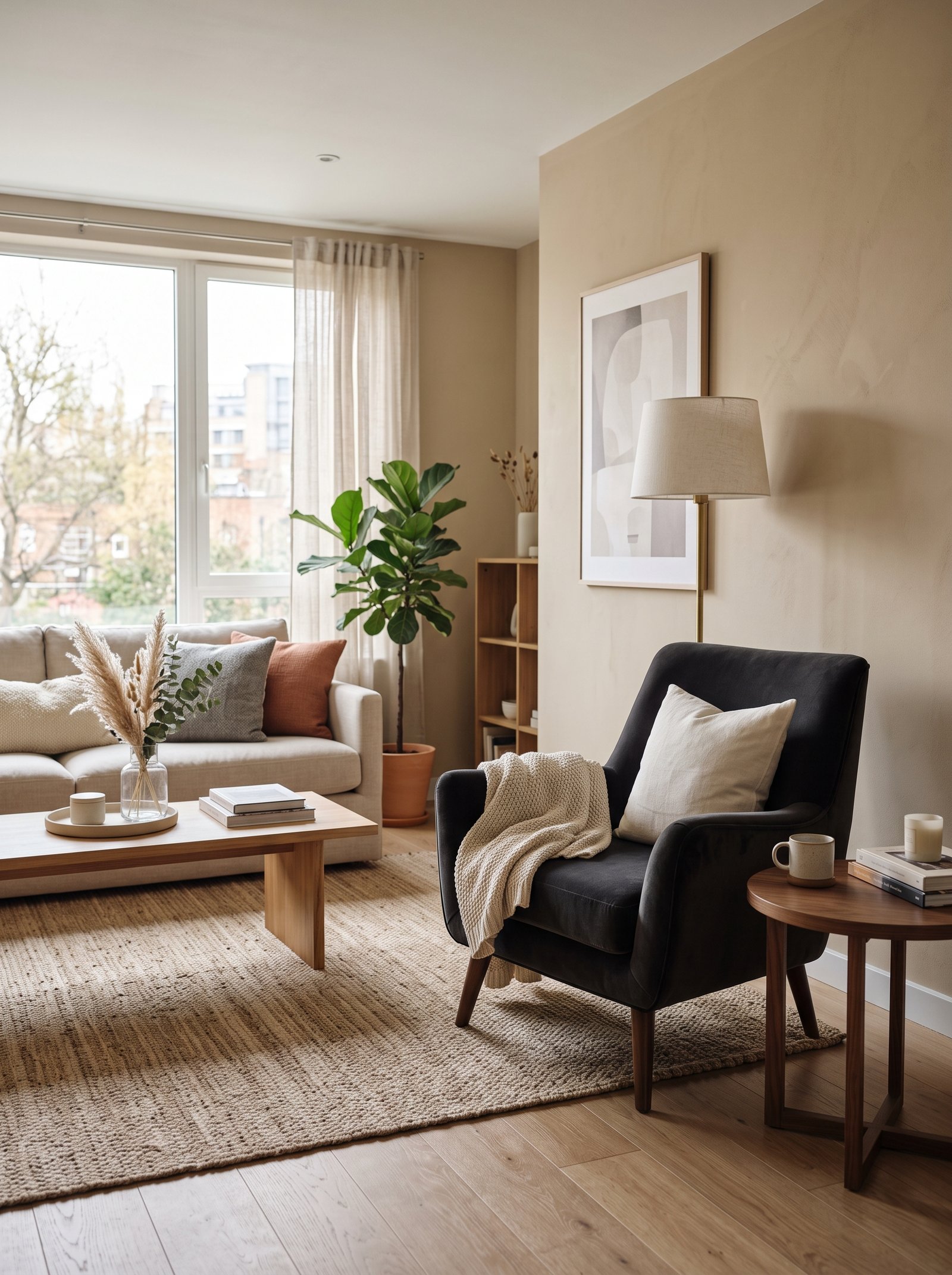
Pure cream + beige everything can read monotone. One dark accent chair — black boucle, deep olive, forest green, or walnut leather — adds visual anchor and makes the warm palette pop.
Look for small-scale accent chairs: Article, West Elm, and World Market all sell them in the $200-600 range.
Choose matte, warm darks — never shiny or saturated. Deep forest, warm charcoal, chocolate leather, olive velvet all work.
Position opposite the main sofa for contrast. The one dark piece pulls the eye through the room.
One contrasting piece makes everything else read more intentional. Monochrome without contrast reads flat.
10. Hang a large woven wall hanging

A large cotton or wool woven wall hanging in cream, oatmeal, or warm terracotta tones adds texture and covers wall area that framed art would need multiple pieces to equal.
Look for 3-5 foot wide woven hangings. Etsy, Society6, and West Elm sell them in the $60-250 range.
Hang from a wooden dowel or driftwood branch, mounted on one Command hook. The wood is visible decor.
Choose fringed, textured, or hand-woven looks — never flat printed fabric. The texture is the whole point.
One woven hanging can cover 20-30 sq ft of beige wall with layered, warm, intentional texture.
11. Layer a vintage patterned rug
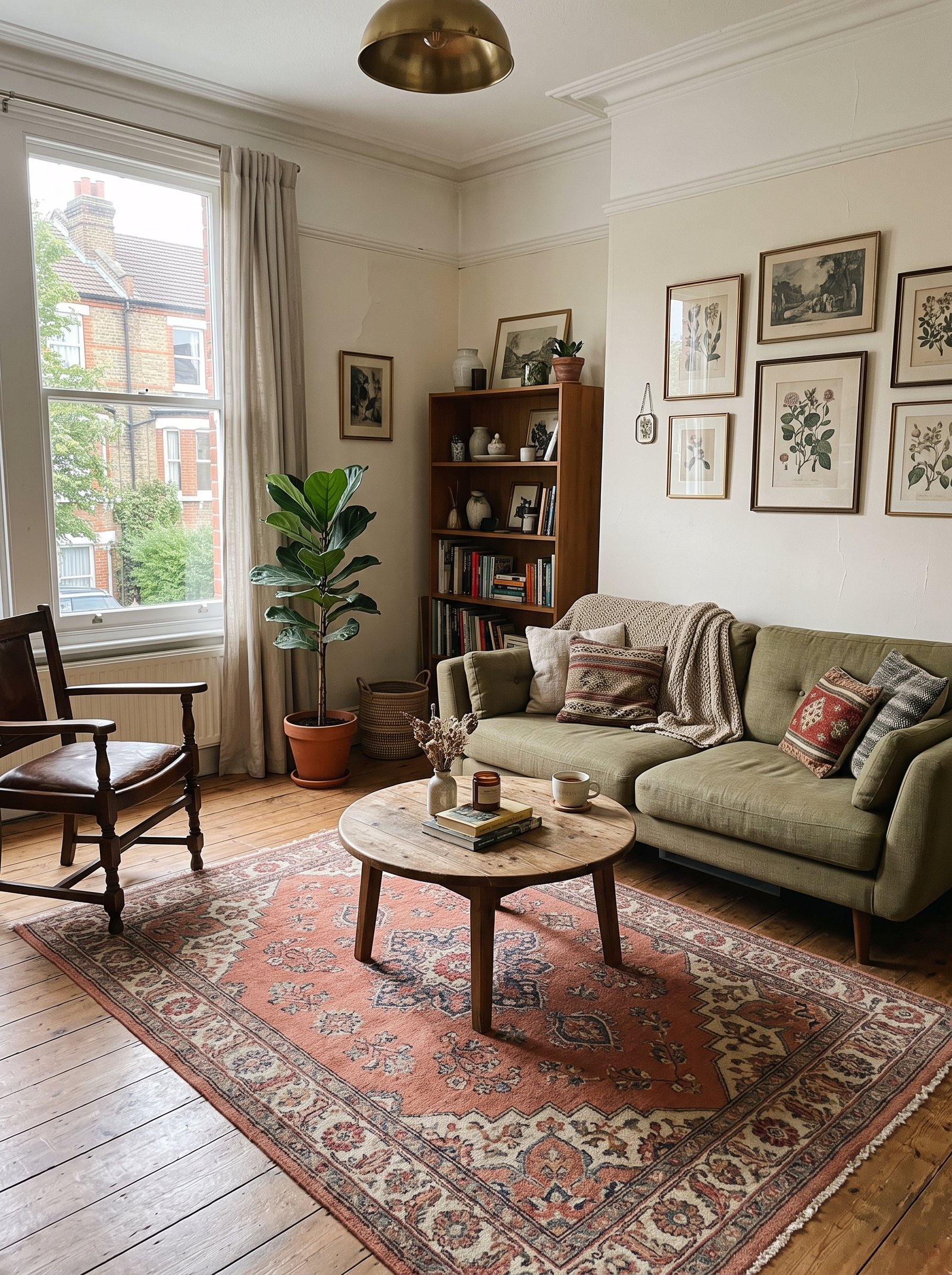
A vintage patterned Persian or Turkish rug in muted terracotta, cream, and warm tones adds the single most “collected” element you can add to a rental living room.
Shop Etsy, Chairish, and estate sales for authentic vintage rugs in the $200-600 range for 8×10 sizes.
Choose rugs with warm palette (terracotta, cream, soft blue, muted gold) — avoid saturated reds or stark black-and-white.
Layer the vintage rug over a larger jute base rug for maximum texture and warmth.
Vintage rugs only get more beautiful with age and travel with you from rental to rental forever.
12. Lean a full-length floor mirror against the wall

A full-length (6-foot tall) leaning floor mirror in a brass, oak, or matte-black frame reflects light, doubles perceived depth, and covers a large chunk of beige wall at the same time.
IKEA (NISSEDAL, $59), West Elm, Target Studio McGee, and Anthropologie all sell leaning mirrors in the $60-400 range.
Lean against the wall opposite a window if possible — the mirror then reflects daylight into the whole room.
Secure the top with a small Command hook for homes with pets, kids, or in earthquake zones.
One large leaning mirror reads expensive and architectural while hiding a 6×2 foot section of beige wall.
13. Style open shelves against the wall
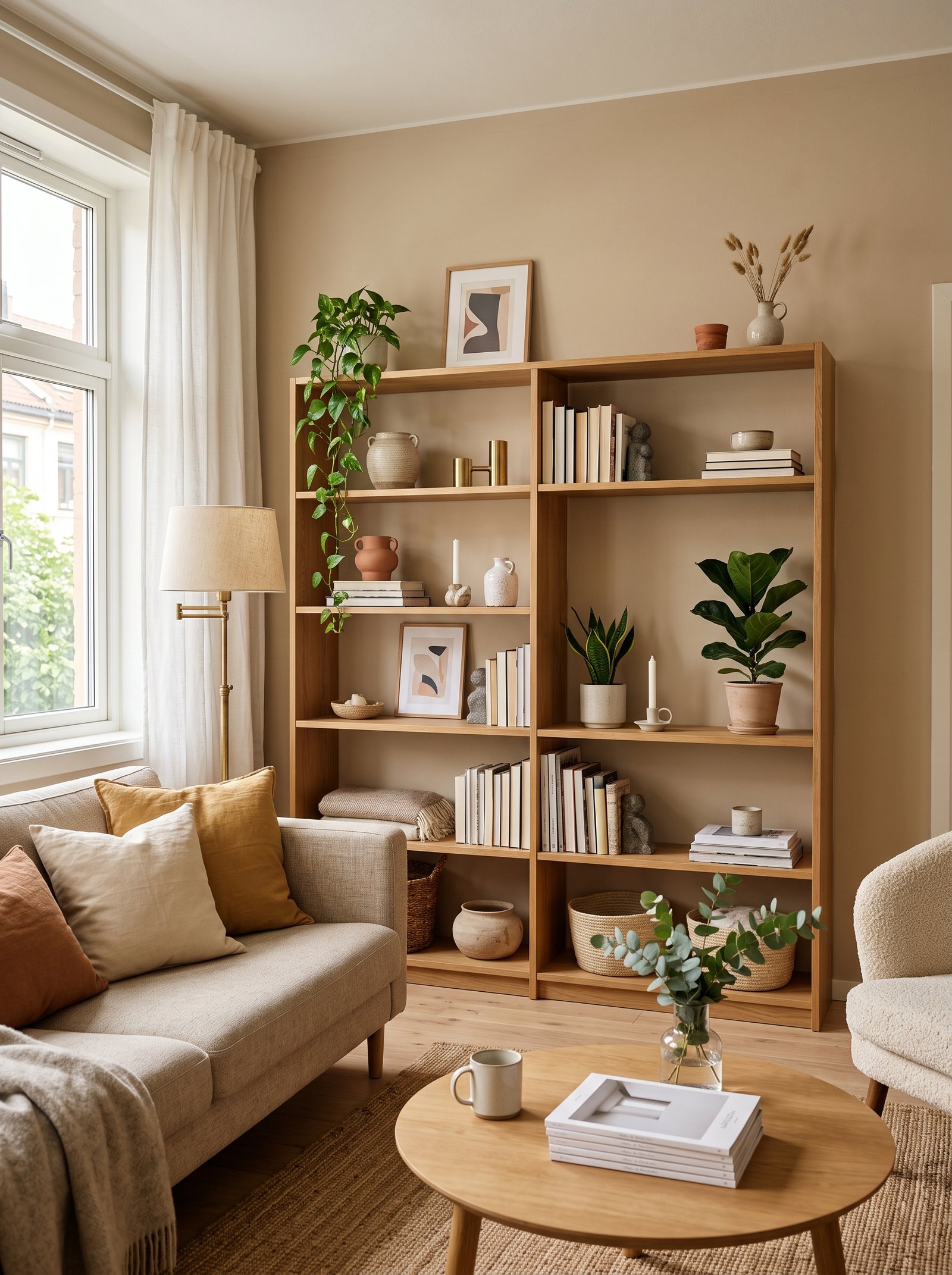
A low or wall-mounted open shelf unit styled with pottery, books, plants, and small objects becomes a textured decor piece that masks the beige behind it.
Choose warm oak or walnut shelves. IKEA, West Elm, and Etsy all sell them in the $40-200 range.
Style three to five objects per shelf — one tall vase, one stack of books, one small sculpture, one plant. Odd numbers only.
Mix materials: ceramic, brass, wood, woven fiber, dried florals. The variety is what makes it look curated.
One well-styled open shelf unit replaces the need for art on that wall entirely.
14. Slipcover the sofa in cream linen
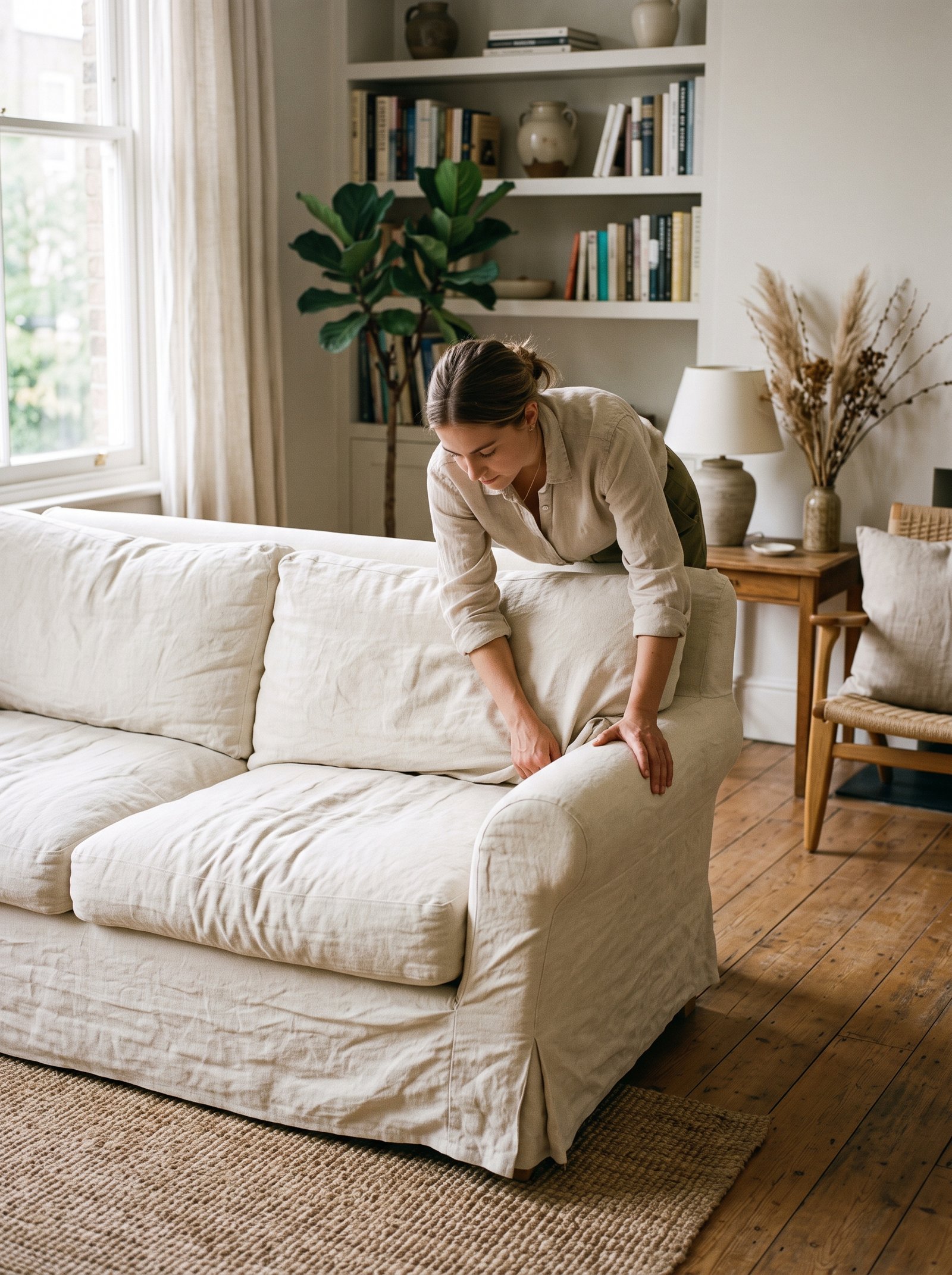
If your sofa is a bad color (gray, dark brown, worn beige), a cream linen slipcover from Bemz, Comfort Works, or Target changes the single biggest piece of furniture in the room instantly.
Slipcovers run $100-400 depending on sofa size. Pre-washed linen in cream or oatmeal is the goal.
Choose cream over pure white — pure white reads clinical in a warm beige room.
Even on a nice sofa, swapping to a cream linen slipcover warms the whole palette and ties it to the beige walls.
On move-out, remove the slipcover. Original sofa underneath, cover goes with you.
15. Add a sculptural woven basket for storage
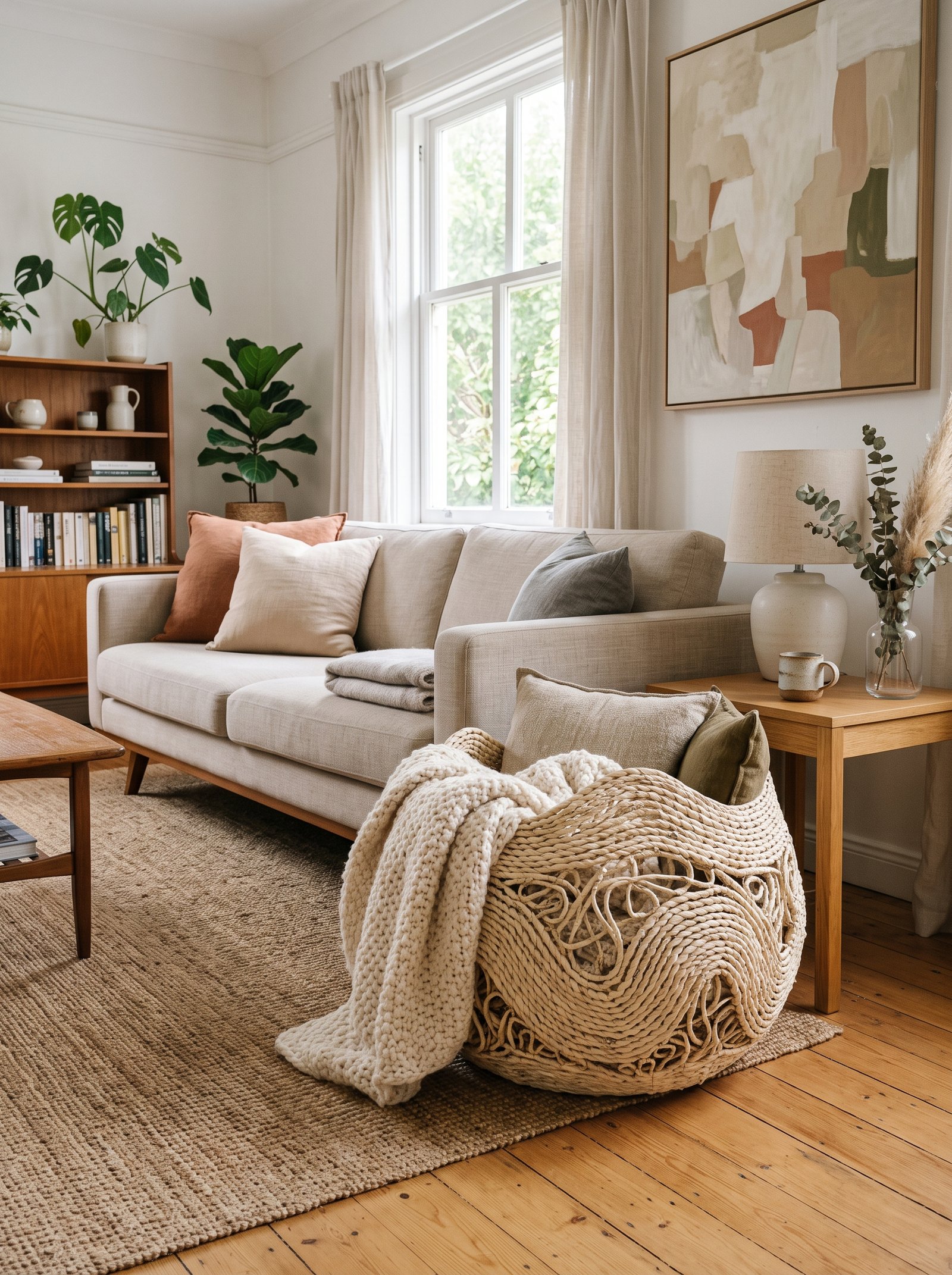
A large sculptural woven basket (24-30 inches tall) next to the sofa or against a wall adds texture, storage, and visual interest to a flat beige wall.
Target Studio McGee, World Market, and Etsy all sell oversized woven baskets in the $40-150 range in natural seagrass, rattan, and painted finishes.
Fill with a few throw blankets, extra pillows, or children’s books — functional AND decorative.
The natural fiber texture reads warm and softens the hard beige wall behind it.
One large basket does what three small decor pieces try to do, more effectively.
16. Mount floating shelves with Command strips
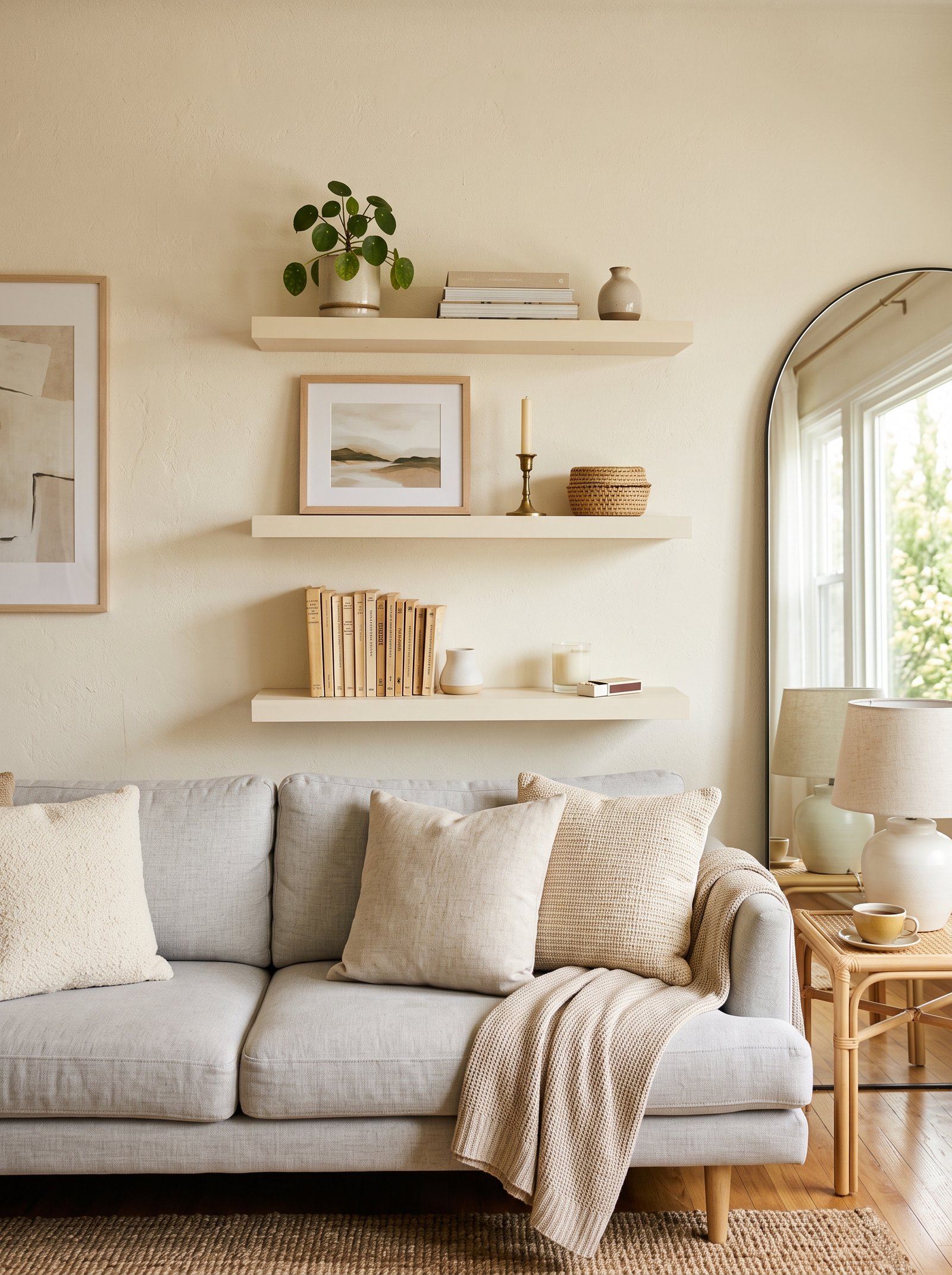
Floating oak or walnut shelves mounted with heavy-duty Command strips (rated for 10-16 lbs each) break up a beige wall with warm wood tones and styled objects.
Choose solid wood shelves (not MDF with wood veneer). Etsy and West Elm sell them in the $25-120 range.
Mount in pairs or trios of varying lengths and heights for visual rhythm. Avoid symmetrical grids — asymmetry reads editorial.
Style with ceramics, small plants, books, and framed photos. 3-5 objects per shelf max.
On move-out, warm the adhesive strips with a hair dryer and release. Zero wall damage, maximum styling.
17. Add a cream boucle ottoman
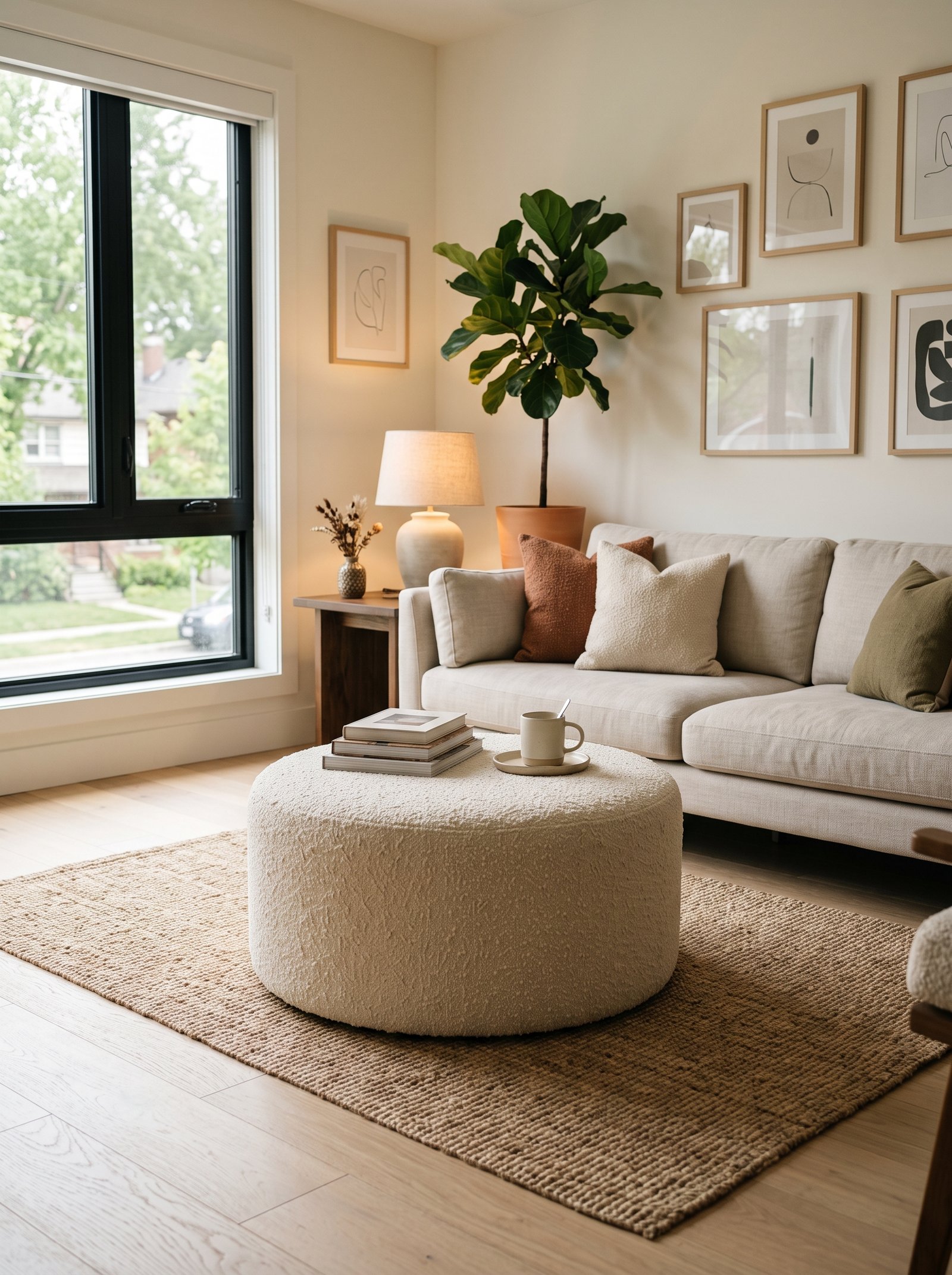
A soft boucle ottoman in cream or oatmeal becomes a multipurpose piece — footrest, extra seating, side table — while adding soft texture that warms the whole room.
West Elm, CB2, Article, and World Market all sell boucle ottomans in the $150-500 range.
Position in front of the sofa or beside an accent chair. Can replace a traditional coffee table.
The texture of boucle is the visual draw — the fuzzy, warm fabric reads expensive and inviting.
Great for small living rooms where a hard coffee table would feel heavy. The soft shape reads lighter visually.
18. Style with dried florals in earthenware

Dried florals (pampas grass, wheat, lavender, eucalyptus) in a stoneware or terracotta pitcher add seasonal variation without any watering.
Buy dried bundles from Trader Joe’s, farmers markets, or Etsy for $8-25 per bundle. Lasts 1-2 years.
Pair with a matte stoneware or terracotta vessel in warm cream or soft terracotta. $20-60.
Place on the coffee table, side table, or styled shelf. The height and texture draws the eye to a specific focal point.
Change the florals seasonally — pampas in fall, wheat in winter, cherry blossoms in spring, olive in summer.
19. Mix wood tones — oak + walnut + rattan

A living room with only one wood tone reads flat. Mix oak coffee table + walnut side table + rattan accent chair + warm pine shelves and the room reads layered, collected, and expensive.
Mix is the key: 2-3 different wood tones (not more than 4) throughout the room creates depth.
Mix finishes too: matte oak, oiled walnut, lacquered rattan. The variation is what reads sophisticated.
This single mindset — stop matching, start mixing — transforms how a rental living room looks.
Mixed wood is the look of every editorial living room. Matching wood sets look like showroom displays.
20. Group three plants of staggered heights

Three plants grouped together in staggered heights — tall, medium, short — in matching terracotta or cream pots creates a mini garden corner that softens beige walls.
Tall: olive tree, fiddle leaf, or snake plant (3-5 feet). Medium: fern, pothos, or small rubber tree (18-24 inches). Short: trailing ivy or baby monstera (12 inches).
Use matching pots in warm neutrals (terracotta, cream, matte sand) to tie the three together visually.
Position in a corner or along a wall. The staggered heights create a natural, layered look.
Group odd numbers (3 or 5), never even. Odd numbers read organic; even numbers read staged.
21. Add a warm ceramic lamp base
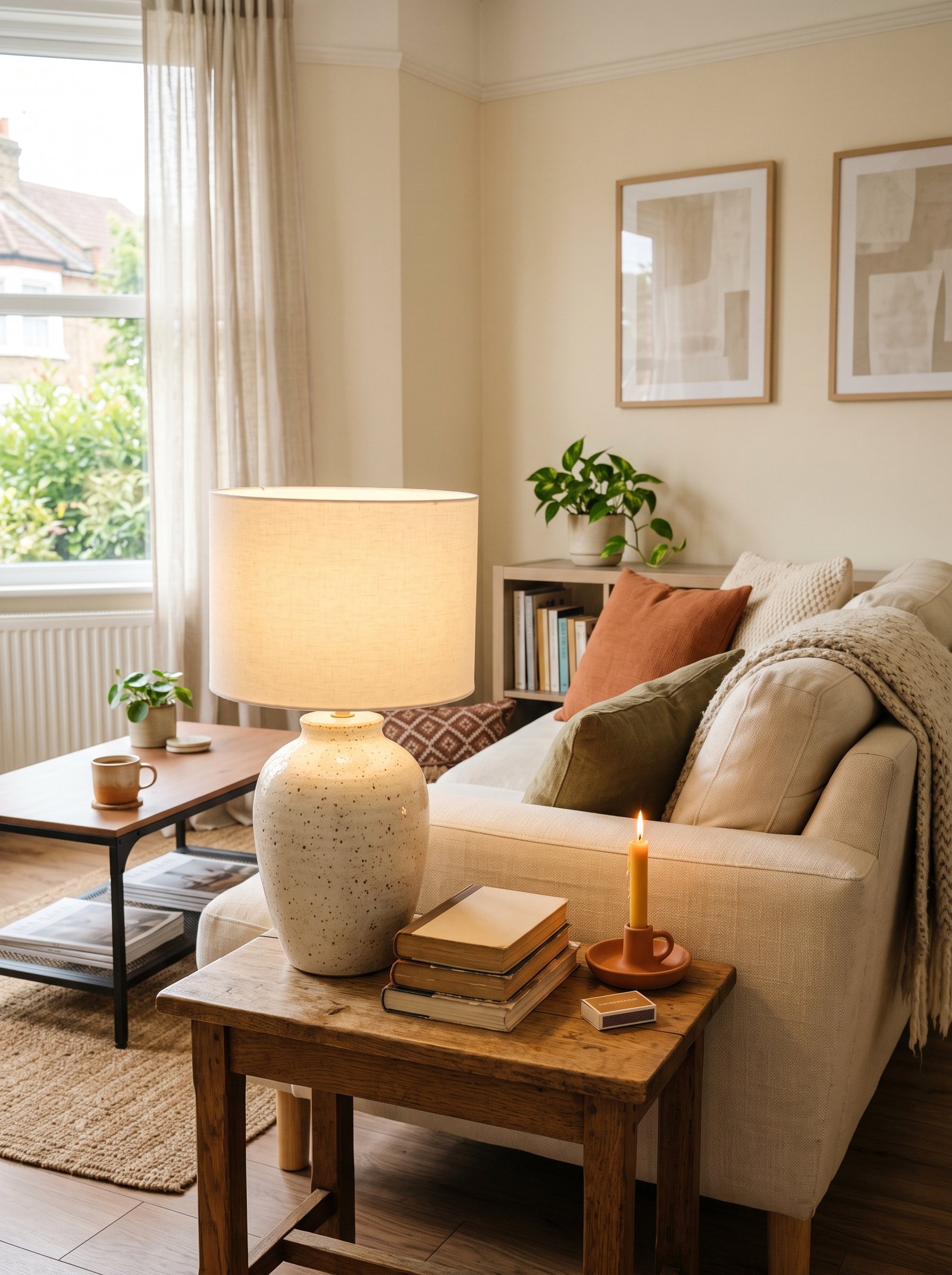
A warm ceramic table lamp with a cream or oatmeal linen shade becomes jewelry for the side table — small object, massive visual impact.
Look for matte ceramic lamp bases in warm terracotta, cream, or sand tones. Target Studio McGee, Serena & Lily, and Etsy sell them in the $80-250 range.
Pair with a cream linen drum shade and a 2700K warm bulb inside.
Place on the sofa side table or in the corner opposite the accent chair.
One ceramic lamp adds warmth, light, and sculptural interest at the same time. Great value per dollar.
22. Add a reeded oak side table

Reeded (vertically-grooved) oak or walnut side tables are the editorial detail everyone copies right now. Adds architectural interest without permanent commitment.
Look for small 16-20 inch tall reeded oak side tables. Article, CB2, Target Studio McGee all sell them in the $150-400 range.
Reeded texture catches light differently throughout the day — the table looks different every hour.
Position next to the main sofa or beside the accent chair. Two side tables (one each side) read symmetrical and intentional.
The vertical grooves draw the eye upward, visually heightening the room.
23. Drape a sheepskin over a chair

A single real or faux sheepskin draped over the back of a chair, ottoman, or sofa arm adds immediate texture and warmth to a flat beige room.
Look for cream or warm oatmeal real or faux sheepskins. IKEA (TEJN, $20), West Elm, and Etsy sell them in the $20-120 range.
Drape casually — one corner over the chair back, let the rest hang naturally. The casual drape reads intentional.
The soft fluffy texture against a hard beige wall creates visual contrast that photographs beautifully.
Change position seasonally — on a chair in winter for warmth, on an ottoman in summer for texture.
24. Stack coffee books by category

Stacks of 3-4 oversized coffee table books on the ottoman, coffee table, or side table create instant styled personality and signal taste.
Choose books by category — architecture, photography, food, travel, design. Each stack of 3-4 books in a related category reads curated.
Shop secondhand bookstores and Chairish for affordable oversized coffee books ($5-25 each). Avoid Amazon-new only — the vintage mix is the point.
Top each stack with one small object: a ceramic bowl, a brass tray, a small sculpture, a plant.
Three stacks across a coffee table beats one stack every time. Rhythm, color, and height variation.
25. Put it all together — the fully styled rental living room

You do not need all 24 ideas in one room. Three to five well-chosen ideas per room is the right amount. More becomes cluttered.
Start with the biggest impact: ceiling-height curtains (4), warm brass floor lamp (2), swap all bulbs to 2700K (7). Under $200 total.
Add warmth: cream linen slipcover on the sofa (14), jute rug under everything (3), two cream boucle throw pillows + one terracotta accent pillow.
Then add character: one leaning oversized art piece (5), one olive tree in terracotta (8), and three dried floral stacks of coffee books on the coffee table (24).
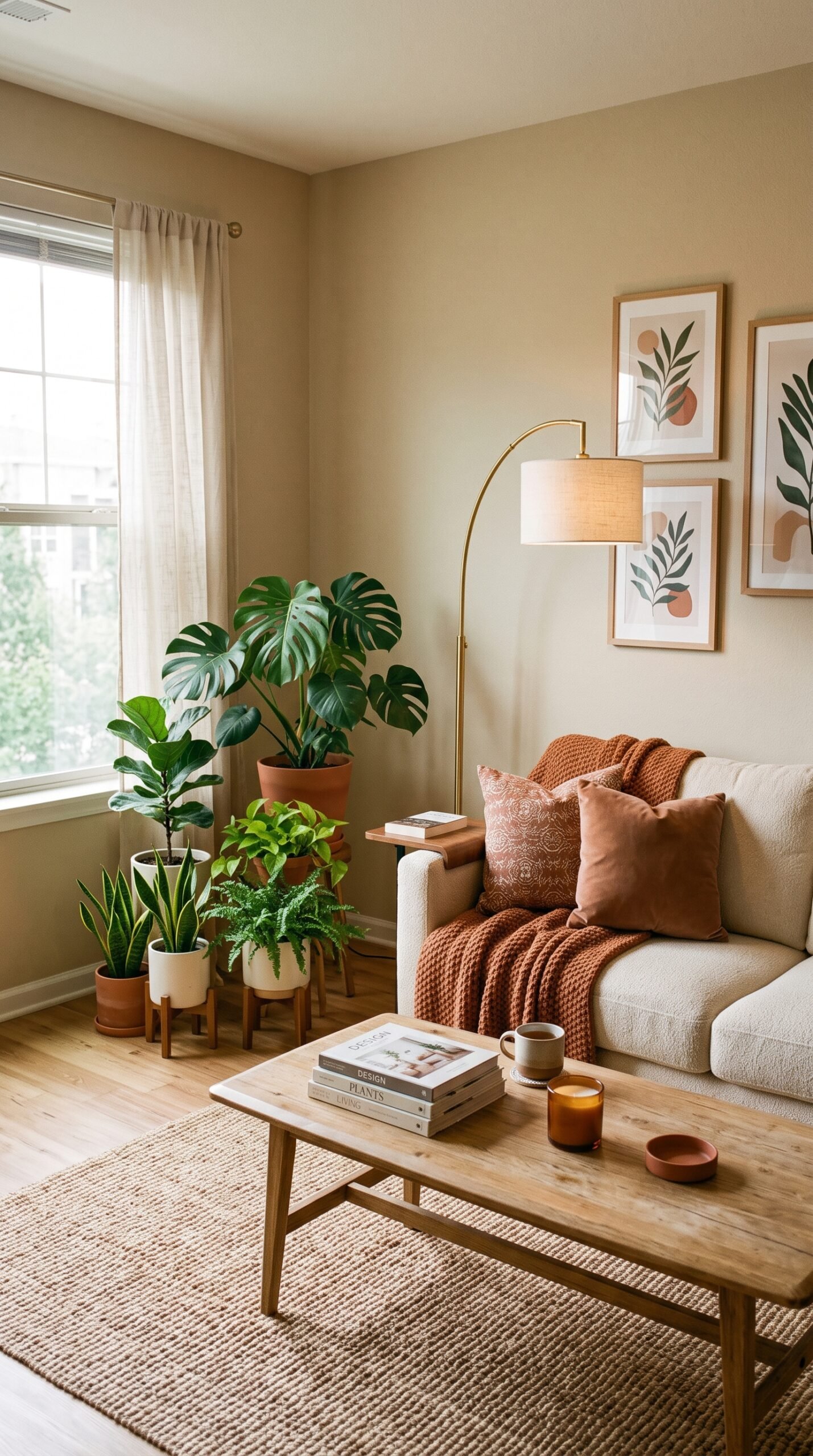
The photograph at the top of this idea is one living room with all these elements layered together. The “ugly beige walls” are barely visible anymore — covered or reframed by cream curtains, warm wood, soft textiles, plants, and warm light. The beige is just the backdrop, no longer the problem.
The beige-wall mindset shift
Beige is not the enemy. Fighting the beige is. The moment you stop trying to make a beige room feel like a gray-and-white Pinterest post and start treating beige as a warm European neutral, the whole room comes together.
Think Provence farmhouse, Tuscan villa, Moroccan riad — all built on warm beige and sand tones. That is the palette you are already working with. Embrace it.
Keep reading — related decor guides
- → 25 No Damage Wall Decor Ideas
- → 25 Peel & Stick Wallpaper Ideas
- → 30 Small Living Room Ideas
- → 25 Rental Kitchen Makeover Ideas
Save this to your Pinterest rental decor board. New home-decor guide every day at Abodenest.
Take our 2-minute Decor Style Quiz
Answer 10 quick questions and discover whether you’re Modern Boho, Scandinavian Minimalist, Modern Farmhouse, Mediterranean, Japandi, or Classic Traditional — plus your color palette and 3 articles made for you.
Our interactive tools can help
Take the style quiz, generate a beige wall color palette, or calculate the perfect pillow stack for your bed — all free, all in under 2 minutes.