30 Small Bedroom Ideas That Fit a Real Bed and Actual Storage
Twenty-five specific, room-transforming ideas for a small bedroom that fits a real bed and actual storage — no loft, no murphy, no compromise. Platform beds with drawers, wall sconces that free the nightstand, ceiling-height curtains, and the tiny styling moves that separate a rental bedroom from a hotel suite. Everything below has been tested in bedrooms under 120 square feet.
Small bedrooms do not have to feel small. Most of the “small bedroom fixes” you see online — loft beds, murphy beds, converting to only a mattress on the floor — throw out the actual usability of the room. This list does the opposite: it keeps the real bed, keeps the real storage, and uses vertical scale, warm light, edited surfaces, and clever furniture footprints to make the room read twice as large as its square footage suggests.
Start with the free changes (idea 11 tonight — you will thank me tomorrow) and work up to the furniture swaps as budget allows. Every single idea below is landlord-friendly and reversible.
1. Choose a platform bed with built-in storage
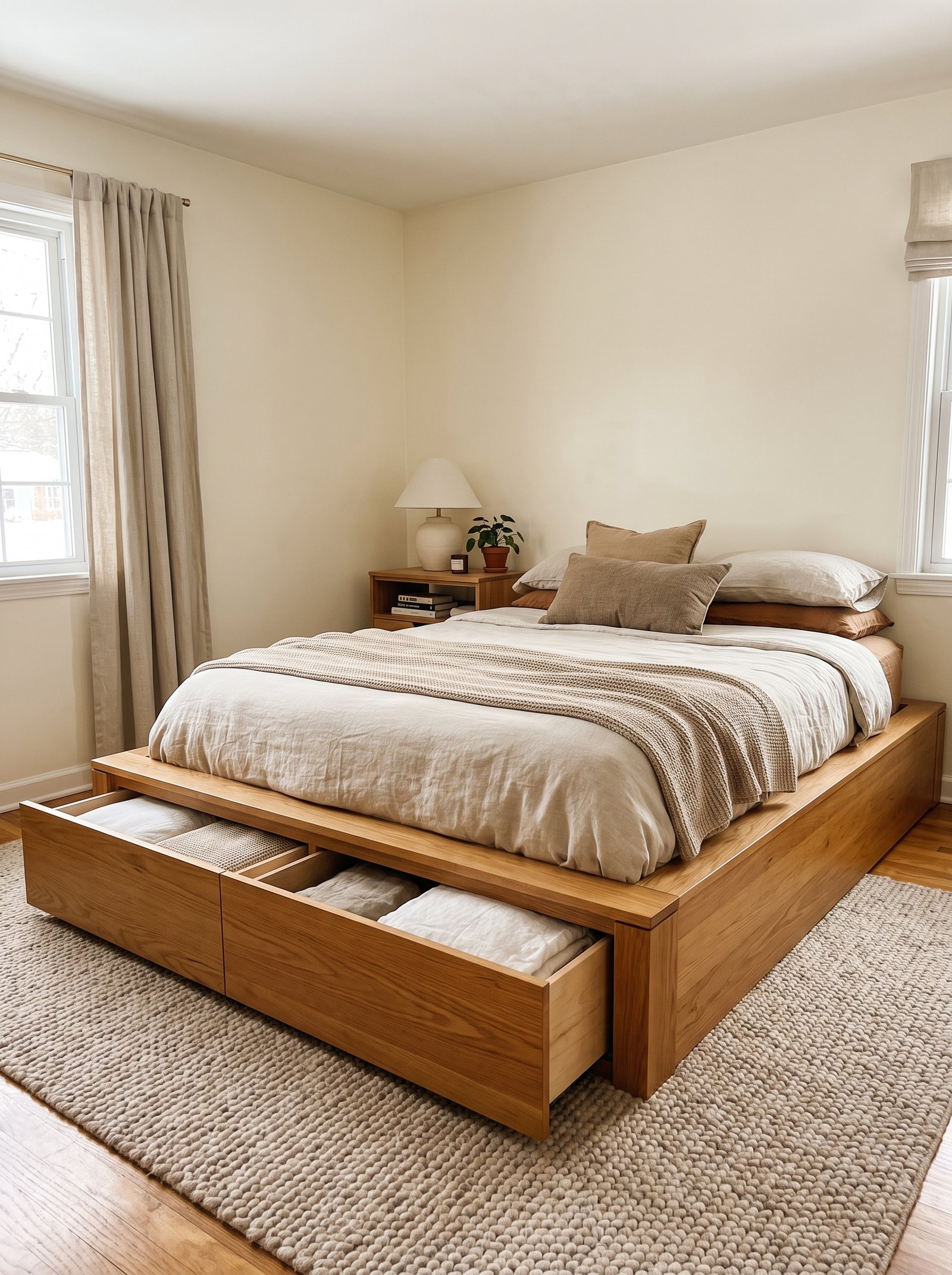
If you have less than 120 square feet of bedroom, the single biggest decision you can make is a bed frame that stores things underneath it. Not a bed on legs with dust bunnies. A proper platform bed with two, four, or six built-in drawers replaces the entire dresser you were about to buy.
IKEA’s MALM (six drawers), Nordli (three or more drawers, modular), and Brimnes (four drawers) all hit under $500 for a queen and are the workhorses of the small-bedroom internet. Above that price, look at Article, Room & Board, and Crate & Barrel for solid-oak versions that last 20 years.
Six drawers under a queen equals roughly the storage of a mid-size chest of drawers. That means you fold your sweaters, jeans, and off-season bedding under the mattress instead of in a piece of furniture that eats three feet of floor.
Choose a frame with soft-close drawers if you can — the difference in daily quality of life is real, and slamming drawers at 6am wakes you up. Also choose one where the drawers pull out from the sides, not the foot, if your room is long and narrow.
The floor space you free by skipping a dresser can become a reading chair, a plant, a small desk, or just breathing room. In a small bedroom, empty floor is a design choice, not a lack of decoration.
2. Mount wall sconces instead of table lamps
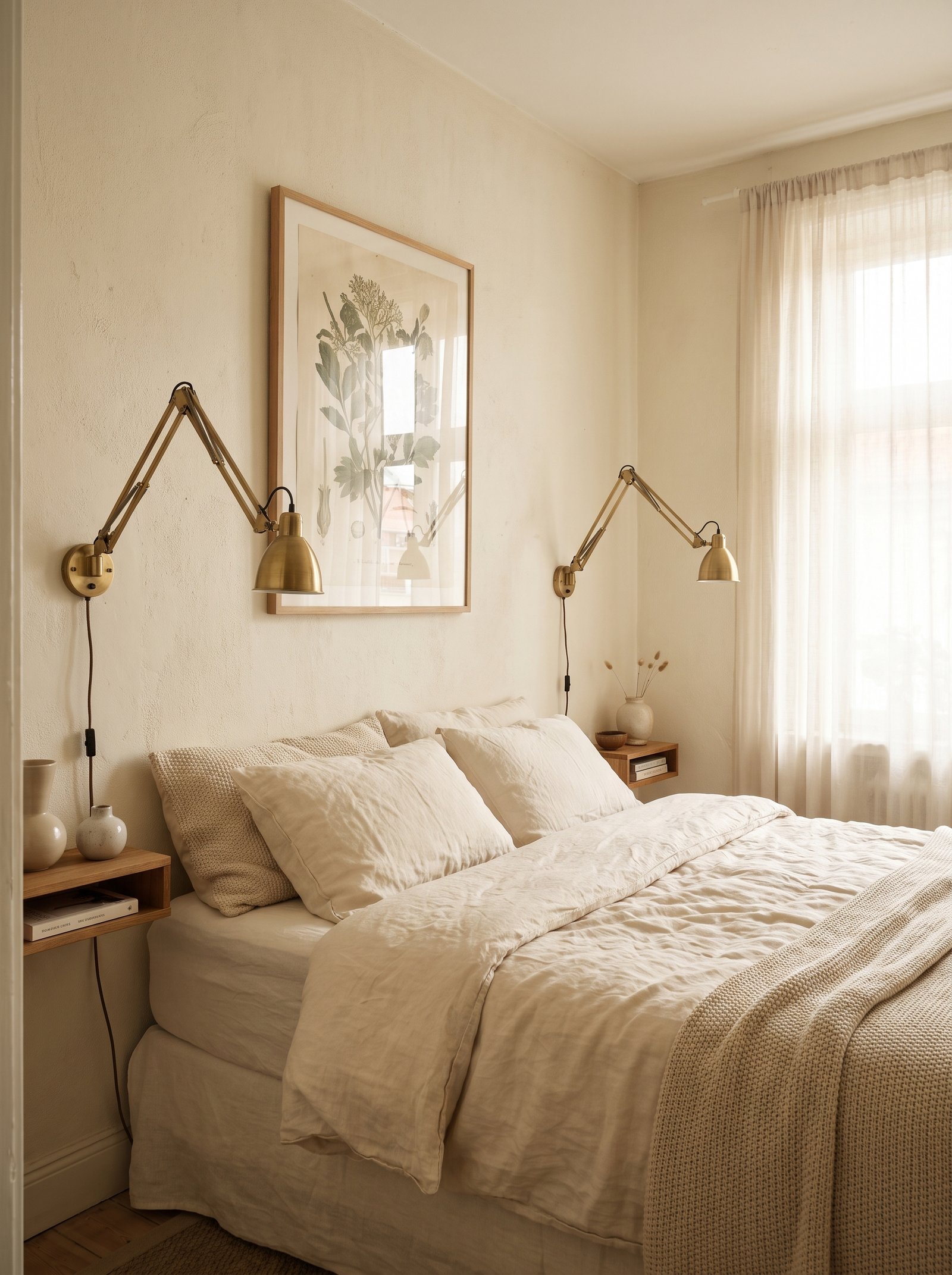
Bedside table lamps eat the entire top of your nightstand and force you to reach past a hot bulb to grab your phone. Wall-mounted swing-arm sconces solve both problems while looking dramatically more sophisticated.
Look for hardwired-look plug-in sconces so you do not need an electrician. Brands like Hudson Valley, Rejuvenation, and West Elm all make swing-arm sconces with a hidden cord channel that runs down the wall and plugs into the outlet behind your nightstand.
Mount them 24-30 inches above the mattress top and 4-6 inches out from the wall so the arm swings out over the bed for reading. Aged brass or dark bronze finish reads more hotel than any polished chrome fixture ever will.
With the sconces mounted, the nightstand top becomes actual usable surface: a book, a water glass, a small plant, one candle. That is the difference between “cluttered” and “styled” bedside — the space that a lamp used to eat.
Two matching sconces, one on each side of the bed, are the single most editorial move you can make in a small bedroom for under $200 total. Every hotel bedroom does it for a reason.
3. Use a floating nightstand instead of a floor one
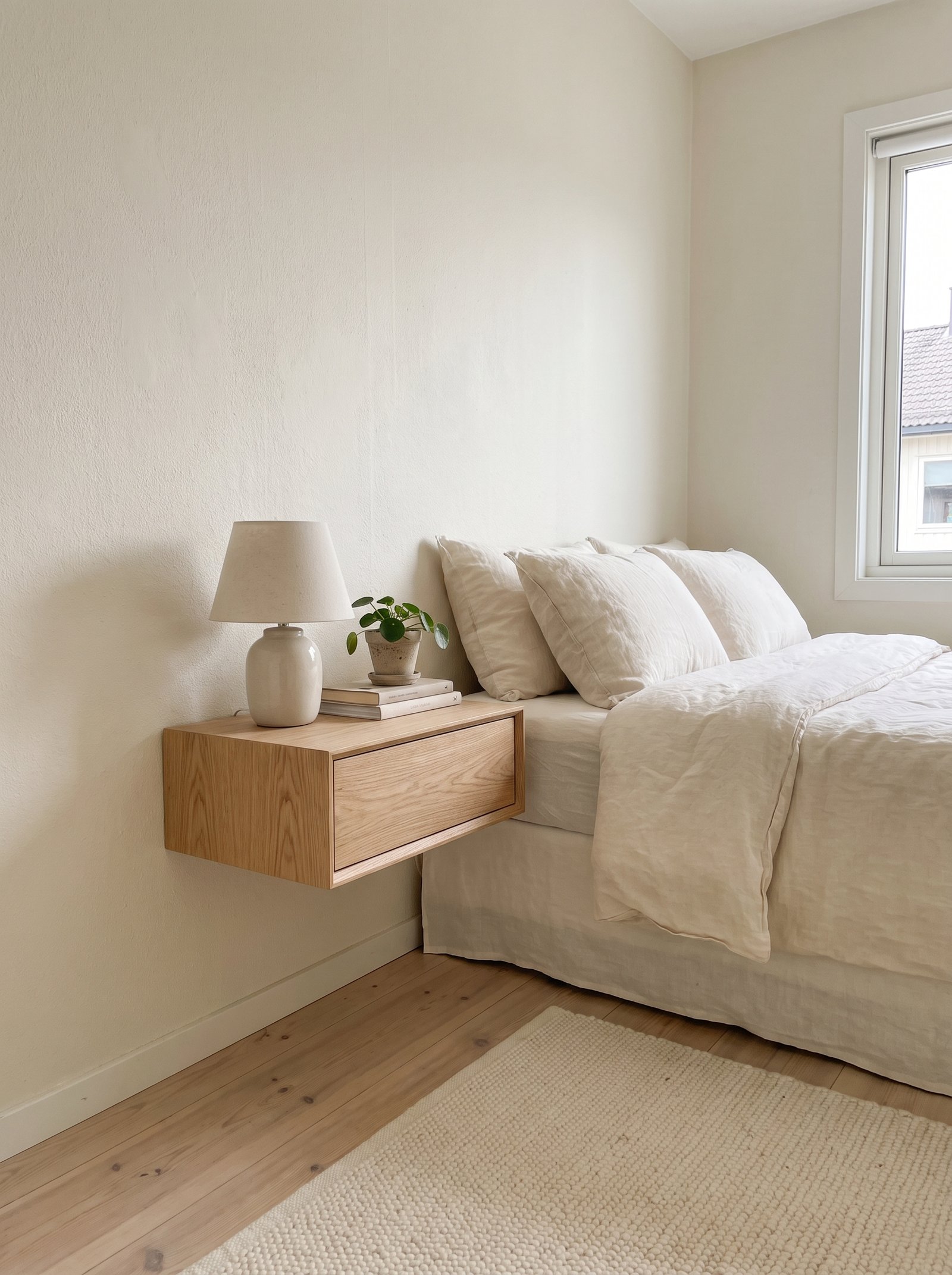
A floating oak or walnut shelf mounted at nightstand height (about 26 inches off the floor) accomplishes exactly what a small nightstand does — book, glass, phone — while showing all the floor underneath. In a tight room, showing the floor is what makes it feel bigger.
You can DIY this from a 10-inch-wide piece of oak or walnut plus two heavy-duty floating shelf brackets ($20 total from a hardware store). Or buy pre-made floating nightstands from Etsy in the $60-150 range.
Mount it into wall studs, not drywall anchors, and give it a solid 15-20 inch depth so a book fits comfortably. The visual effect is immediate: the wall reads open, the corner feels breathing, and you gain a couple inches of floor width beside the bed.
For rentals, use the same French-cleat mounting technique used for heavy artwork. Screws into studs are usually landlord-accepted with a small spackle repair on move-out.
Style it exactly like a full nightstand — book, small brass task lamp (or wall sconce above), a tiny olive branch in a ceramic vessel. Under-styling looks broke; over-styling looks cluttered. Three items only.
4. Swap the tall bed frame for a low-profile one
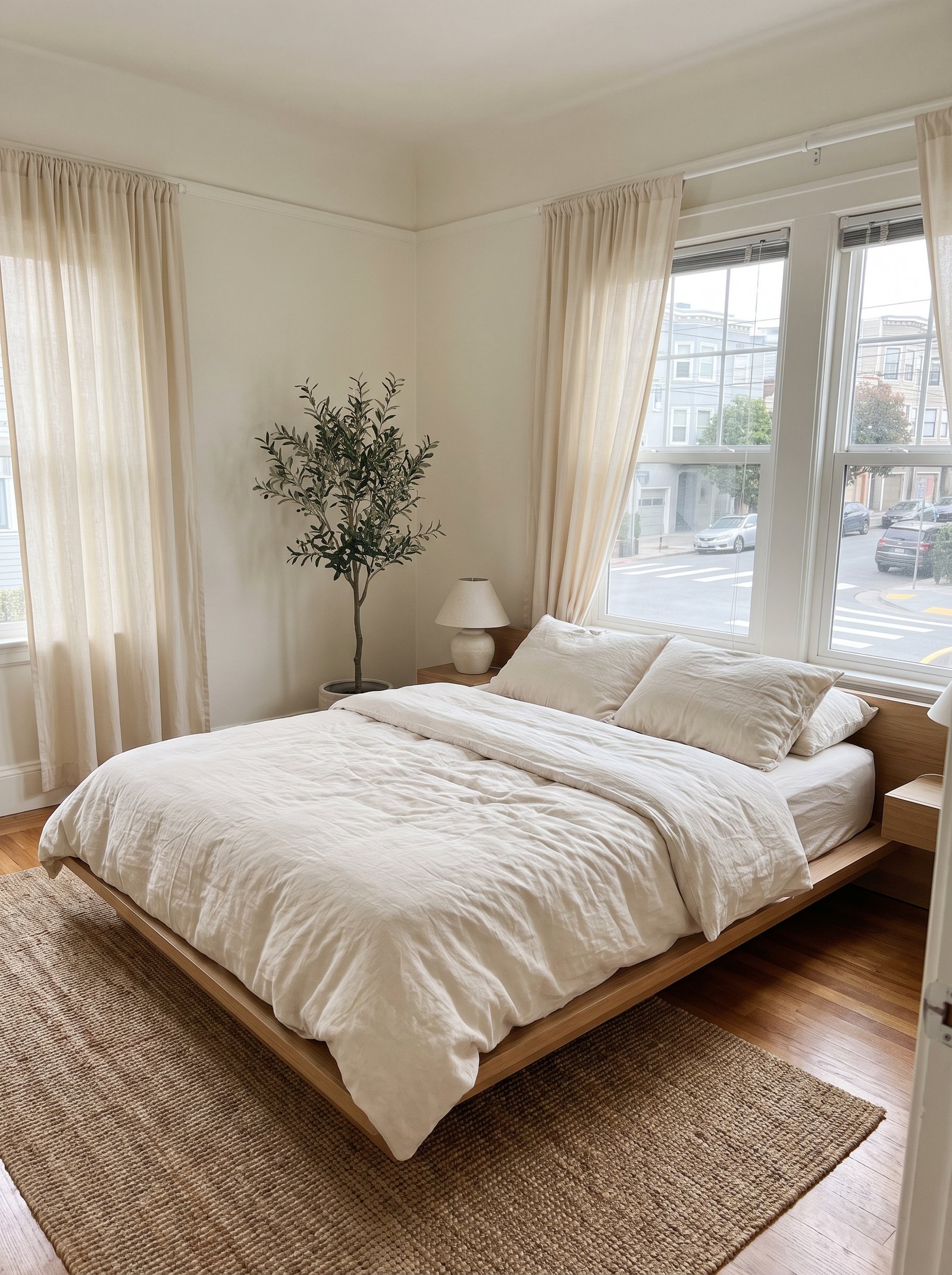
A tall traditional bed frame — 20+ inches of headboard plus a box spring on legs — visually eats the entire vertical space of a small bedroom. Swap to a low-profile platform bed and the room instantly reads twice as tall.
A low platform bed sits about 10-14 inches off the ground. Above the mattress, you have three feet more of exposed wall — the entire vertical field that used to be blocked. Suddenly the ceiling reads high and the room reads Japanese-inspired minimal.
This trick works especially well in rentals with 8-foot ceilings, which read cramped with a tall bed. IKEA’s MALM low frame and Article’s Kova bed both hit this look and cost half of what a traditional four-poster costs.
A low bed also makes a small room feel calmer because horizontal lines dominate the eye. Vertical, tall furniture chops the room into busy sections. Long low horizontals — bed, dresser, art — visually stretch it.
Layer the bed with plenty of pillows and a slightly oversized headboard to keep it from looking short. The goal is low-frame, generous-mattress-and-bedding, not “monk cell.”
5. Push the bed into a corner (headboard against long wall)
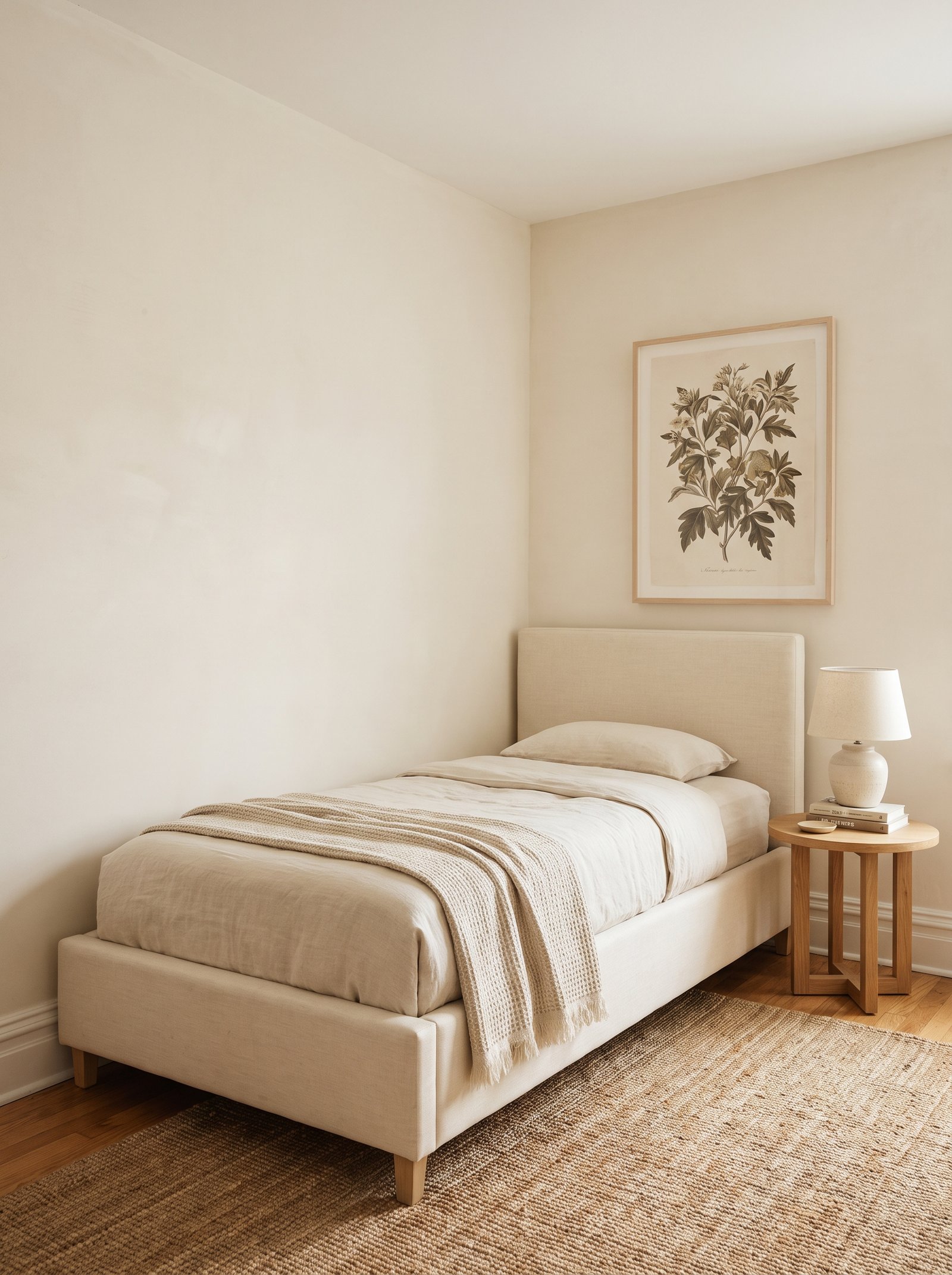
The default American bedroom layout centers the bed on the wall opposite the door with a nightstand on each side. In a 10×10 room, this eats all your usable floor. Pushing the bed into a corner instead — headboard against the long wall, one side against the short wall — frees up half your floor.
This works especially well for guest bedrooms, kids’ rooms, and one-person primary bedrooms. You lose access to one side of the bed for nightstand use, so keep it on the wall with the closet or the window, whichever you touch less at night.
On the accessible side, install a wall sconce and a floating nightstand (see ideas 2 and 3). On the wall side, you can build in a floor-to-ceiling bookcase, a run of hooks, or hang a piece of art the full length of the bed.
The freed floor space becomes a proper reading chair, a small vanity, or a workspace — turning a “sleeping-only room” into an actual multi-function room without adding a single square foot.
This layout is standard in European hotels and small NYC apartments. It is also what stylists reach for when they need to make an “impossibly small” room read livable on Instagram.
6. Hang a large mirror above a dresser or bed
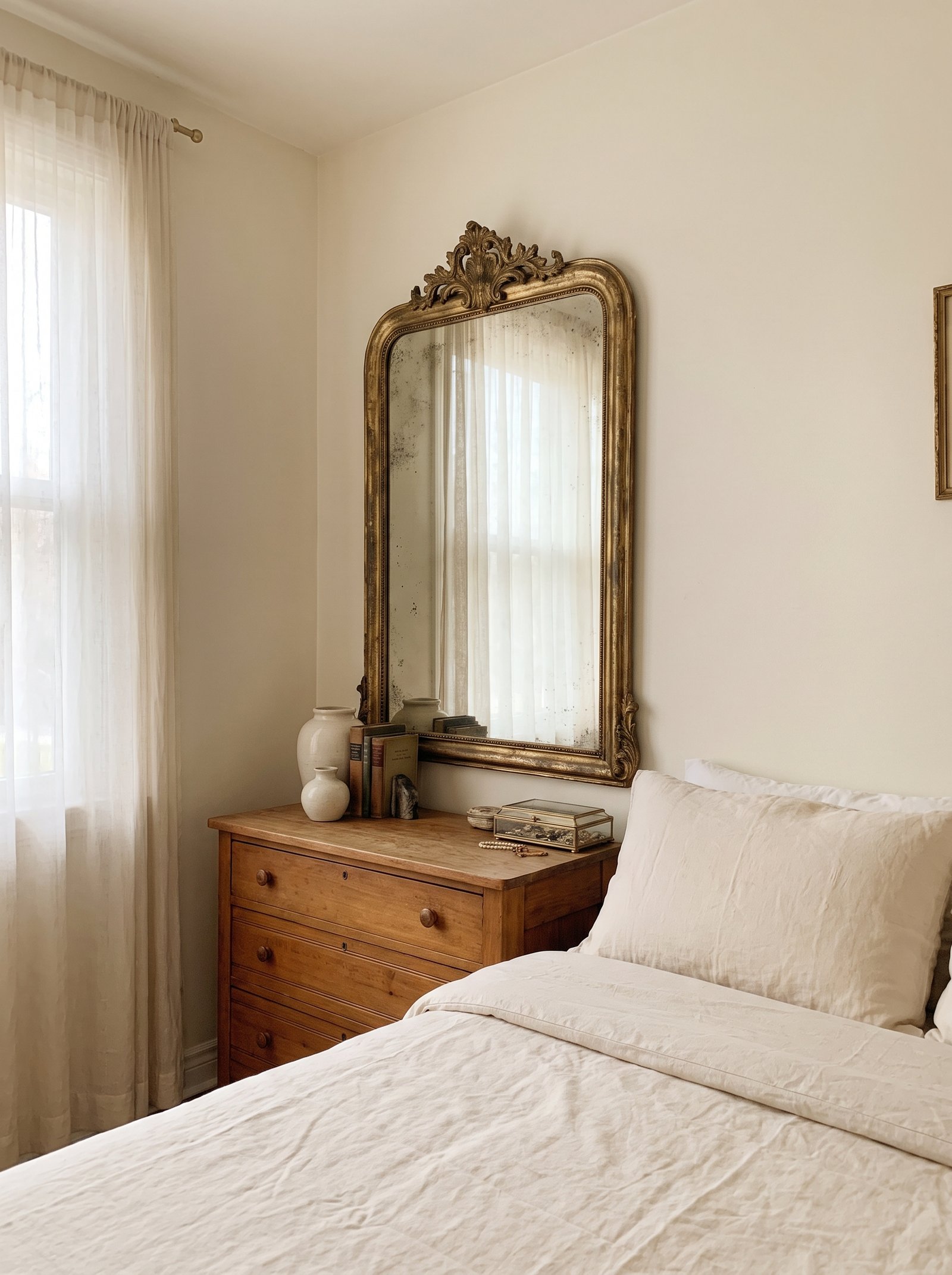
A 30×40-inch or larger mirror on the wall directly doubles the visible depth of a small bedroom by bouncing whatever light and view is opposite it back at your eye. It is the oldest trick in the small-space book and it still works.
Mount it above a dresser (or where a dresser would go), across from a window ideally, so the mirror reflects daylight into the room. If not opposite a window, mount it opposite a lamp or the doorway — anywhere the reflection adds visual depth.
Choose a frame that matches your metal accents: brushed brass or aged brass with warm wood, matte black with cool tones, or a simple no-frame beveled edge for a modern room. The frame is jewelry — pick one you would happily wear.
Sizes matter. A tiny 12-inch mirror hung alone looks lost. Go big — 30×40 minimum, 40×60 if the wall allows. In a small bedroom, one big object beats five small ones every time.
On the practical side, a large mirror also functions as a full-length mirror if placed correctly, so you can retire the wobbly plastic one hanging on the closet door. Two objects removed, one better one added — that is small-space thinking.
7. Hang curtains from ceiling to floor
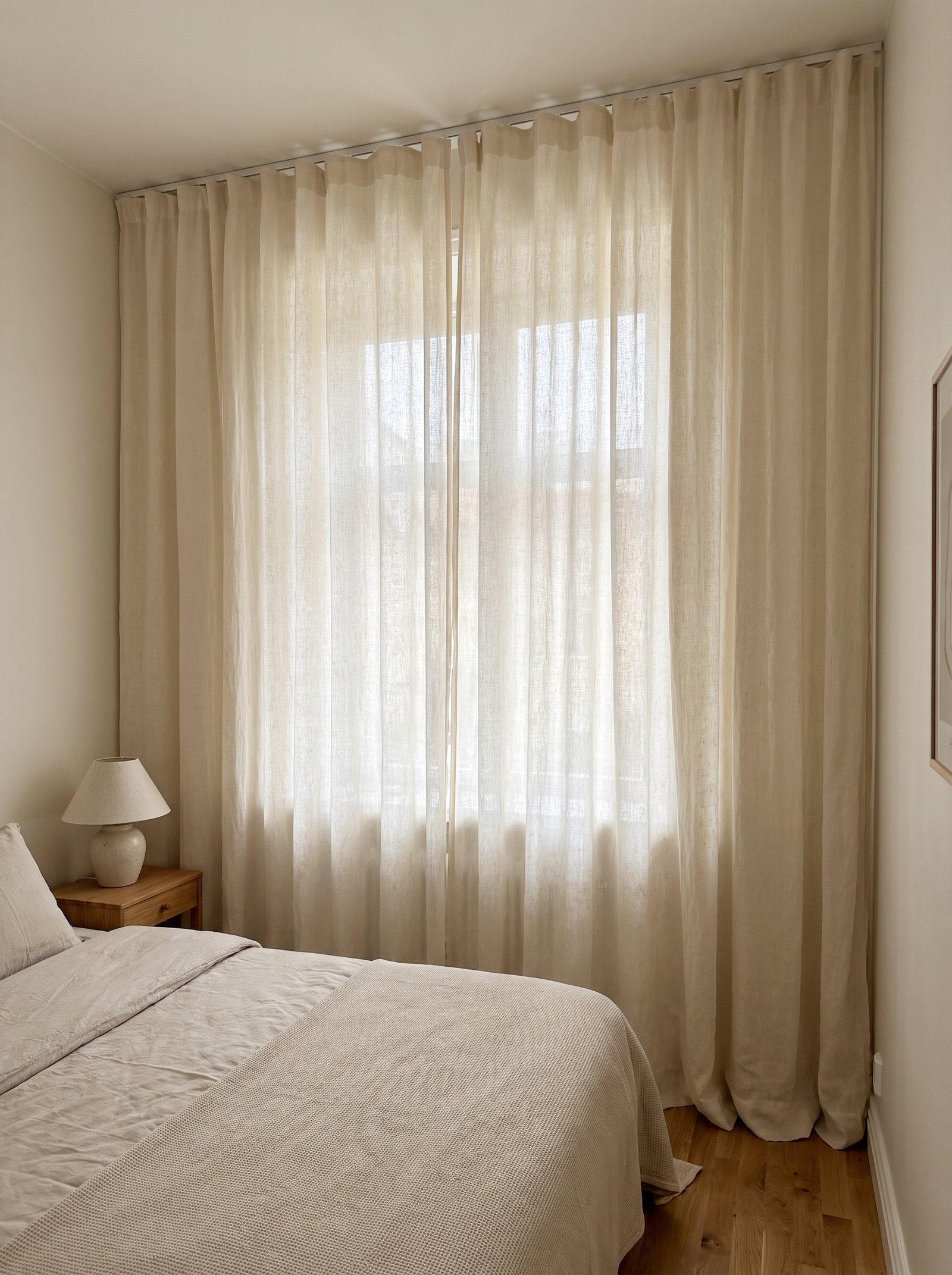
The single quickest way to add visual height to a small bedroom is to mount the curtain rod as close to the ceiling as possible — not just above the window frame. Then let the curtains fall all the way to the floor. This one move can add a visual foot of ceiling height.
Mount the rod 4-6 inches above the top of the window frame, or all the way to within an inch of the ceiling if you can hit the framing. Extend the rod 6-8 inches past each side of the window so, when open, the curtains stack off the glass and let full daylight in.
Use floor-length, slightly-longer-than-touching-the-floor curtains in linen, cotton, or a linen-cotton blend. Cream, oatmeal, natural flax — all of these read expensive. Avoid busy prints in a small room; they shrink it visually.
Even in a rental where you cannot drill into the frame heavily, you can use a heavy-duty tension rod at ceiling height (Umbra makes an excellent one that spans 3-6 feet). Same effect, zero holes.
The visual jump from “window curtains” to “ceiling curtains” is one of those tricks that costs $50 and looks $500. It is the number-one recommendation of every small-space designer for a reason.
8. Put a bench at the foot of the bed
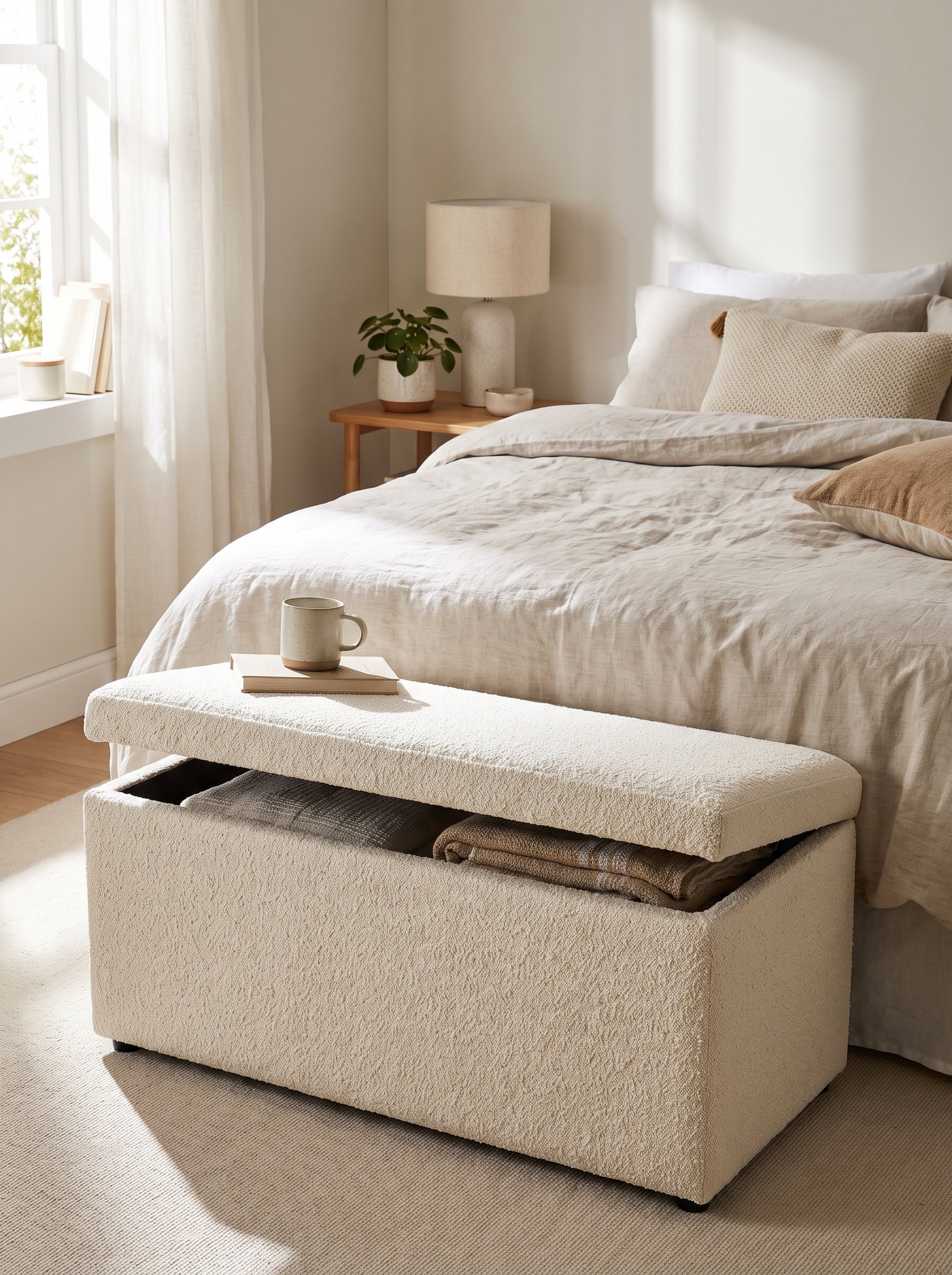
A slim bench (or a cream boucle upholstered ottoman) at the foot of the bed is one of those touches that instantly makes a small bedroom feel intentional and hotel-like, while also being useful storage or seating.
Look for a bench that is roughly the width of the mattress and 14-18 inches deep. IKEA’s LANDSKRONA line, West Elm’s pieces, and any vintage church pew from Facebook Marketplace all work. Upholstered tops in cream boucle or linen photograph beautifully.
Storage benches with a hinged top add another 3-4 cubic feet of hidden storage for extra bedding, pillows, or off-season sweaters — the space that would otherwise require a full closet.
As seating, it becomes the place you sit to put on shoes, the spot a partner throws yesterday’s clothes, or the extra seat when a friend hangs out in your room during a phone call.
Beyond function, visually it terminates the eye at the foot of the bed and gives the bedroom a “finished” feeling. Without it, small bedrooms often read like the bed is floating in the middle of nowhere.
9. Choose a tall slim dresser instead of a wide one
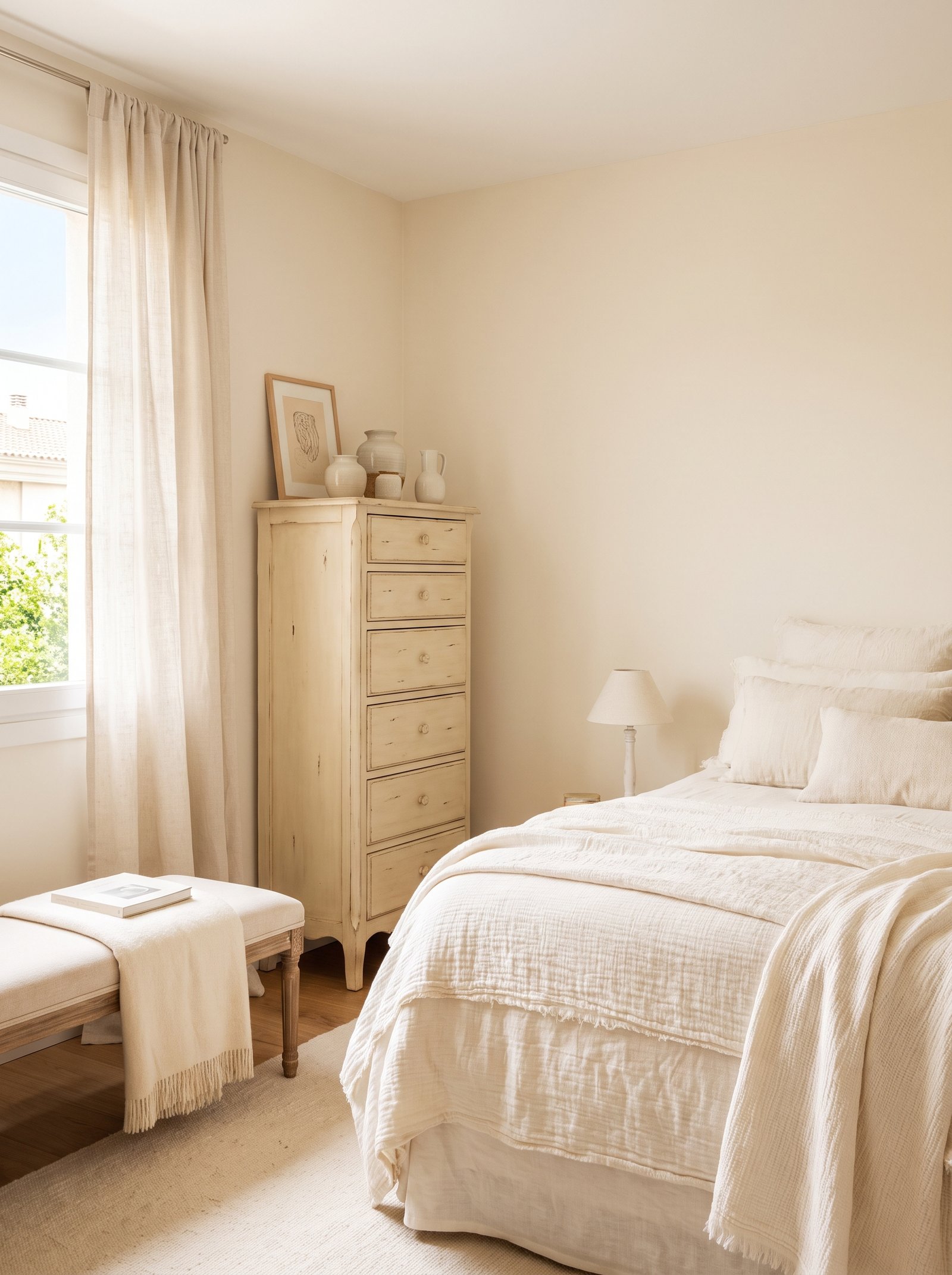
If you cannot skip a dresser entirely (see idea 1), at least choose one that stores things vertically instead of horizontally. A tall slim dresser (18-22 inches wide, 50+ inches tall) fits into a corner that a wide dresser could never occupy.
IKEA’s HEMNES 6-drawer chest, Article’s Culla tall dresser, and West Elm’s Anton line all hit this footprint. You get the same drawer volume as a wide dresser without the horizontal floor footprint.
Tall dressers also draw the eye upward, reinforcing the vertical scale trick from ideas 4 and 7. Every horizontal thing in a small room shortens it visually; every vertical thing stretches it.
Place the tall dresser in the corner or on the shortest wall segment. Top it with one piece — a leaning mirror, a small ceramic bowl for keys, one plant. Never crowd the top with framed photos in a small bedroom; it turns busy fast.
Choose warm oak, walnut, or a soft cream painted finish over dark espresso or stark white — warm mid-tones photograph better in the mixed light of a small bedroom.
10. Try a canopy bed frame (even in a small room)
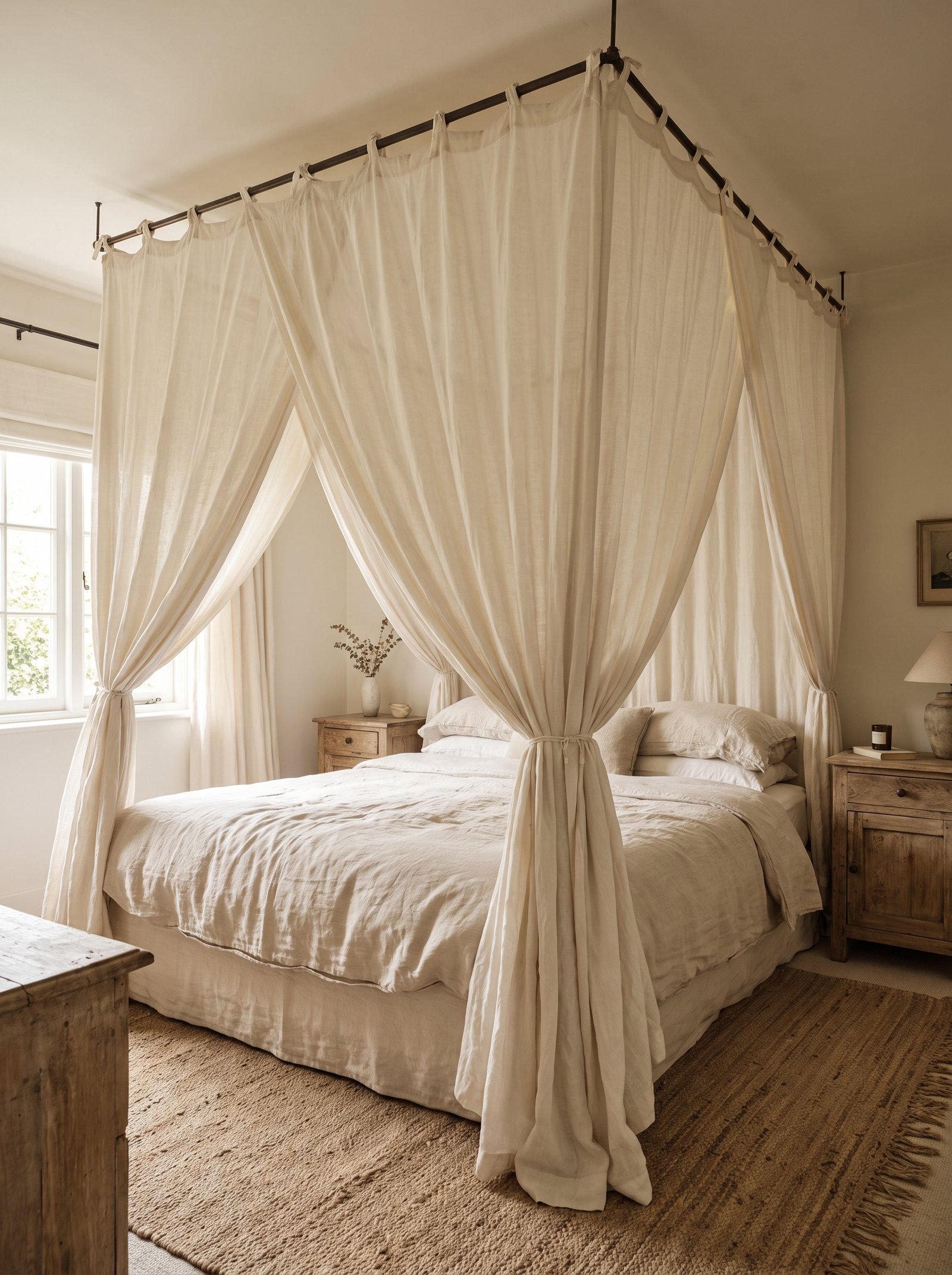
Counterintuitively, a canopy or four-poster bed can actually make a small bedroom feel bigger, not smaller. The vertical lines of the posts draw the eye up, and the open frame reads more like architecture than furniture.
Choose a slim, minimal canopy frame in oak, walnut, or matte black. Room & Board’s Copenhagen, IKEA’s HEMNES canopy version, and Article’s Ecole are all restrained enough to work in tight spaces.
Skip the actual canopy fabric across the top unless your ceiling is 9 feet or higher — draping it low visually crushes the room. Just the frame itself, no fabric, does 80% of the visual work.
Optionally, hang two linen panels at the head-side posts only, creating a soft “room within the room” feeling on the pillow side. Pull them back with tiebacks during the day so the room stays open.
The result: a small bedroom that reads architectural, curated, and hotel-like rather than cramped and college-dorm-like. This is a “spend $600 to feel like you spent $6,000” move.
11. Change every bulb to 2700K warm white

If you take one idea from this whole guide, take this one. Change every single lightbulb in your bedroom — ceiling fixture, lamps, closet light, everything — to a 2700K warm-white LED. It costs $15 and takes ten minutes.
2700K is the warm, golden tone of an old incandescent bulb. It reads sunset. 4000K reads office. 5000K reads morgue. Every editorial bedroom photograph you have ever loved was shot in 2700K–3000K light. Every rental bedroom you found cold and uninviting was probably lit in 4000K–5000K.
Buy a multipack of Philips Warm Glow, Cree TW, or GE Relax LEDs. Standard A19 bulbs for lamps, BR30 for recessed ceiling cans, whatever fits your fixture. All rated 2700K.
Layer the warm light: overhead ceiling on a dimmer if possible, two bedside sconces or lamps, and one floor lamp in a corner if the room allows. Turn the ceiling off at night and use only the low lamps — that is exactly what makes a bedroom feel hotel-like.
After the swap, walk in and notice how the walls look creamier, the linens look softer, and your own reflection in the mirror looks healthier. That is what warm light does. It is the highest-leverage $15 you will ever spend on decor.
12. Style the nightstand with only three things

A cluttered nightstand is the single most visible sign of an unedited small bedroom. Three items is the rule: something to read, something to drink from, and one styled object. That is it.
Something to read: current book (not a stack of ten), a small notebook, or nothing. Something to drink: a stone or ceramic tumbler or a small water carafe, never a plastic bottle. Styled object: a very small ceramic vessel with one dried stem, a candle, or a small brass tray with the day’s essentials.
Store the everything else — chargers, chapstick, hand cream, headphones — in the nightstand drawer or the top drawer of the platform bed. Out of sight equals out of visual noise.
Once you commit to three-object rule, your daily habits reinforce it: at night, you put things away instead of on top. Within two weeks you cannot tolerate seeing four objects up there.
A small nightstand styled at three objects reads editorial in every photograph. A small nightstand crowded with eight objects reads cluttered no matter how beautifully each individual object was chosen.
13. Use rolling baskets under the bed
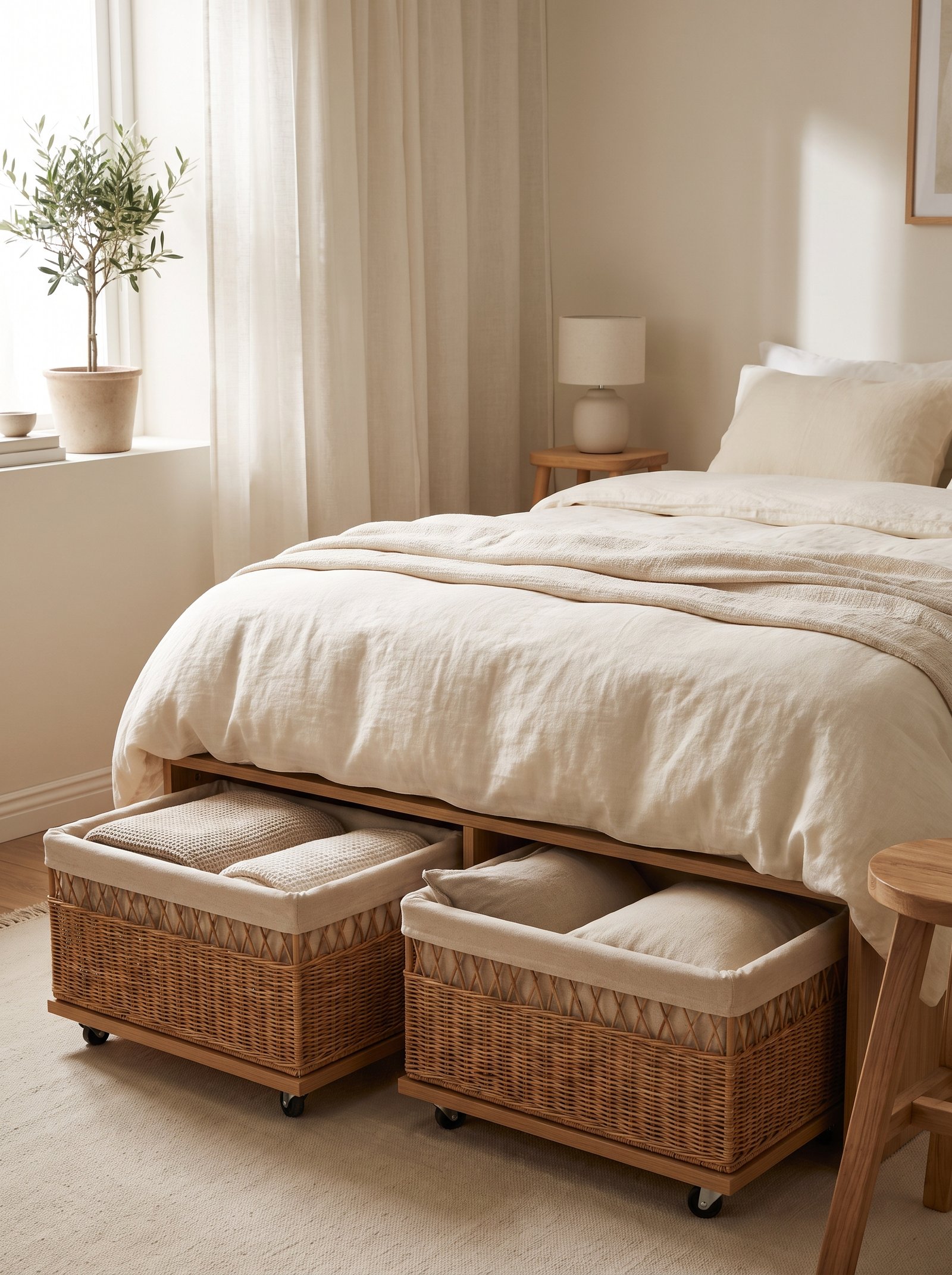
If your bed has no built-in drawers, do not waste the six-plus cubic feet of storage under it. Buy shallow rolling baskets or fabric bins in warm neutrals and use them for off-season clothes, extra bedding, shoes, or gift wrap.
IKEA’s SKUBB series (fabric with a zip lid, roll-out or lift-off), IRIS clear rolling bins, and any wicker basket on wheels from Target all work. Match your under-bed storage — mismatched bins under a bed look chaotic even when the bed skirt hides them.
For rental beds without much clearance, use lower 4-6 inch shallow bins. For platform beds and taller frames, deeper 12-inch bins double capacity.
If your bed skirt or bedding covers everything, appearance does not matter — cheap plastic is fine. If the storage will be visible, spend the extra for wicker or fabric that reads styled.
Rotate seasonally: winter sweaters under the bed in summer, summer linens under the bed in winter. Your closet suddenly has 30% more space with zero new furniture.
14. Skip the dresser — use wall hooks instead
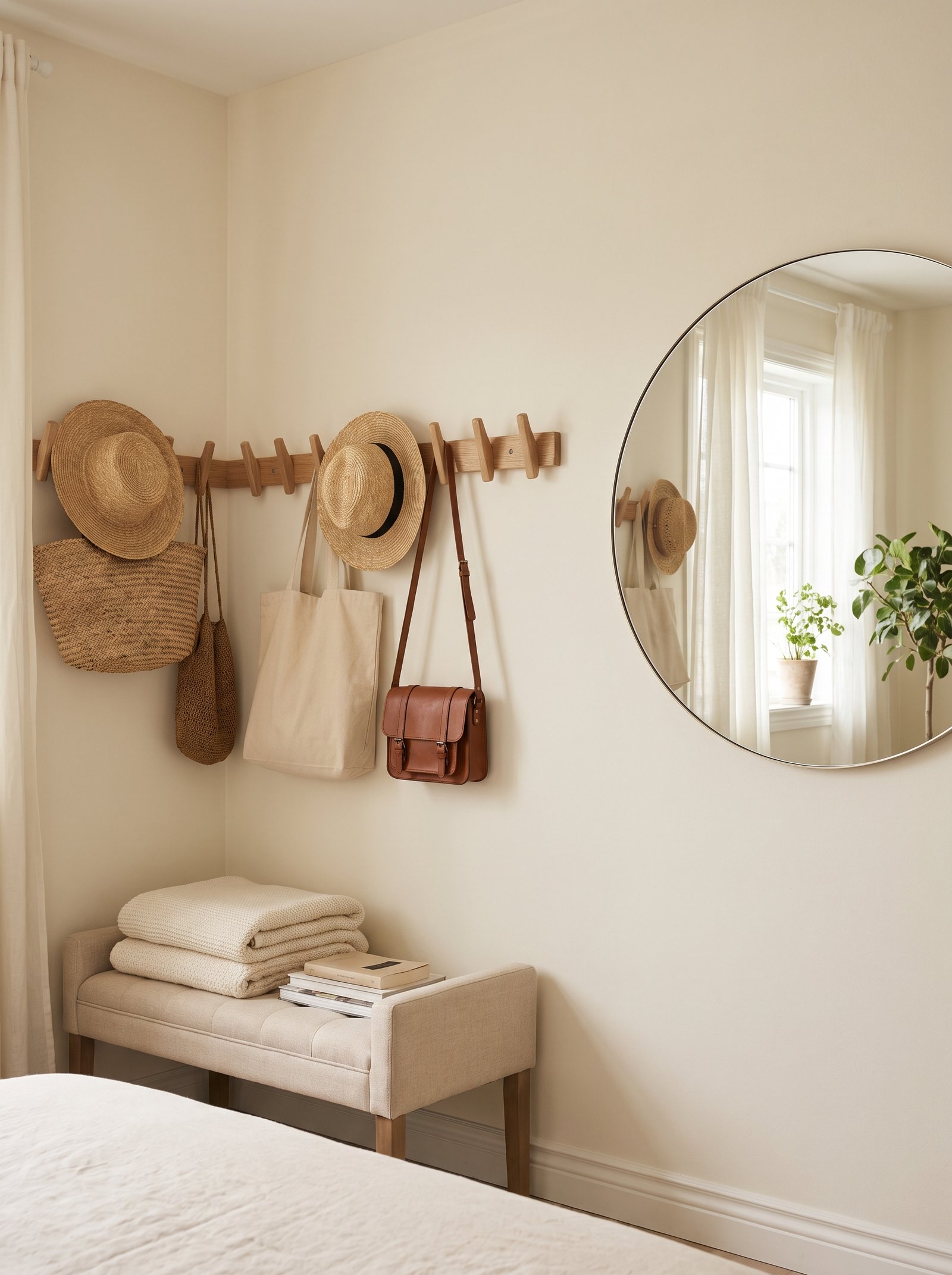
If your bedroom is truly tiny (under 100 square feet), consider ditching the dresser entirely. Combine platform-bed drawers (idea 1) with a wall run of hooks for everyday items — hats, bags, robes, tomorrow’s outfit — and you eliminate the biggest furniture footprint in the room.
A row of five to seven brass or matte-black wall hooks along one wall reads like a Scandinavian entryway. Anthropologie, Rejuvenation, and IKEA all make them in the $8-30 per hook range.
Mount them at 60-66 inches from the floor (a bit lower than a coat rack) and 6-8 inches apart. Two rows — one high, one lower for bags — works even better if the wall allows.
This works especially well next to the closet or bedroom door, doubling as an “outfit on deck” area where you can hang tomorrow’s clothes the night before.
Beyond function, a well-styled run of hooks with a linen robe, a canvas tote, and a woven hat photographs as small-bedroom decor. The utility becomes the styling.
15. Hang one oversized piece of art above the bed
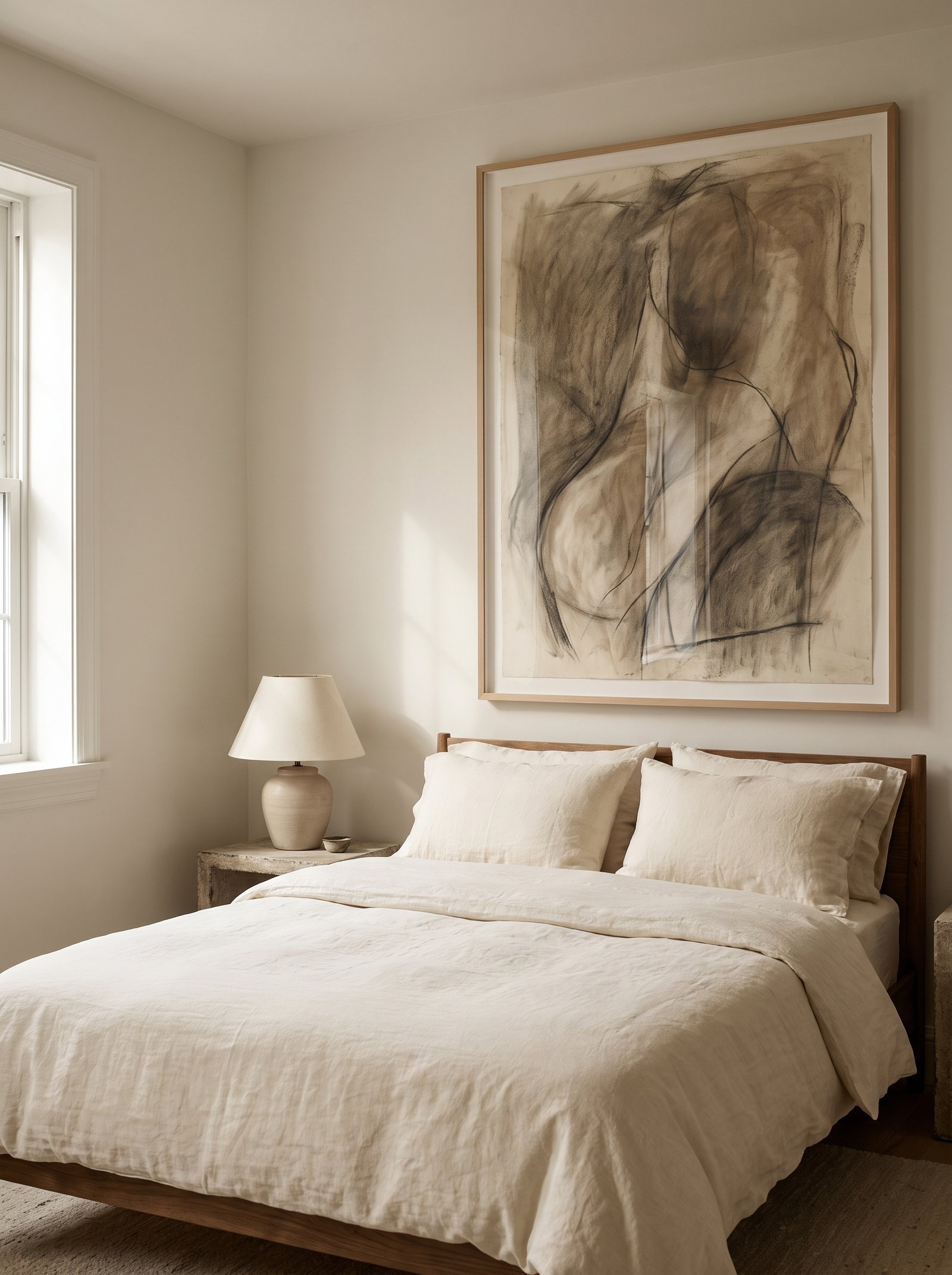
The wall above the bed is the biggest single surface in a small bedroom, and most people either leave it blank or clutter it with a busy gallery of five to ten small frames. One oversized piece — 30×40 inches or larger — is the calmer, more sophisticated move.
A large landscape photograph, a moody abstract painting, or a single vintage botanical print in an oak or brass frame all work. Etsy and Society6 sell large-format prints in the $60-200 range that ship rolled and mount into a frame from Michaels.
Center the piece 8-10 inches above the top of the headboard. If your headboard is wide, the artwork should be roughly two-thirds the width of the bed. Wider reads too horizontal; narrower reads awkwardly small.
One large piece anchors the whole room. It becomes the visual center that everything else — bedding, nightstand, sconces — arranges around. A gallery wall in a small room competes with everything else.
If you cannot commit to one huge piece, do two identical prints side-by-side above the bed. Never do three; that ratio always reads awkward above a queen mattress.
16. Layer bedding in three textures
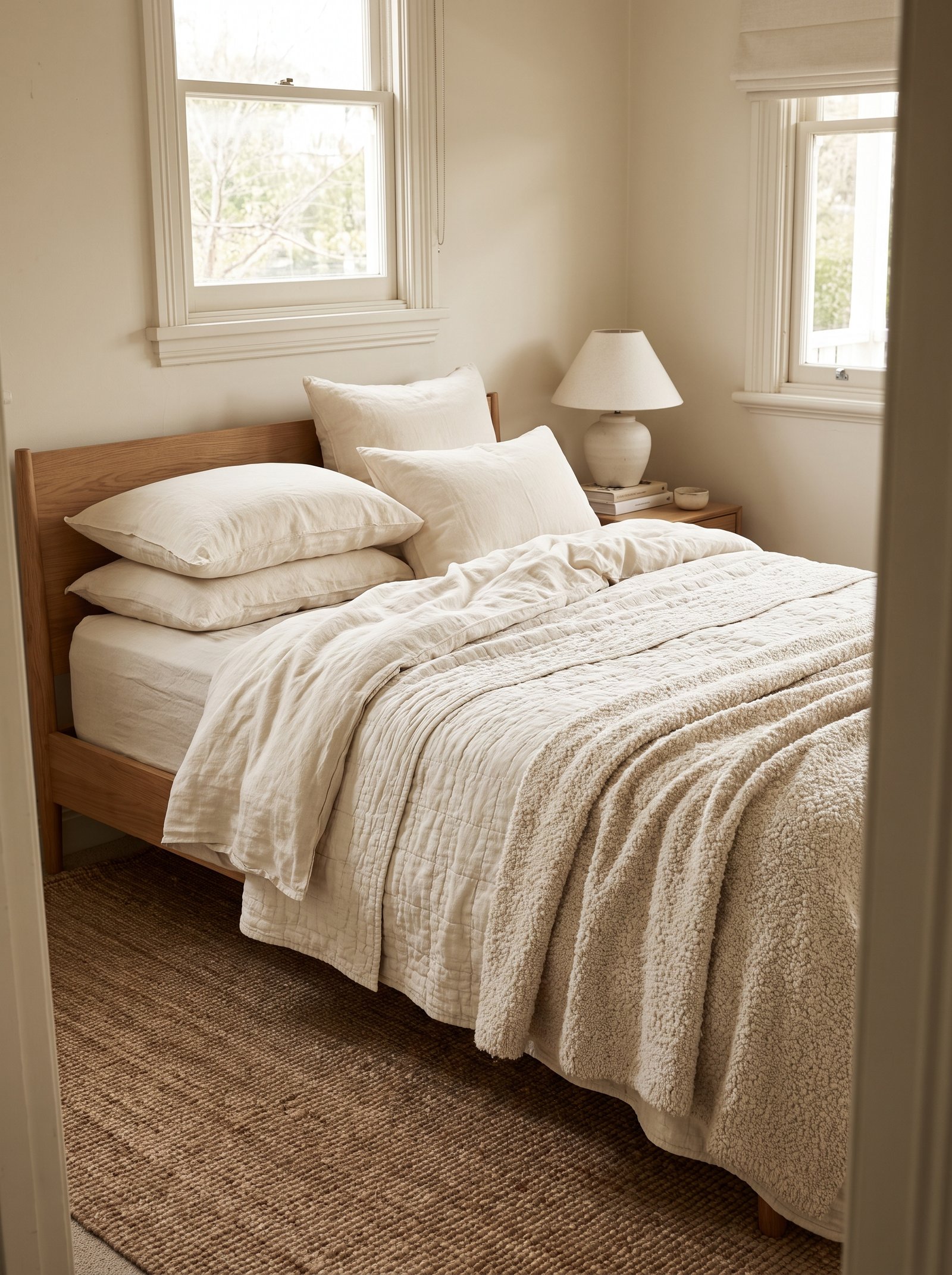
A well-made bed is 80% of a small bedroom’s decor. The trick is layering — never a single flat quilt, always three textures stacked. This is what makes hotel beds look expensive and what makes your bed look untouched even if you slept in it.
Layer one: a fitted sheet and flat sheet in linen or percale cotton (cream, oatmeal, sage — any quiet neutral). Layer two: a lightweight linen or cotton quilt folded across the foot of the bed. Layer three: a chunky boucle throw or knit blanket at an angle over the corner.
Pillows: two standard sleeping pillows behind two square euro shams behind two decorative lumbar or small square pillows. That is six pillows total on a queen, which sounds excessive but reads calm because they are stacked.
Change colors seasonally: linen and cotton in warm cream for summer, brushed cotton and boucle in oatmeal for winter, a small terracotta throw for fall. The bed itself becomes the styling that changes with the year.
Making the bed properly takes 90 seconds. The visual difference between an unmade bed and a properly layered one turns your entire bedroom from “sleeping quarters” to “hotel suite.” Do it every morning.
17. Mix two vintage brass sconces (not matching)
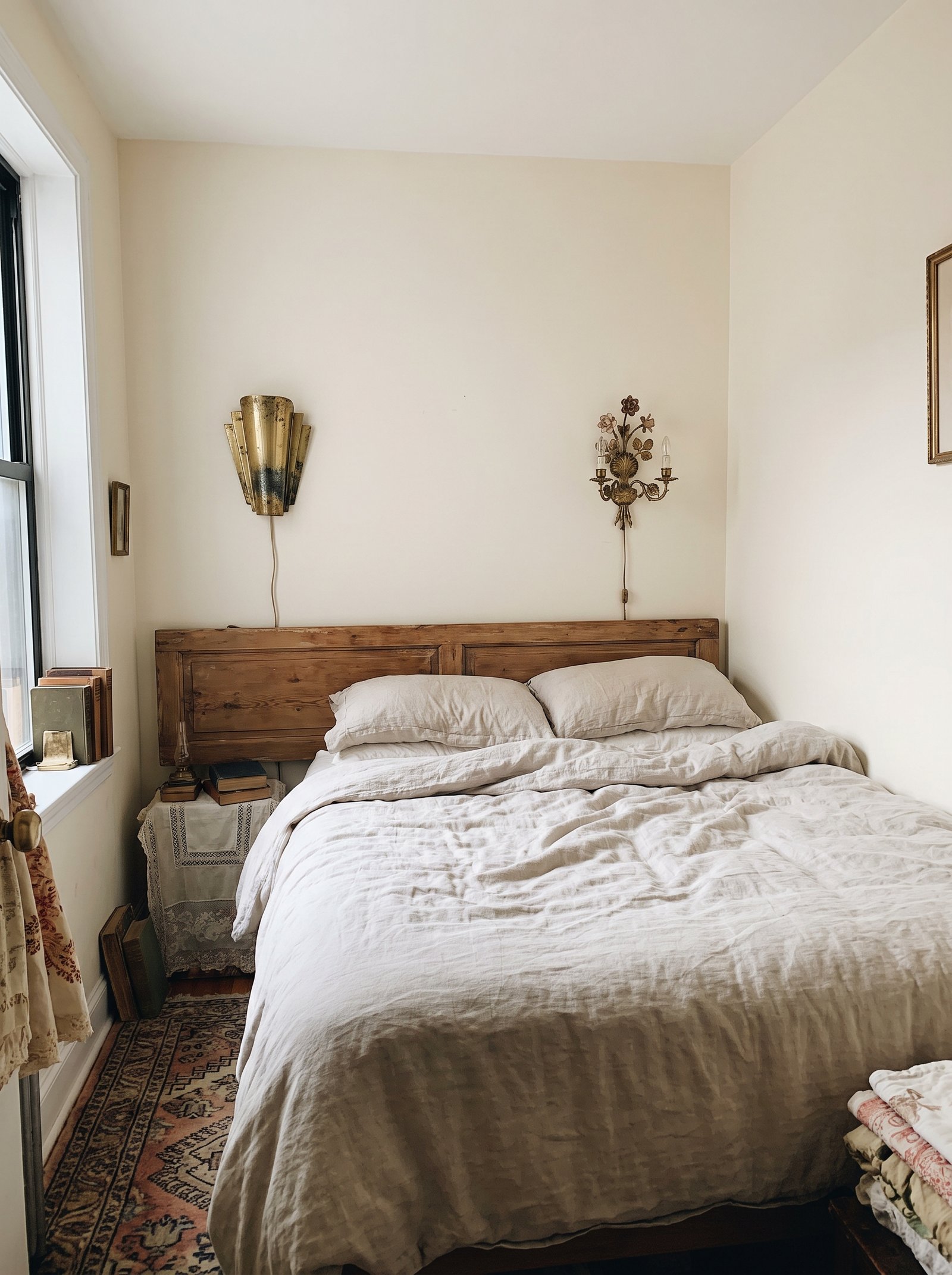
Matching pairs read new-catalog. Two similar-but-not-identical vintage brass sconces read collected-over-time. In a small bedroom, this is the difference between “IKEA showroom” and “someone who has traveled and cared.”
Etsy, eBay, Chairish, and estate sales all sell single vintage brass sconces in the $40-200 range. Look for the same finish (aged brass) and roughly the same scale, but different silhouettes — one swing-arm, one fixed; or two swing-arms with different shade shapes.
Have them rewired by an electrician for $30-60 each if the vintage wiring is questionable. Or buy plug-in modern brass sconces that mimic the vintage look — West Elm, Rejuvenation, and CB2 all sell them.
The eye reads the pair as intentional because both are brass; the eye reads the room as curated because they are not identical. This is a small nuance with a huge effect on how “designed” the bedroom feels.
This same trick — matching material, mismatched form — works with lamp bases, picture frames, and even nightstands. It is the essential move that separates polished small bedrooms from generic ones.
18. Add a peel-and-stick wallpaper accent wall behind the bed
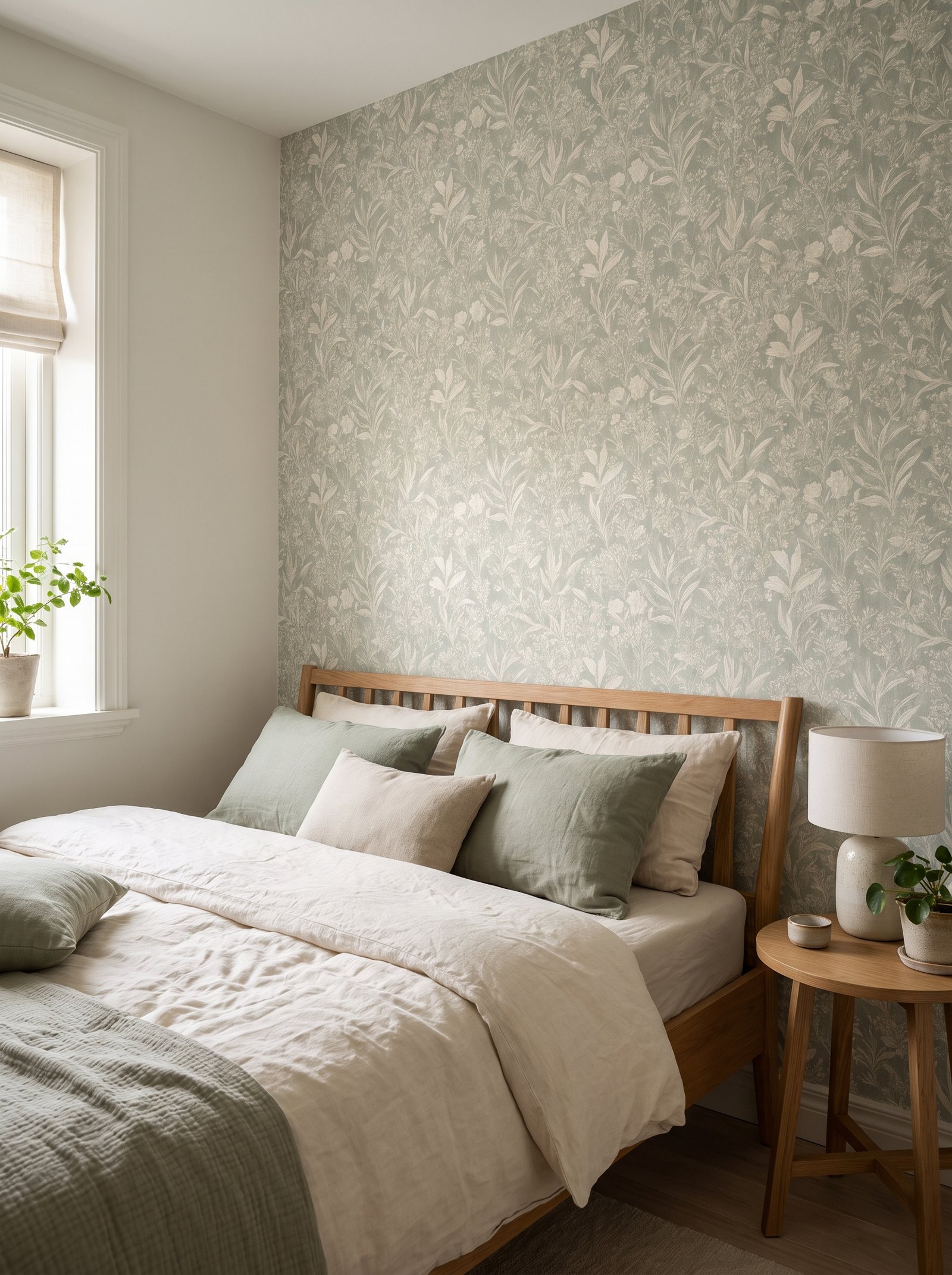
A single accent wall behind the bed — done in a peel-and-stick removable wallpaper — adds depth, warmth, and personality to a small bedroom without committing to real wallpaper you cannot remove.
Look for peel-and-stick wallpaper in a subtle textured pattern — grasscloth-look, linen-look, a very quiet cream-on-cream stripe. Chasing Paper, Milton & King, and Etsy sellers all make removable options in the $4-8 per square foot range.
Only the wall behind the bed. Not all four walls, never. One accent wall reads intentional; multiple walls in a small room shrink everything visually.
Prep the wall with a wash, let it dry, and start from the top corner working down, using a plastic smoothing tool. It is a two-hour job for a standard bedroom wall.
On move-out, peel from a corner and it comes off in strips. The wall underneath is exactly as it was — no landlord confrontations.
19. Put a wall shelf where a nightstand would go
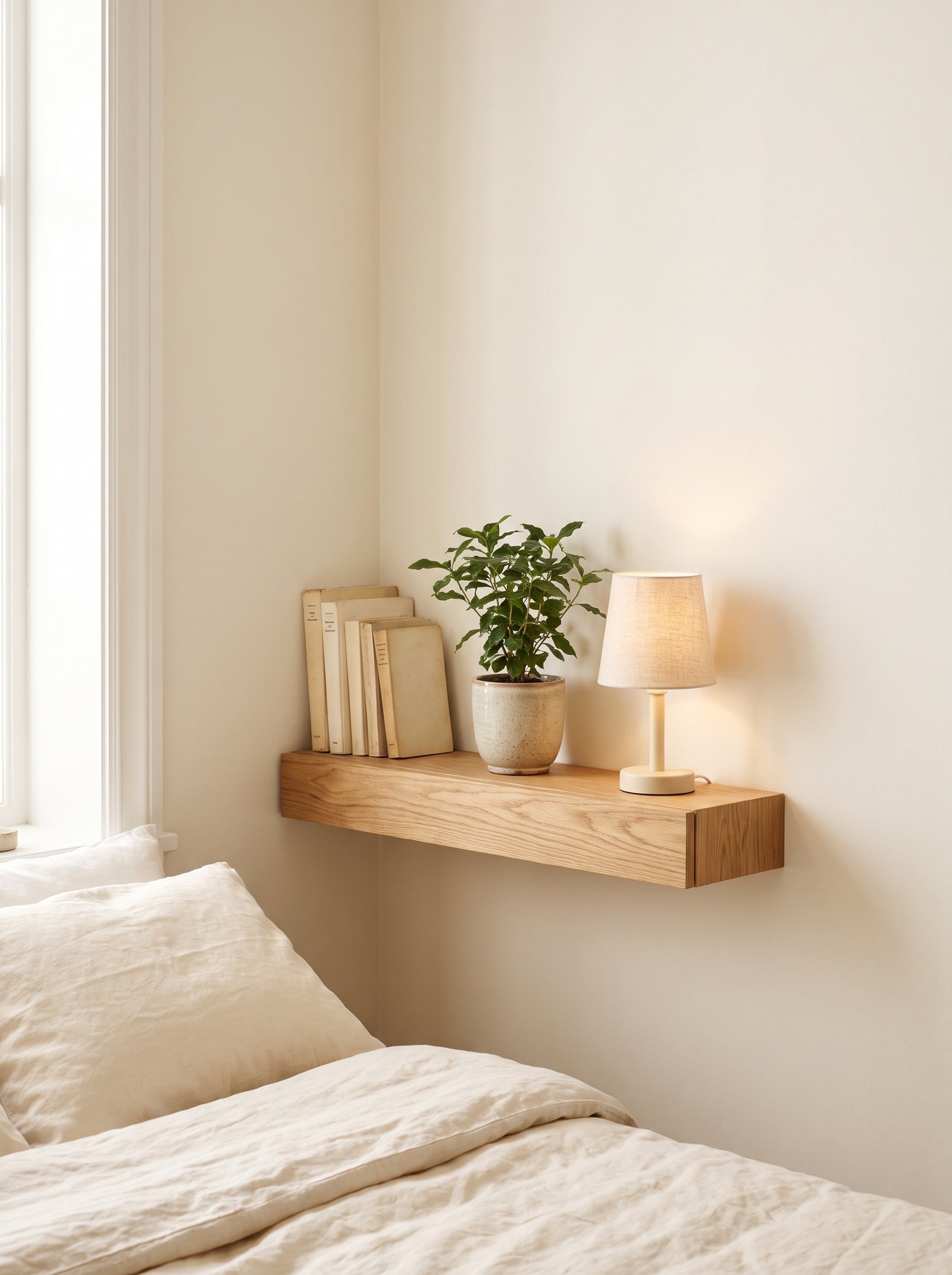
If the wall space allows, a narrow horizontal wall shelf at nightstand height, running the entire length of one bed side, is dramatically more useful than a nightstand. Books stack vertically, a lamp sits on the shelf, and you free the entire floor below.
A 3-inch-deep oak floating shelf mounted 26 inches off the ground gives you space for a book, a small glass, and a plant while showing all the wall and floor below. Ansel + Ivy and Etsy sell them made-to-order.
This works especially well next to a bed pushed into a corner (idea 5) where a nightstand would not fit anyway. It also pairs beautifully with a wall sconce mounted just above.
Style it with edited items: one stack of two books, one small brass reading light, one plant, one small ceramic tray for jewelry at night. No more.
On the floor below, either leave it empty (recommended in a small room) or place a single low basket for slippers or a small woven rug. The empty floor is what makes the wall shelf visually work.
20. Swap the flush-mount ceiling light for a rattan pendant
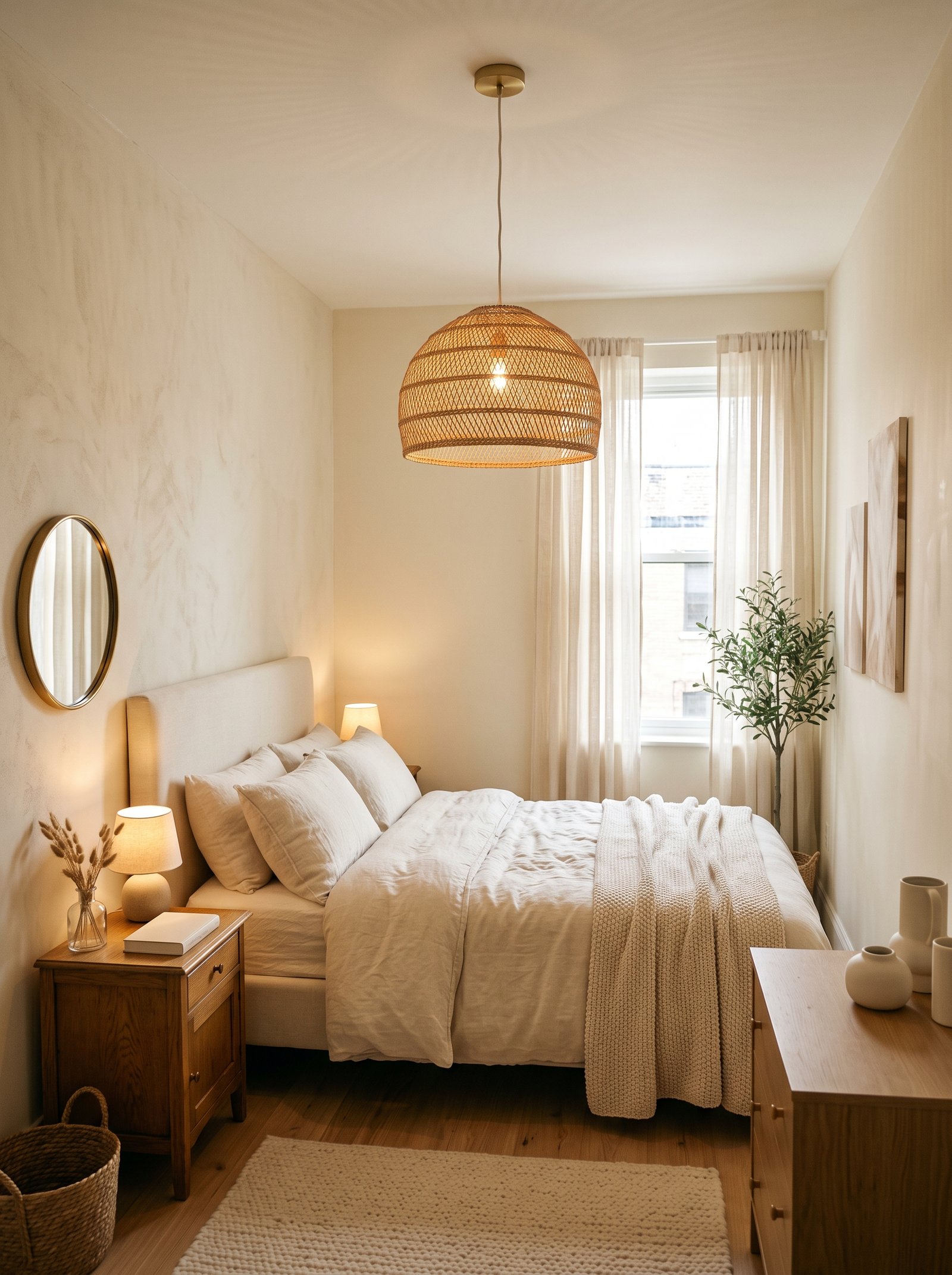
The generic ceiling flush-mount in most rentals — that flat white glass “boob light” — kills the atmosphere of a bedroom the second you turn it on. Swap it for a woven rattan or paper pendant and the entire room’s ceiling changes character.
Look for a semi-flush pendant or a small hanging pendant that clears your head by at least 12 inches (so a 7-foot ceiling can handle up to about a 12-inch drop). West Elm, IKEA’s SINNERLIG line, and Serena & Lily all sell rattan and paper pendants in the $80-300 range.
If you rent and cannot replace the fixture permanently, a swag pendant (plug-in with a hook mounted to the ceiling) achieves the same effect. Hook into a joist, drape the cord along the ceiling to the corner, drop down the wall to an outlet.
Combine with a 2700K bulb (idea 11) for warm, filtered light that casts pattern on the ceiling. This is the single most photograph-friendly ceiling upgrade you can make.
On move-out, unscrew the pendant, reinstall the original fixture (which you saved in a box in the closet), and you leave zero trace.
21. Install a wall-mounted fold-down desk
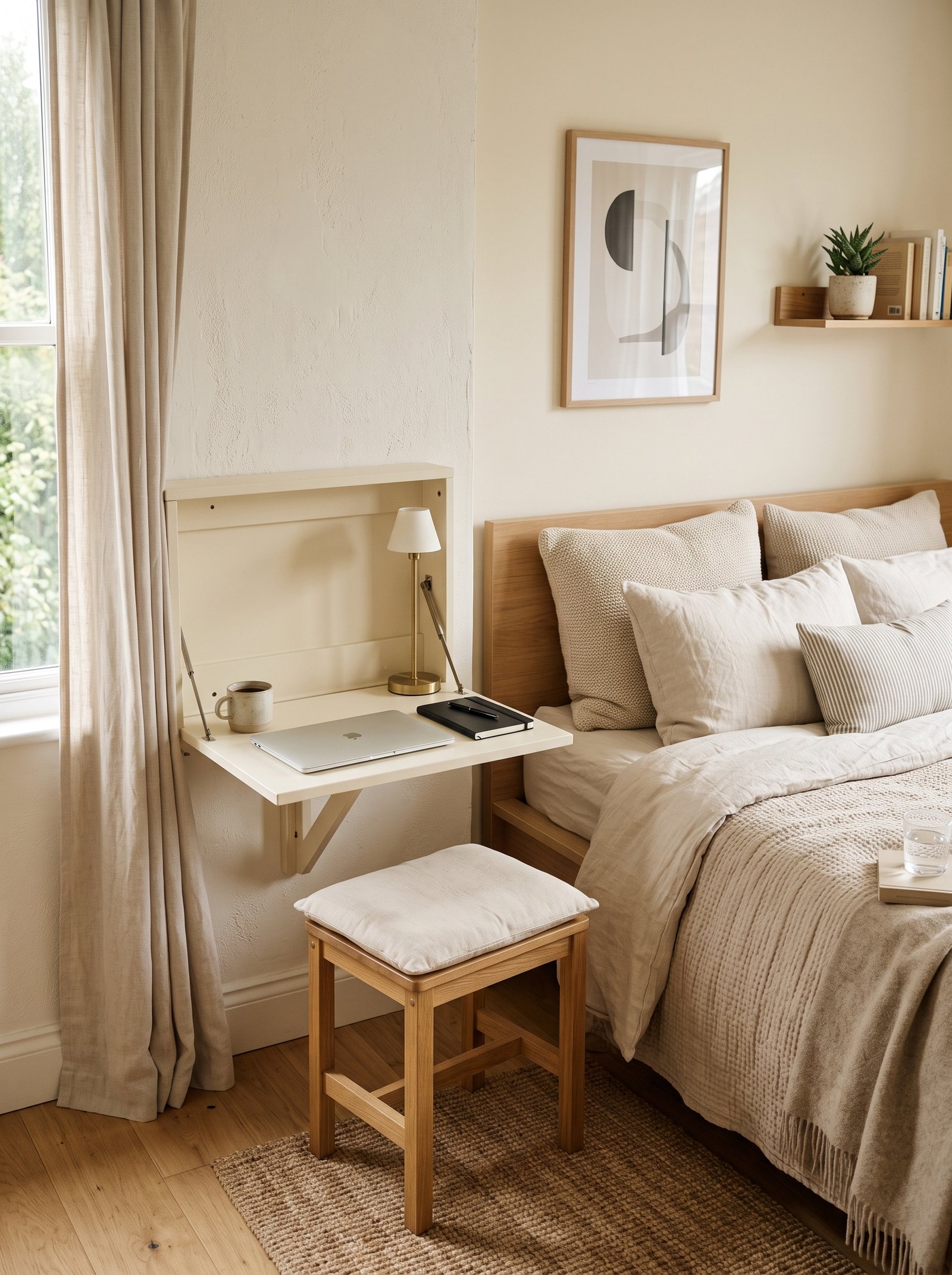
If you need a workspace in your bedroom but the room is small, a wall-mounted fold-down desk saves the floor when you are not using it and disappears into the wall when you are.
IKEA’s NORBERG (fold-down wall desk), or a DIY version made from a hinge and a 24×36-inch birch plywood top, both work. Total cost $30-100.
Mount it at 29-30 inches from the floor. When folded up, it looks like a large wall panel or a piece of art. When folded down, it becomes a laptop-and-notebook workspace that seats one comfortably.
Add a wall-mounted swing lamp above and a small shelf inside the fold-down area for pens, notebook, and a mug. The whole system takes up six inches of depth when closed.
Pair with a small folding chair (fabric-covered, oak, or matte black) that lives against the wall next to the closet when not in use. Total workspace footprint in a small bedroom: essentially zero when not working.
22. Anchor the bed with a rug that extends past the sides
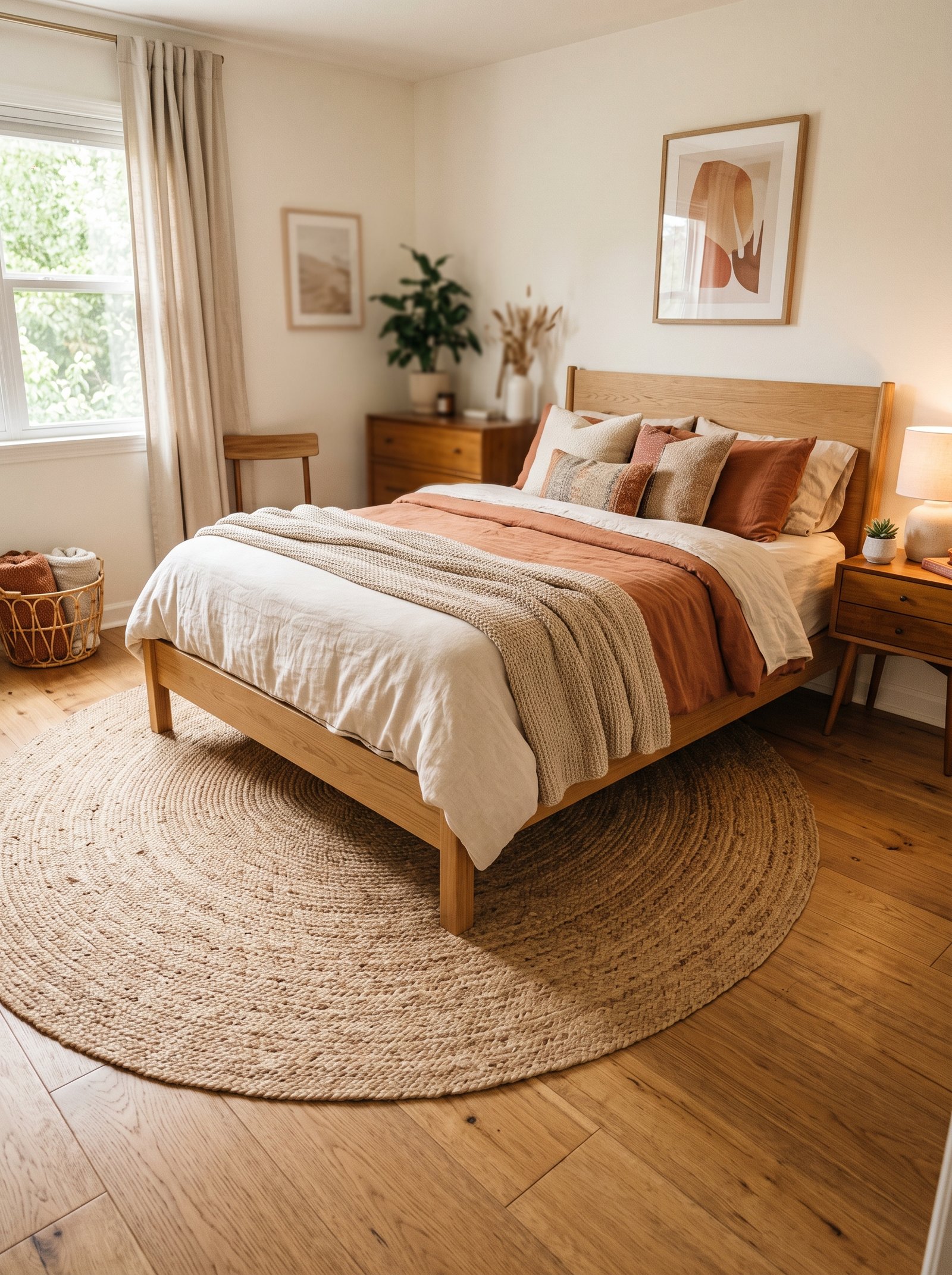
A properly sized area rug under the bed makes a small bedroom feel more finished and larger — but only if you size it correctly. Too small a rug (a 3×5 shoved under just the bottom third of the bed) actually shrinks the room visually.
The rule: the rug should extend at least 18 inches past both long sides of the bed and 24 inches past the foot. For a queen, that means an 8×10 minimum; for a king, a 9×12.
Use natural fiber — jute, sisal, or a flat-weave wool in cream/oatmeal — as the base. Cheap and durable. If you want warmth on your feet in the morning, layer a small runner in wool or cotton along one side of the bed on top of the jute.
A rug that reaches past the bed sides makes the visible floor read intentional and adds warmth and softness — three separate benefits from one purchase.
If a large rug feels out of budget, two smaller runners flanking the bed (one on each long side, extending past the foot) are the second-best solution. Never do a single small rug at the foot only — it reads incomplete.
23. Upholster (or fake-upholster) the headboard
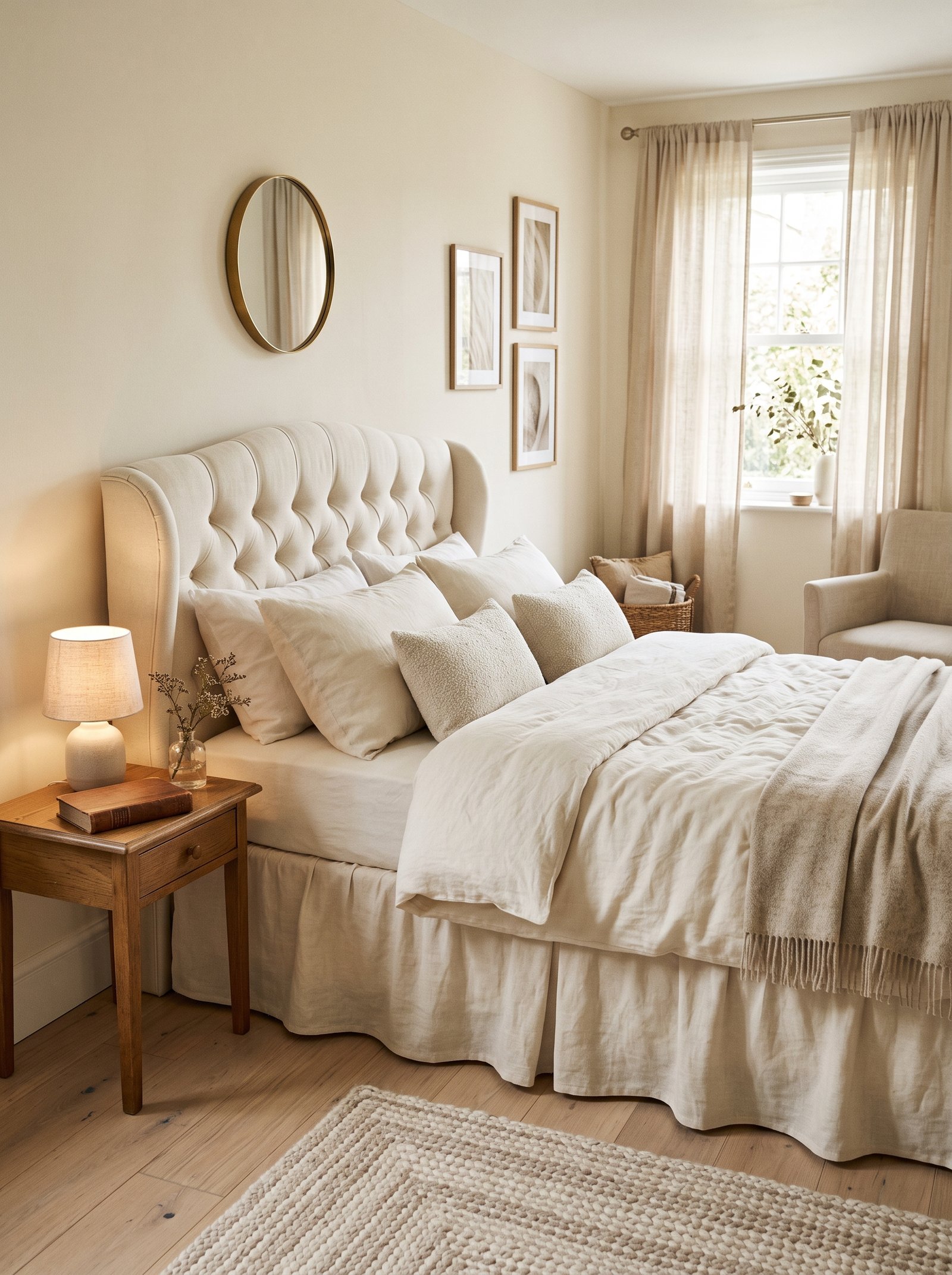
A large soft upholstered headboard — cream boucle, linen, or velvet — is the single most hotel-like move for a small bedroom. It softens the visual weight of the bed and gives the room a “styled” feeling that a plain wooden headboard cannot match.
Buy an upholstered headboard from IKEA (BJÄRUM, $180), West Elm, or Article. Or DIY: buy a 4-foot-wide piece of plywood, batting, cream boucle fabric ($30/yard from OnlineFabricStore), and staple it together in an afternoon. Total DIY cost: about $80.
For rentals where you cannot mount to the wall, choose a floor-mount headboard or a headboard that leans against the wall behind a platform bed. Weight of the mattress holds it in place.
Choose warm neutrals: cream boucle, oatmeal linen, sage cotton. Avoid dark saturated colors in a small bedroom; they visually shrink the space.
Layer with pillows in slightly darker or textured tones (see idea 16) so the headboard reads as the softness foundation, not as a lonely wall panel.
24. Put an olive tree in the corner
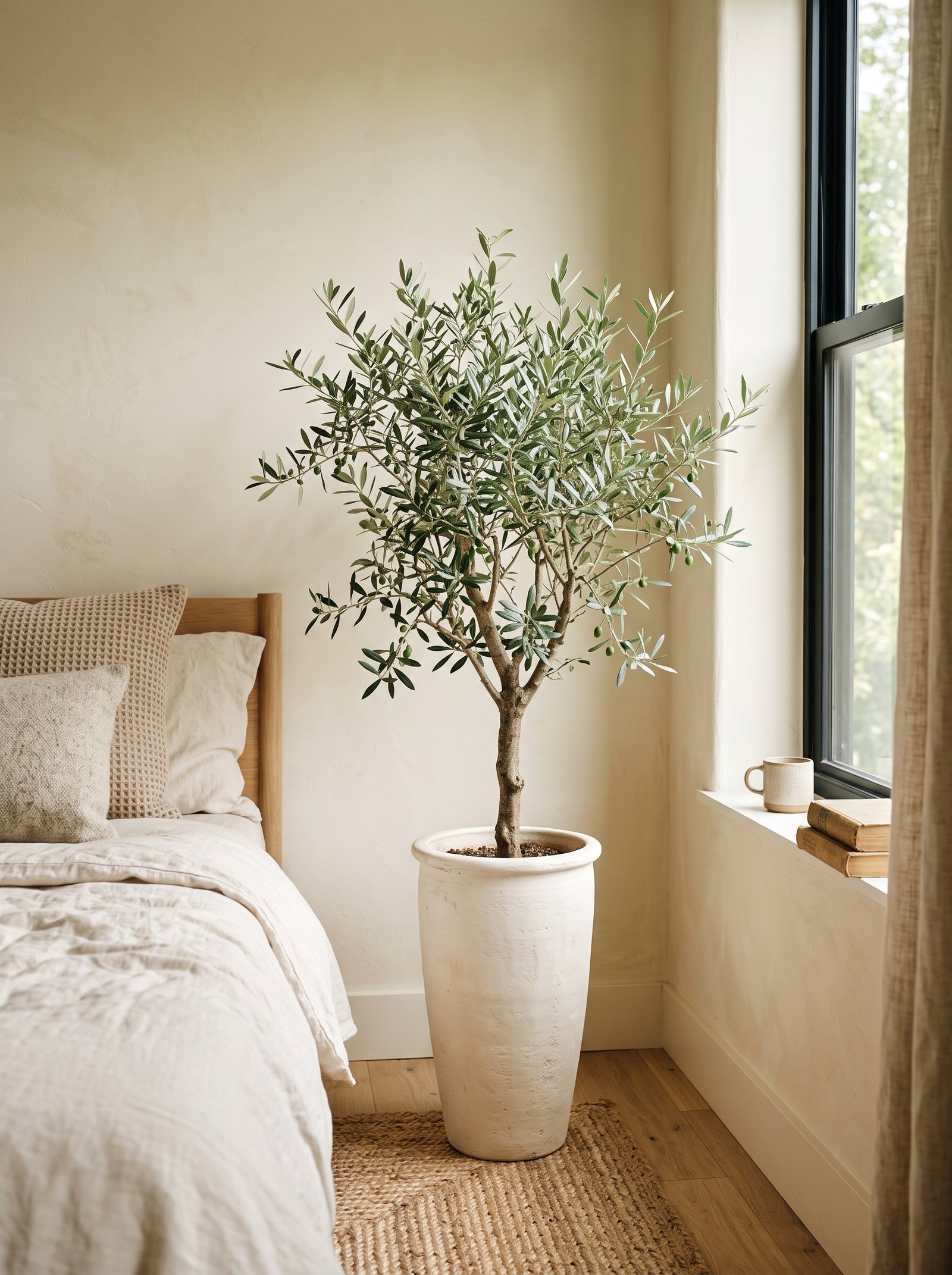
A single tall potted plant — an olive tree, a fiddle leaf fig, or a rubber tree — in the corner of a small bedroom adds instant life, height, and softness. It is the closest thing to a room-transforming purchase for under $100.
An olive tree is the most rental-friendly and low-maintenance option. It handles low light better than a fiddle leaf, does not shed like a bamboo palm, and looks fully editorial. Home Depot sells them for $30-70; specialty shops for $80-200.
Pot it in a heavy terracotta or cream stoneware planter (drop the plastic grocery-store pot inside a nicer one). Cost of the pot: $20-60 depending on size and finish.
Place it in the corner farthest from your bed, ideally beside a window if you have one. It draws the eye up and adds a soft vertical line that visually opens the room.
Water once every 10-14 days and rotate a quarter turn weekly so it grows evenly. In two to three years it will have doubled in size and become a permanent visual anchor of your room.
25. Put it all together — the hotel-style small bedroom
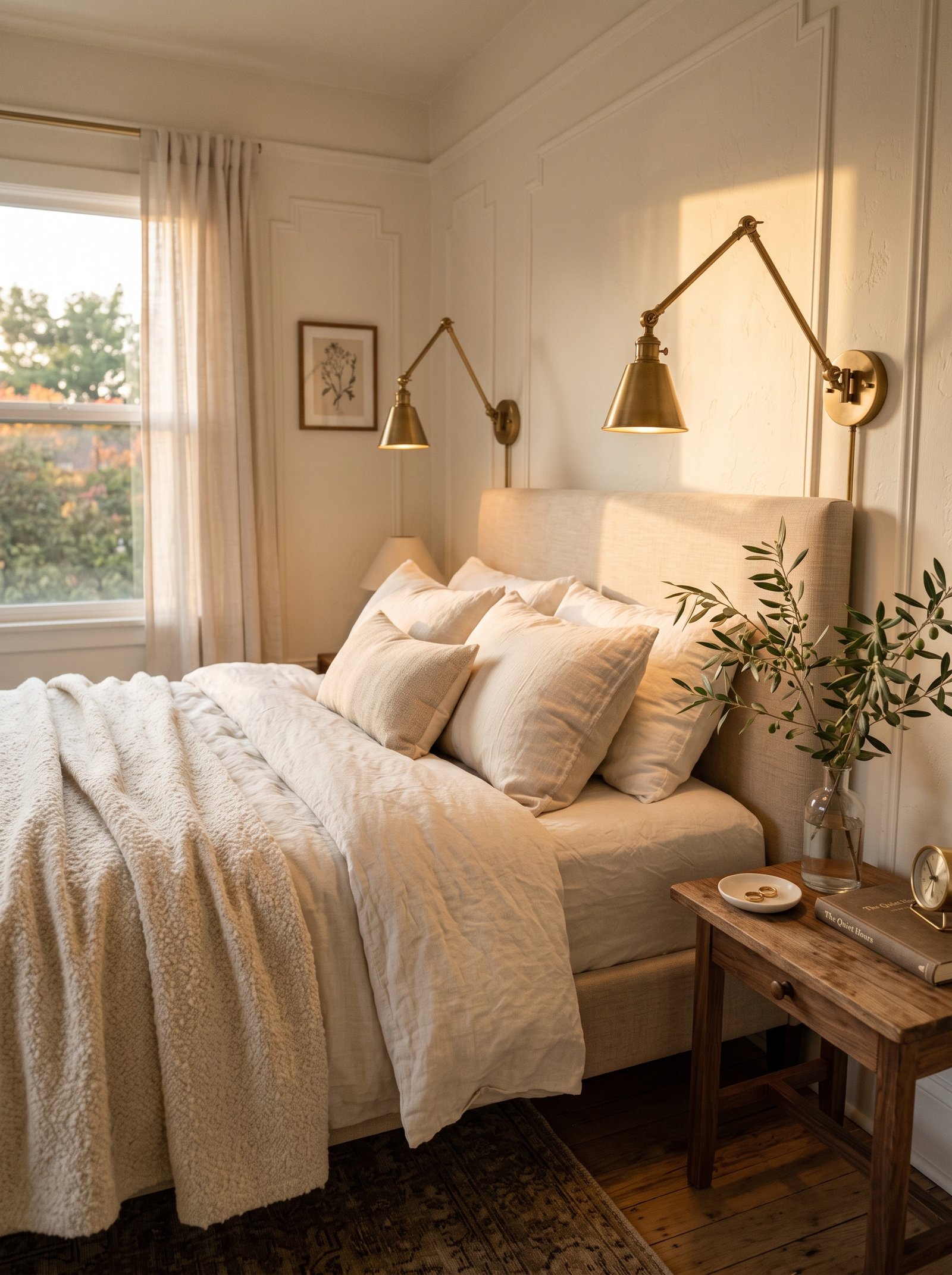
You do not need to do all 25 ideas at once. In fact, doing them all in a weekend gets you a bedroom that reads staged rather than lived-in. The best small bedrooms are built one deliberate change at a time over three to six months.
Start with the free/cheap changes: swap all bulbs to 2700K (11), edit the nightstand to three items (12), make the bed with layered textures (16), and hang one big piece of art above the bed (15). Total cost under $100. Total visual change: enormous.
The next month, upgrade the bones: a platform bed with drawers if you do not already have one (1), floor-length ceiling curtains (7), and an oversized area rug under the bed (22). Total cost: $500-800 depending on choices.
From there, one weekend project per month: wall sconces (2), a wallpaper accent wall (18), a rattan pendant (20), an olive tree in the corner (24). Live with each change for a couple of weeks before adding the next so you notice what actually matters.
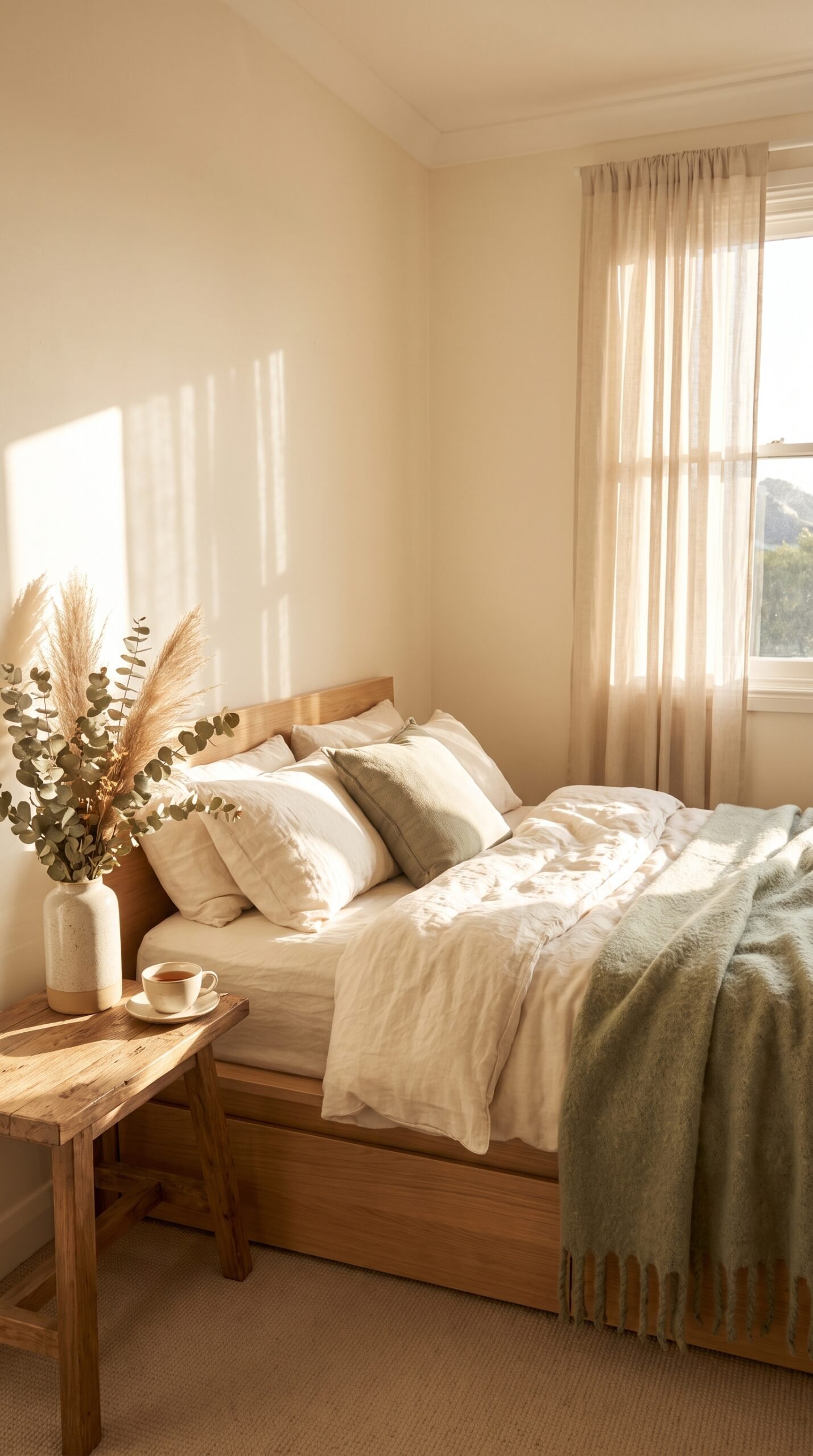
The photograph at the top of this idea is what six to twelve months of small, deliberate small-bedroom moves look like all put together — a room that reads warm, layered, hotel-like, and completely personal, in a footprint that started as generic rental drywall. The whole point of this guide is that “small bedroom” and “beautiful bedroom” were never actually opposites.
The mindset — small is a feature, not a bug
A small bedroom, done well, is calmer, easier to clean, cheaper to furnish, and more sleep-conducive than a big one. Every editorial hotel room you have ever loved was about 180 square feet. The constraint is the design; the scale is the feature.
Focus on the four things that actually matter in a bedroom: the bed itself, the light in the room, one big piece of art, and one plant. Get those four right and the room reads hotel-quality no matter how small it is.
Save this to your Pinterest small-bedroom board and share with a friend fighting the same square footage. New home-decor guide every day at Abodenest.
Keep reading — related decor guides
- → 30 Small Living Room Ideas
- → 25 Studio Apartment Layout Ideas
- → 25 Tiny Kitchen Ideas
- → 30 Small Bathroom Ideas Under $100
- → 25 Rental Kitchen Makeover Ideas
Take our 2-minute Decor Style Quiz
Answer 10 quick questions and discover whether you’re Modern Boho, Scandinavian Minimalist, Modern Farmhouse, Mediterranean, Japandi, or Classic Traditional — plus your color palette and 3 articles made for you.
Our interactive tools can help
Take the style quiz, generate a beige wall color palette, or calculate the perfect pillow stack for your bed — all free, all in under 2 minutes.