
25 Ways to Make a Small Bedroom Feel Bigger That Designers Use
A small bedroom can read tight, dim, and functional — or it can read calm, light, and surprisingly spacious — depending almost entirely on the design decisions made inside it. The square footage never changes. What changes is how the eye reads the space, how light moves through it, and how the furniture guides your body around the room. The difference between a small bedroom that feels cramped and one that feels like a boutique hotel suite is rarely more space — it is usually a dozen small decisions that interior designers make instinctively.
The strategies below come from how professional designers approach small-bedroom projects in New York studios, London mews houses, Tokyo apartments, and anywhere else small square footage is a reality rather than a problem to solve. Each move is based on how human perception actually works — how we read depth, light, ceiling height, visual weight, and spatial flow. Apply them in the right combinations and a 10×10 bedroom can genuinely feel like a 14×14 one, without any renovation or a single wall coming down.
The 25 ways to make a small bedroom feel bigger below are designer-tested, apartment-friendly, and in many cases rental-safe. Pick the two or three that fit your space and your constraints — paint color changes alone can transform a room, but combined with the right mirror placement, bed scale, and lighting layering, the effect compounds dramatically. Small bedrooms don’t need to feel small; they need to be designed with the perception tricks that make square footage read as more than it actually is.
1. Paint the Walls a Light, Warm Neutral
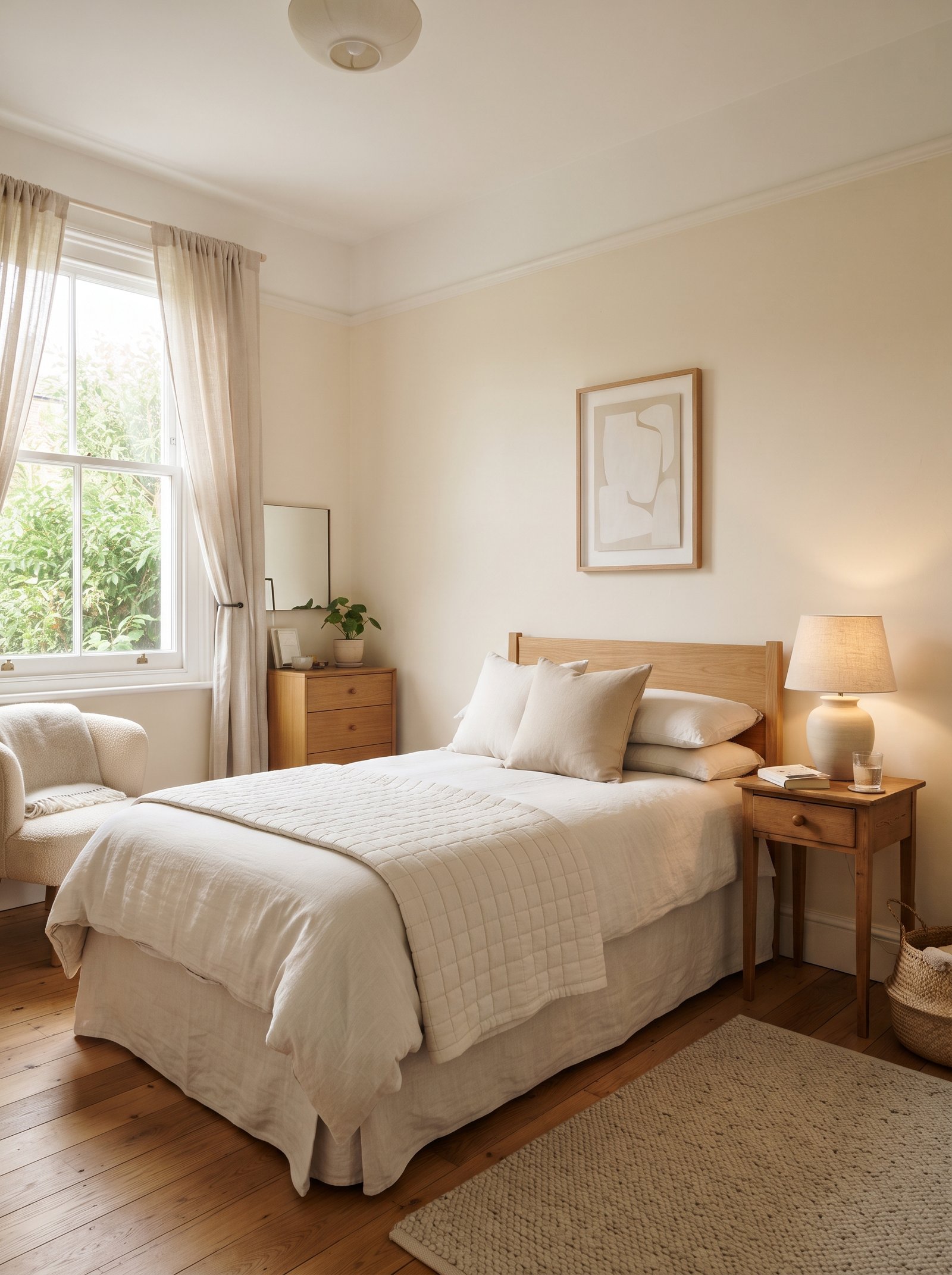
Light wall colors genuinely do make small rooms feel bigger — this is not a myth. Pale paint reflects more light, which spreads brightness evenly across every surface and reduces the shadows that make rooms feel confined. The eye reads a brighter room as larger because the walls fade into the background instead of advancing toward you.
Choose warm whites, soft creams, oatmeal, and warm greys rather than stark whites or cool greys. Warm neutrals keep the room feeling inviting rather than clinical, and they flatter skin tones and warm wood furniture better than cool alternatives. Benjamin Moore White Dove, Farrow & Ball Pointing, Clare Snow Day, and Backdrop Dover all perform beautifully in small bedrooms.
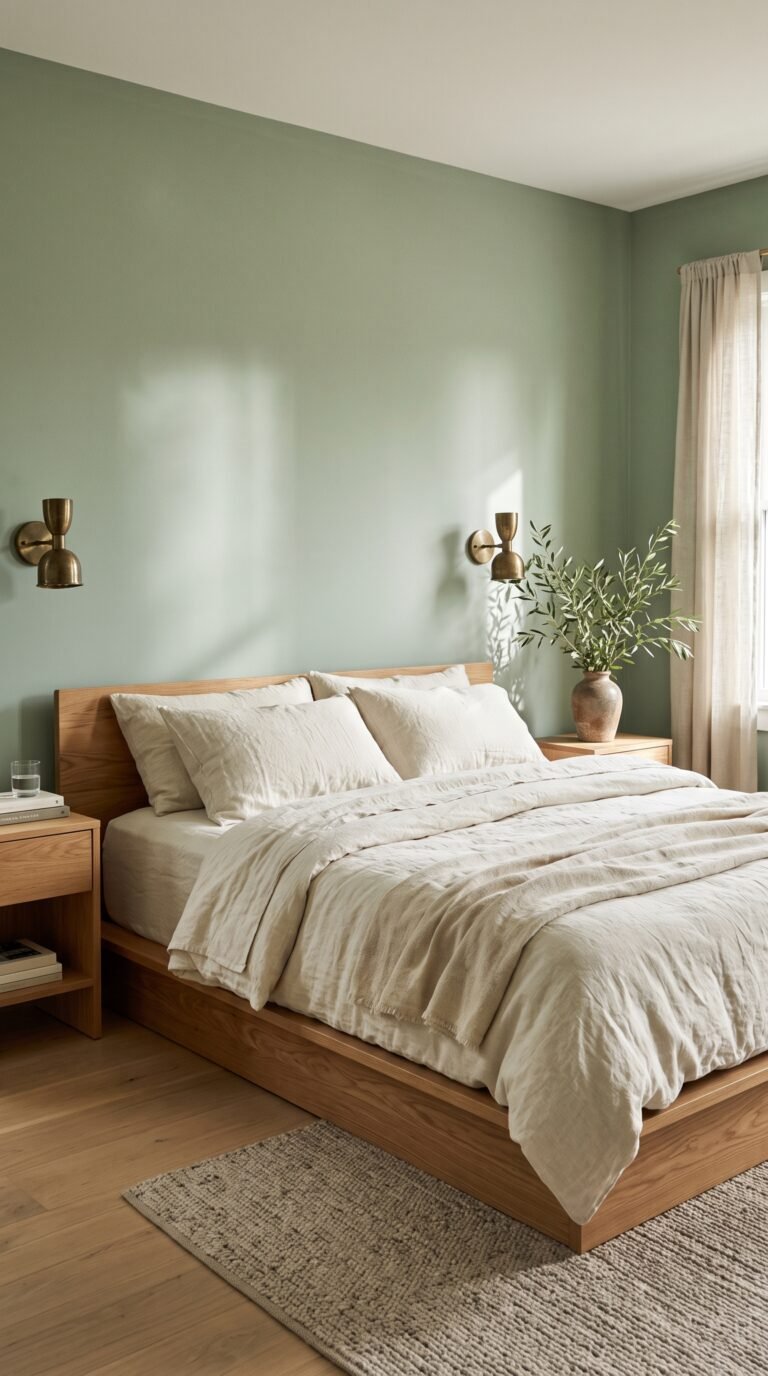
Avoid any paint with strong undertones in a small room. Blue-grey can make a small bedroom feel icy; purple-grey can make it feel oppressive; green-grey can make it feel underwater. Test paint samples on multiple walls over several days before committing — the color changes dramatically with the quality of light in your specific room.
Consider painting the ceiling the same light color as the walls. The seamless transition from wall to ceiling makes it harder for the eye to find the room’s edges, which translates visually to more space. The move takes an extra half-gallon of paint and dramatically changes how large the room feels.
2. Choose a Bed Frame That Lets Light Pass Through
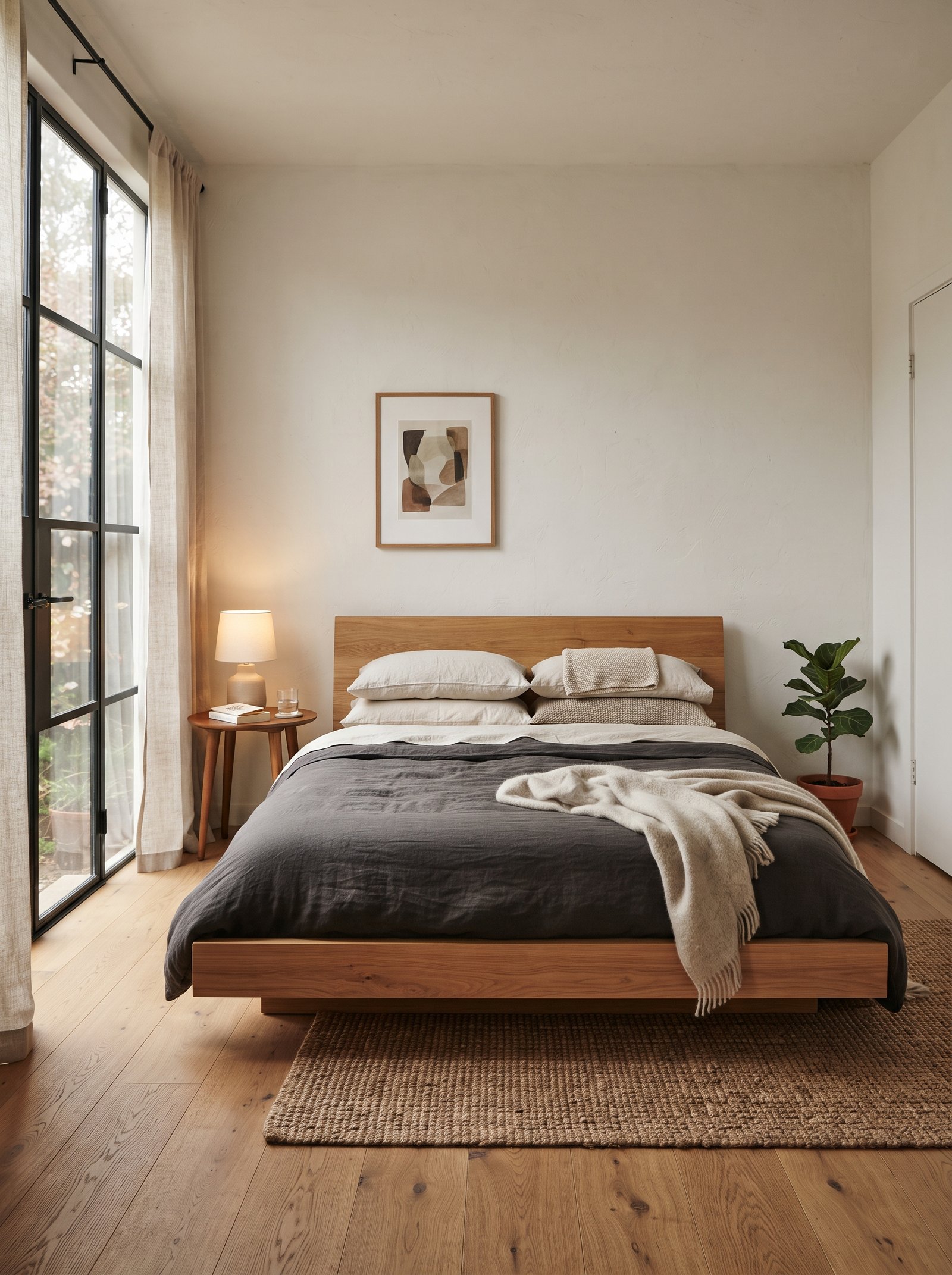
Heavy platform beds with solid storage below block visual light and make small rooms feel heavier. A bed frame with legs — raised 6-10 inches off the floor — lets light and air pass under the bed, which keeps the room feeling open. The eye reads the visible floor space as more square footage even when the actual footprint is identical.
Metal bed frames in slim profiles work especially well in small bedrooms because the open structure creates minimal visual mass. Slender wooden four-posters, iron sleigh beds, and simple platform beds on tapered legs all offer the same benefit — the eye flows through and around them rather than being blocked by solid mass.
Avoid upholstered beds with full-length skirts that touch the floor. They effectively close off the under-bed space and make the room feel heavier than it needs to. If you must have upholstery, choose a bed with visible legs and a low profile frame.
For maximum effect, position the bed so you can see under it from the doorway. The visible floor space is what the eye registers immediately when entering the room, and that first impression sets the perceived size of the whole space.
3. Hang Curtains From Ceiling to Floor
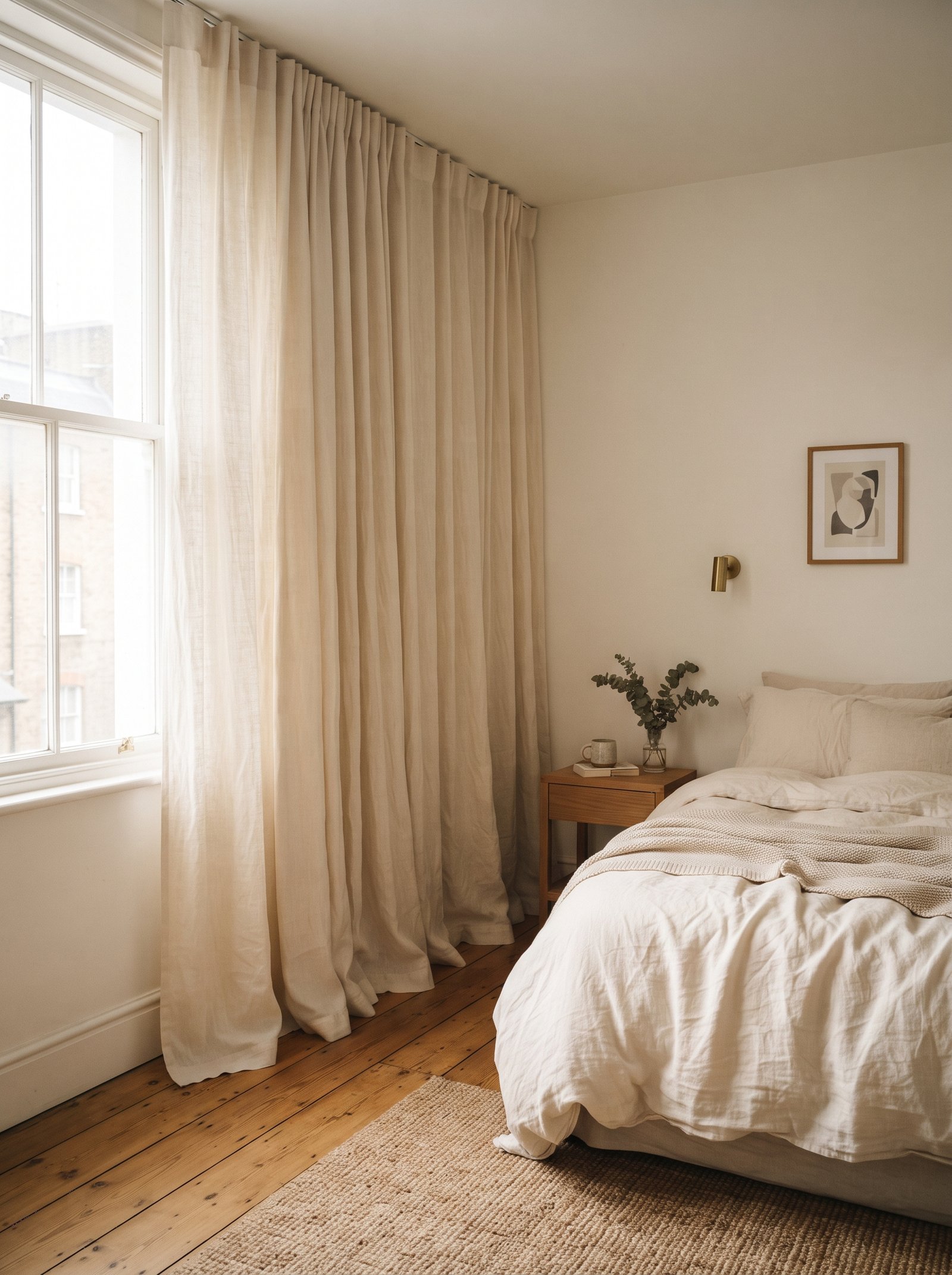
Hang curtain rods as high as possible — close to the ceiling, not just above the window frame — and extend the curtains all the way to the floor. The vertical sweep draws the eye upward and makes the ceiling feel significantly taller than it actually is. This single change transforms the perceived height of a small bedroom more than any other styling decision.
Choose light-colored curtains in natural fabrics (linen, cotton, light-weight wool) rather than heavy dark drapes. Light curtains filter sunlight into the room and keep the whole space feeling airy; dark heavy curtains absorb light and visually weigh the walls down.
Mount the curtain rod wider than the window frame — extend it 8-12 inches past the window on each side. This makes the window appear larger when the curtains are open, and it brings more light into the room during the day because the fabric isn’t covering any of the glass.
Let the curtains puddle slightly on the floor — a half-inch to one-inch of extra fabric pooled on the floor reads as luxurious and intentional. Curtains that end exactly at the floor read as off-the-rack; curtains that puddle gently read as custom.
4. Use a Large Mirror as a Faux Window
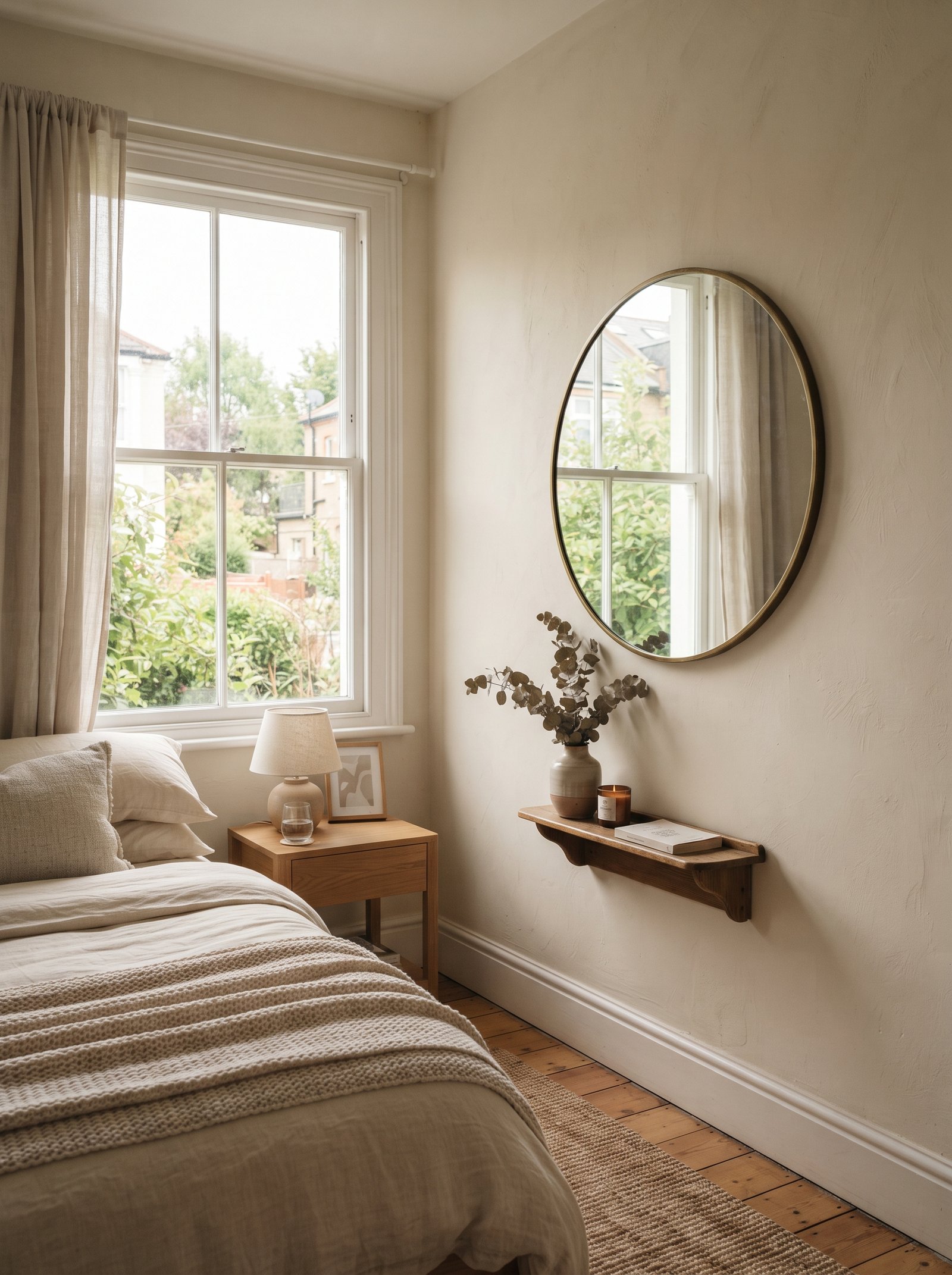
A large floor-length mirror leaned against the wall opposite a window reflects daylight back into the room and effectively doubles the window’s light-giving effect. The mirror also visually extends the room — the eye reads the reflection as additional space beyond the glass, which makes the whole bedroom feel significantly larger than its actual footprint.
Scale is everything in this move. A small mirror has minimal effect; a mirror at least 5-6 feet tall and 2-3 feet wide creates the dramatic illusion of a second window or an archway into another room. The bigger the mirror, the bigger the perceived room expansion.
Lean the mirror rather than hanging it for the casual-chic effect that reads boutique rather than bedroom-store. Secure the top with a small anchor to prevent tipping, but let the mirror rest at a slight angle against the wall for the architectural look.
Position the mirror to reflect something beautiful — the view out the window, a well-styled corner, a piece of art on another wall. Mirrors reflecting back cluttered or ugly views amplify the clutter visually; mirrors reflecting beauty amplify the beauty.
5. Keep the Floor Visible Around the Bed
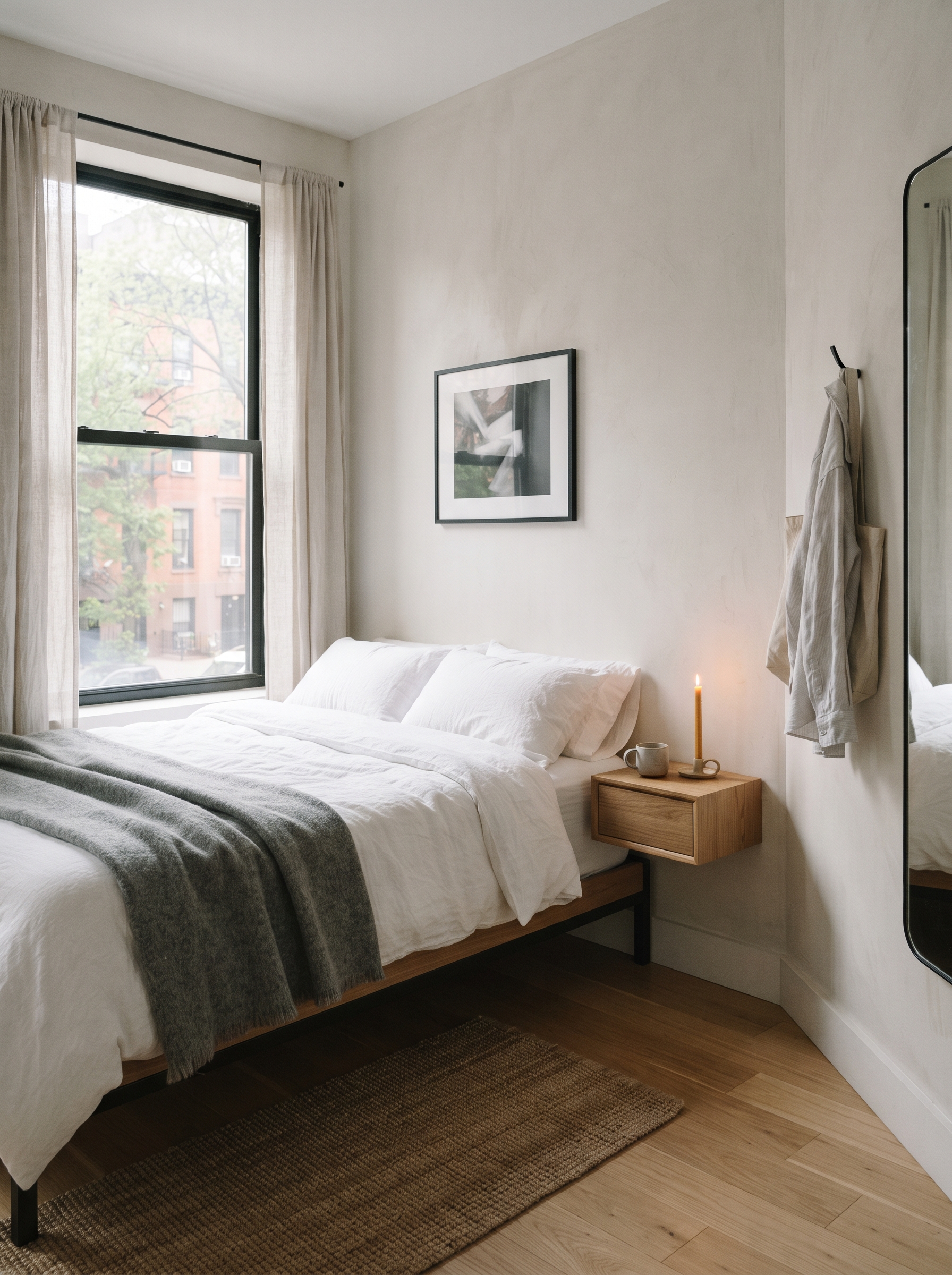
The amount of visible floor space in a bedroom directly correlates to how large the room feels. Every piece of furniture that covers floor space makes the room read smaller; every square foot of visible floor makes it read larger. In small bedrooms, this means being ruthless about what furniture earns its place in the room.
Aim for at least 50% of the floor to be visible when you stand in the doorway. If your bedroom has a dresser, two nightstands, a chair, a desk, and a bookshelf, you’re almost certainly fighting the space. Edit down to the bed, two slim nightstands, and one additional piece — the room will feel dramatically larger.
Store what used to live on the floor in vertical furniture, closet systems, or under-bed storage with low visual profile. The storage still exists; it just doesn’t contribute to the room’s visual weight.
Avoid area rugs that cover more than 60-70% of the floor around the bed. A rug that extends from wall to wall effectively erases the visible floor and makes the room feel smaller. A smaller rug positioned under the lower half of the bed leaves visible floor at the perimeter and makes the room read larger.
6. Lift the Bed on Risers for More Storage and Light
Bed risers add 4-8 inches of height to any bed frame and transform the under-bed space into functional storage. In a small bedroom where closet space is limited and vertical storage is maxed out, this hidden storage zone is often the difference between a cluttered room and a clean one.
Use flat storage boxes (not full-depth bins) under the raised bed for seasonal clothes, extra bedding, shoes, or anything else that doesn’t need daily access. Clear plastic bins let you see contents without pulling everything out; fabric bins look nicer when visible.
The raised bed also creates more visible floor space because the gap between bed frame and floor reads as additional air flow. The under-bed shadow pattern is what makes a bed feel heavy; opening that space with risers makes the bed feel architectural rather than oppressive.
For the fully custom look, use wooden bed risers in a warm oak or walnut finish rather than the plastic utility versions. The upgraded material reads as intentional furniture choice rather than quick fix.
7. Install Wall-Mounted Sconces Instead of Table Lamps

Wall-mounted sconces on either side of the bed replace table lamps and free up nightstand surface area that would otherwise be dominated by lamp bases. The visual weight is also significantly less — a sconce reads as architecture; a table lamp reads as furniture. The difference matters in small spaces where every piece contributes to perceived crowding.
Choose plug-in sconces if hardwiring is impossible (common in rentals). Many plug-in sconces have cords that can be hidden with simple cord-cover channels, or you can route them neatly behind furniture.
Articulating sconces (ones that swing or extend) are especially useful because they double as reading lights. Direct the light where you need it when reading, then push it back against the wall when sleeping. The functional flexibility reads as considered design.
Keep the sconce style simple — plaster, brass, matte black, or linen-shaded. Ornate sconces visually fight small rooms; simple ones integrate quietly into the architecture and let the light do the work.
8. Use a Monochromatic Palette
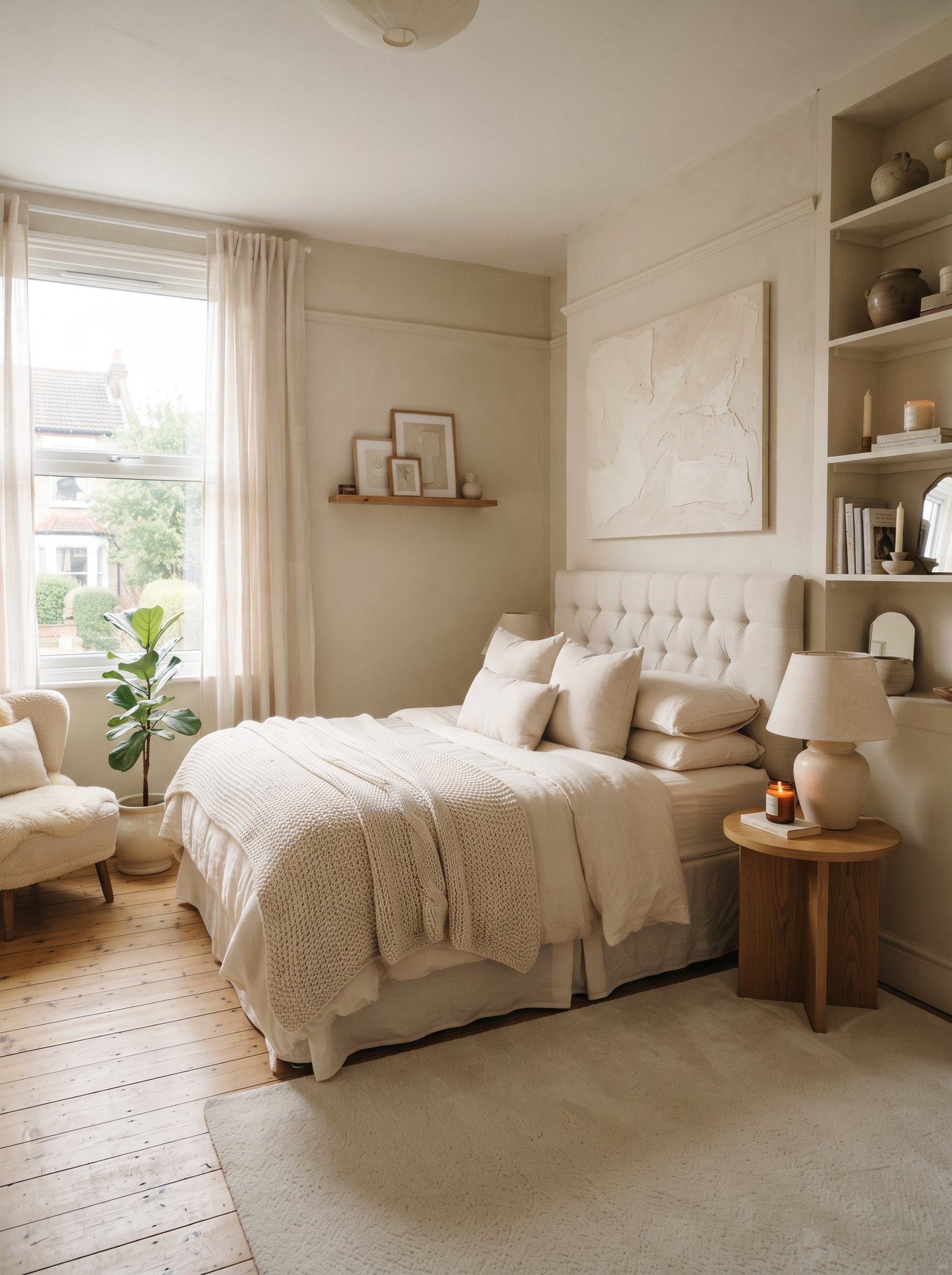
A monochromatic room — where the walls, bedding, curtains, and furniture are all variations of the same color family — reads as significantly larger than a room with contrasting colors. The eye flows uninterrupted across all the surfaces without hitting hard color edges that break up the space.
Choose one color family (cream, oatmeal, taupe, warm greys, soft blues) and vary only the tones and textures within it. Different shades of the same color still read as a single color story to the eye, so you can have light cream walls, oatmeal bedding, taupe curtains, and warm grey art without any of them competing.
Texture is what prevents a monochromatic room from feeling flat. Mix fabrics with different weaves (linen, boucle, velvet, knit), introduce natural materials (jute rug, oak side table, ceramic lamp), and vary surface finishes. The variety provides visual interest while the color stays unified.
Avoid introducing a single contrasting accent color in a monochromatic small bedroom. The accent will dominate the eye and shrink the perceived space. Save contrast for rooms where you have square footage to spare.
9. Keep the Bedding Simple and Light

Busy patterned bedding and oversized layered pillow stacks visually consume a small bedroom. The pile of pillows and heavy duvet become the room’s focal mass and shrink the perceived space around the bed. Simple, light-colored bedding with a restrained pillow stack lets the bed recede into the architecture.
Keep the bedding palette tight — white, cream, oatmeal, or soft natural tones. Add visual interest through texture (linen duvet, boucle throw, waffle shams) rather than through pattern or color. The textural variety reads as sophisticated rather than busy.
Edit the pillow stack. Two euros plus two sleeping pillows plus one lumbar is enough for a small bedroom; the full seven-pillow hotel stack overwhelms the scale. The streamlined pillow approach also makes the bed easier to actually use for sleeping.
Oversized duvets that drape generously over the sides of the bed read elegant on large beds in large rooms. In a small bedroom with a smaller bed, choose a duvet exactly sized to the bed with modest overhang. Too much draping creates visual mass that fights the small space.
10. Use a Single Statement Light Instead of Multiple Sources

A single beautiful pendant light hanging centered over the bed reads as architectural lighting rather than a collection of lamps. The vertical line of the pendant pulls the eye up and draws attention to the ceiling, which makes the room feel taller and more intentional.
Choose a pendant with simple sculptural form — a cone, a globe, a cluster of exposed bulbs, a woven rattan shade. The simpler the shape, the more it reads as architecture; the more ornate the shape, the more it reads as decor that competes with the rest of the room.
Install the pendant lower than you would in a larger room — about 36-40 inches above the mattress. The lower hanging creates intimacy and draws the eye to the bed as the room’s focal point, which is exactly where it should be in a small bedroom.
Add a dimmer so the pendant can shift from reading light to bedtime glow. The dimmer transforms a single fixture into multiple lighting moods and eliminates the need for additional table lamps.
11. Store Vertically With Tall Narrow Furniture

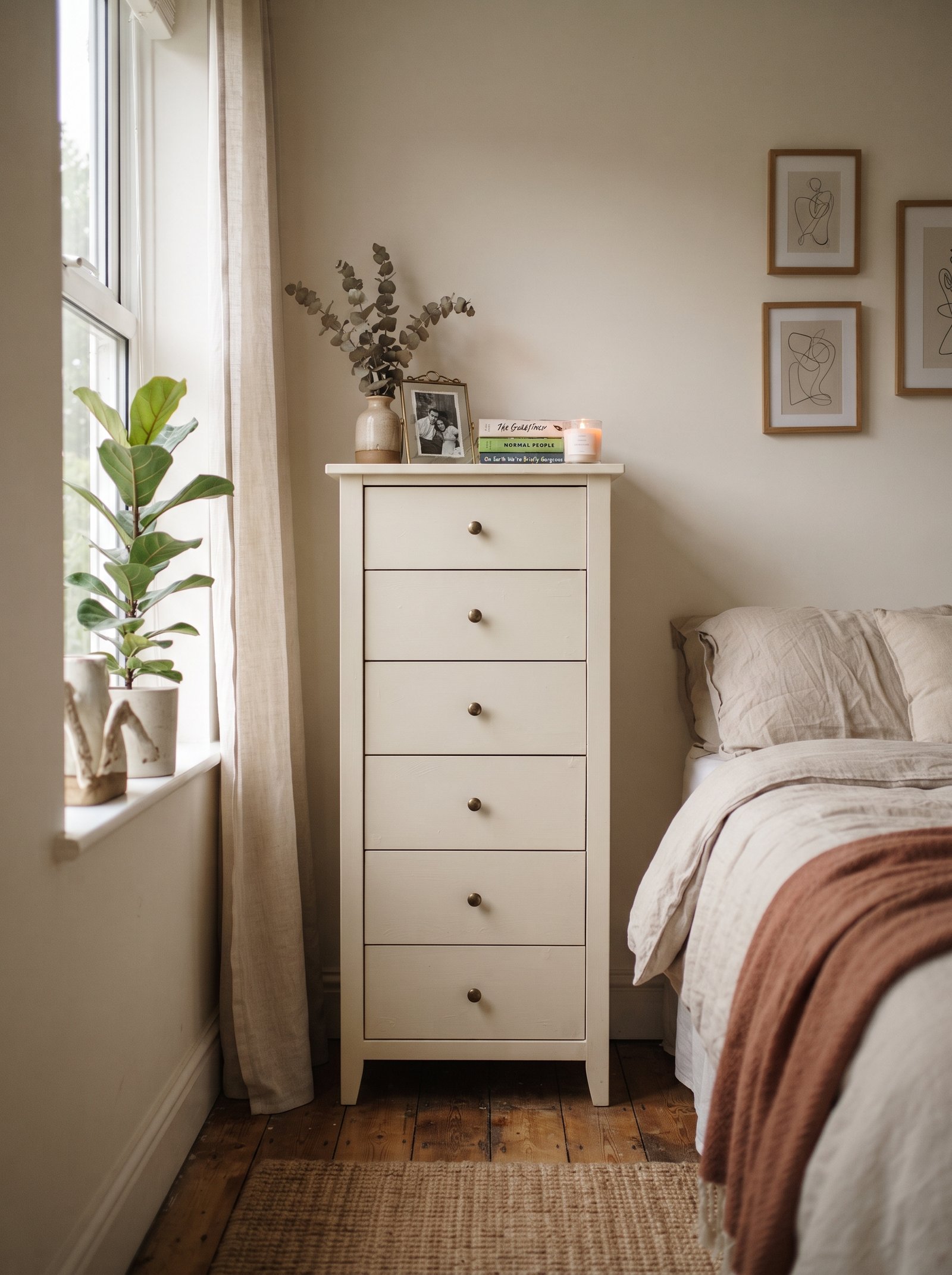
In small bedrooms, vertical storage always beats horizontal. A tall narrow dresser takes up less floor space than a wide low one with equivalent drawer capacity. The eye reads the vertical silhouette as architectural rather than furniture-crowded, and the floor space saved makes the room feel larger.
Look for dressers 48-60 inches tall and 30-36 inches wide for small bedrooms. These proportions give you four to six drawers of real storage while occupying minimal floor footprint. Position in a corner or against a short wall to maximize the room’s open center.
The same principle applies to bookshelves — tall narrow bookcases outperform short wide ones in small bedrooms. A 72-inch-tall bookcase occupies a 12×30-inch footprint but gives you shelf space equivalent to a 30-inch-tall dresser spanning 72 inches of wall.
Mount floating shelves above dressers and nightstands to extend vertical storage into otherwise wasted wall space. The combination of taller furniture plus wall-mounted shelves can double a small bedroom’s storage capacity without consuming more floor space.
12. Choose Furniture With Legs, Not Solid Bases
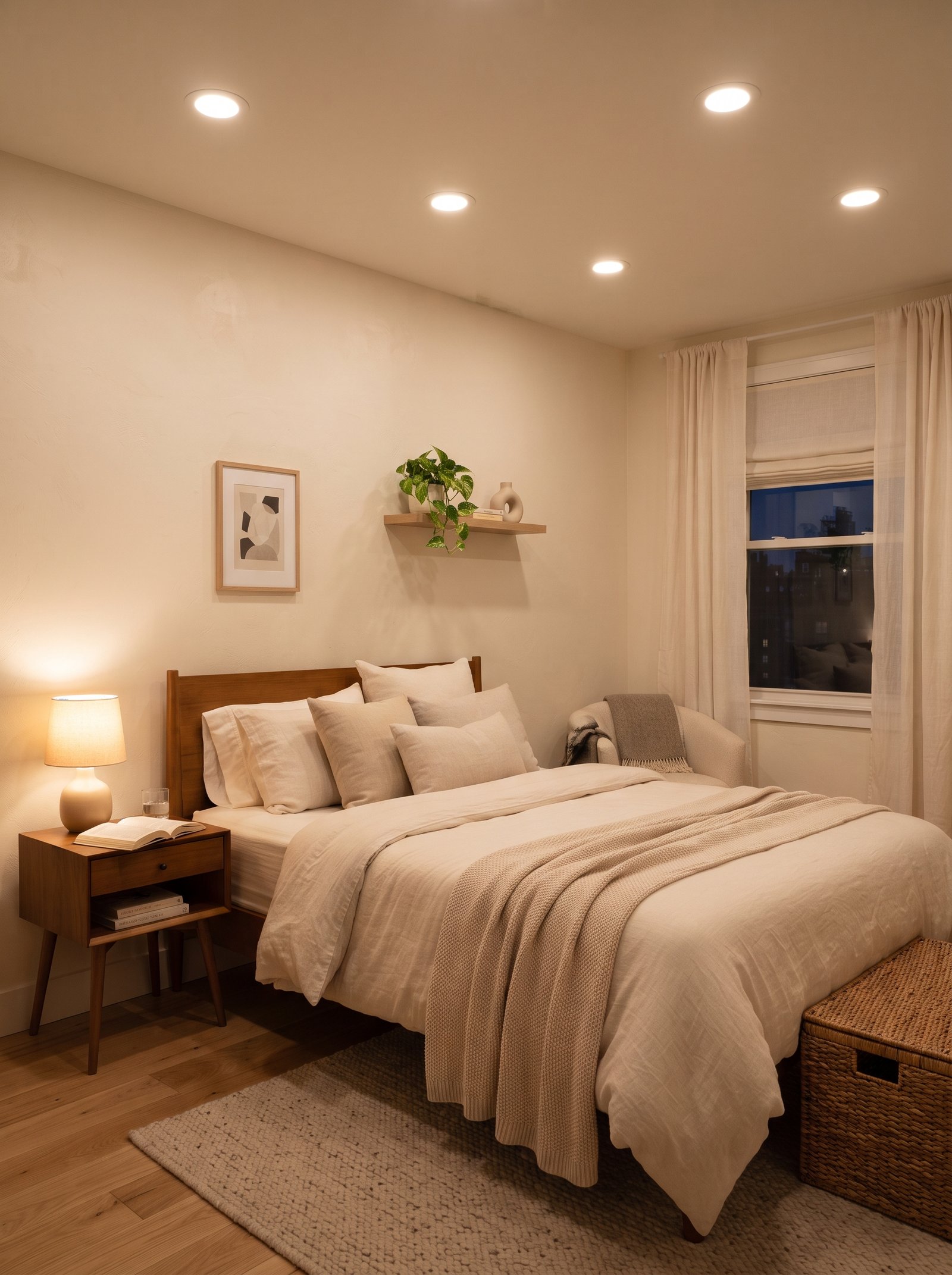
Furniture on visible legs reads lighter and lets the eye flow underneath. Solid-base furniture — pieces that sit directly on the floor without visible legs — reads heavier and blocks visual light. In small bedrooms, this difference compounds across every piece.
Mid-century modern furniture (dressers on splayed legs, nightstands on tapered legs, chairs on hairpin legs) was designed for exactly this reason — the raised profile makes small spaces feel larger. Classic Scandinavian pieces follow the same principle for the same reason.
The visible floor space under furniture reads as additional square footage even though you can’t functionally use it. The eye doesn’t distinguish between usable floor and under-furniture floor; both contribute to the perceived size of the room.
Avoid upholstered pieces with full-length skirts or built-in storage drawers that extend to the floor. The solid base makes even well-designed pieces feel heavier than they need to in a small bedroom.
13. Add a Floor-to-Ceiling Wall Panel for Height

A floor-to-ceiling wall panel behind the bed — in wooden slats, fluted MDF, grasscloth, or textured wallpaper — adds architectural interest and draws the eye vertically. The continuous line from floor to ceiling emphasizes the room’s full height and creates the illusion of taller ceilings even in standard 8-foot rooms.
Choose a panel material that complements the rest of the room’s palette. Natural wooden slats in warm oak work with neutral bedrooms; fluted MDF painted the wall color creates subtle texture; grasscloth adds organic warmth; textured wallpaper offers the most variety and the easiest DIY approach.
The wall panel also eliminates the need for a separate headboard, which can clutter a small bedroom with another piece of furniture. The panel becomes the headboard, adds vertical visual interest, and defines the sleeping zone architecturally rather than through additional pieces.
For rental spaces where permanent changes aren’t allowed, use peel-and-stick wood slat panels or removable textured wallpaper. The visual effect is identical and the installation is fully reversible when you move out.
14. Place a Mirror Behind the Bed

A large horizontal mirror mounted above the bed as a headboard alternative reflects the opposite wall of the room, visually doubling the sense of space. The reflection creates depth where there is only wall, and the eye reads the mirrored space as part of the actual room’s footprint.
Choose a mirror roughly as wide as the bed itself — a 60-inch mirror above a queen bed, a 72-inch mirror above a king. The scale matters; a small mirror above a large bed reads as an accessory, while a properly-scaled mirror becomes the architectural statement.
Frame the mirror in warm wood, aged brass, or matte black for the full custom-headboard effect. Unframed mirrors read as bathroom glass; framed mirrors read as furniture and anchor the sleeping zone with visual weight.
Pair with warm bedside sconces that cast light toward the mirror. The reflected light amplifies the brightness of the whole room and makes the bedroom feel significantly larger especially at night.
15. Keep the Nightstand Styling Minimal

One lamp, one book, one small object or vessel for a glass of water — that’s the small-bedroom nightstand formula. Anything more and the whole bedroom starts to feel crowded; anything less and it feels unused. The three-object rule applies here with special importance.
Hide everything else — chargers, medication, remotes, tissues, readers — inside the nightstand drawer or in a small lidded box on the shelf below. The visible surface stays clean; the functional reality still works. The combination is what makes small bedrooms feel designed rather than survival-mode.
Choose small-scale nightstands (16-20 inches wide, 20-24 inches deep) for small bedrooms. Full-size nightstands with multiple drawers overwhelm the scale and crowd the space around the bed.
Consider wall-mounted floating shelves instead of nightstands if your floor space is especially tight. A floating shelf 24-28 inches above the floor at bed height gives you a bedside surface without any floor footprint at all.
16. Use Open Shelving Over Closed Storage
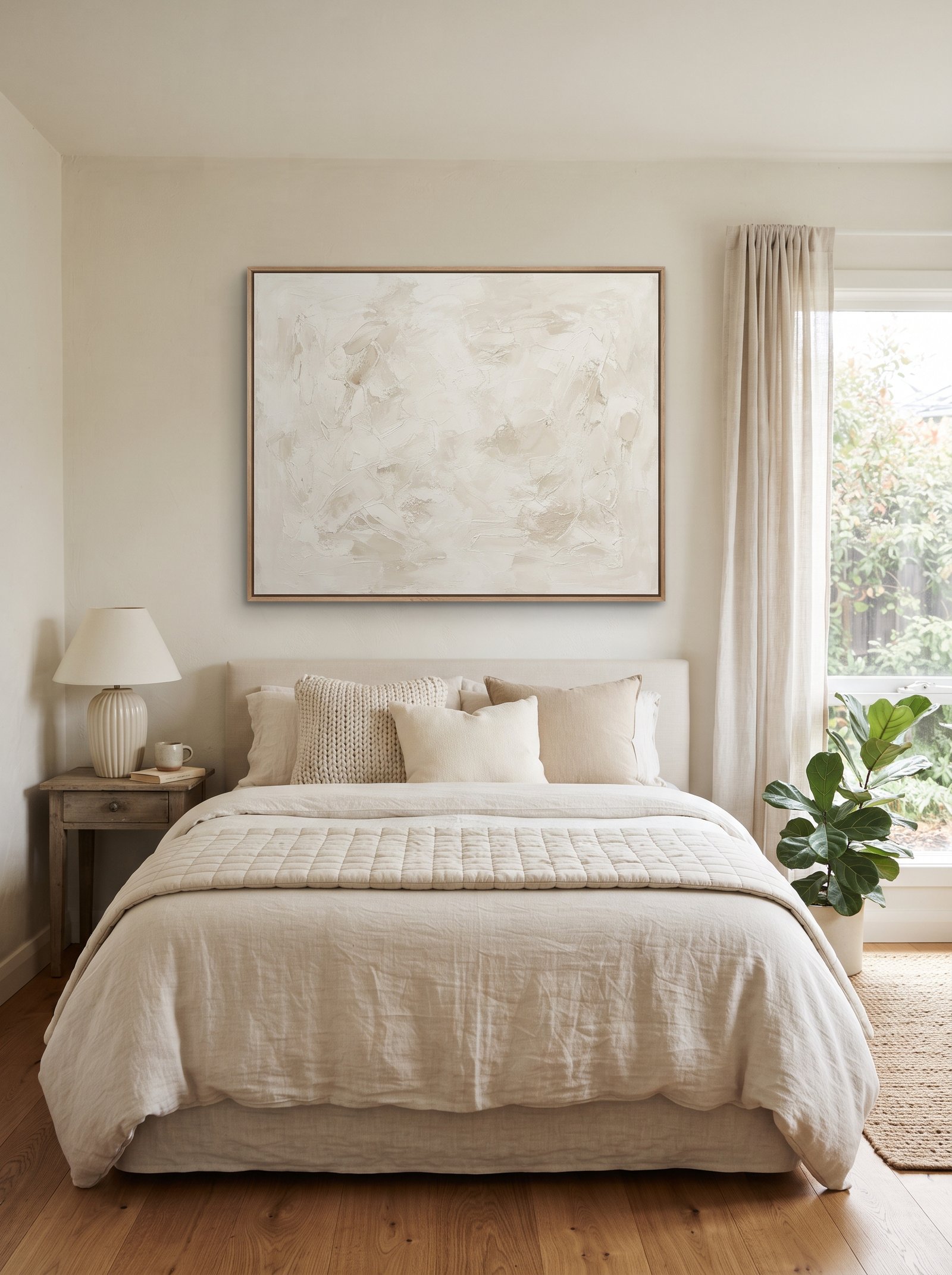
Open shelves let light and visual air pass through them, making walls feel less heavy than when covered by closed cabinets or bookcases with doors. In small bedrooms, open shelving over closed storage keeps the room feeling spacious even when the shelves themselves are full.
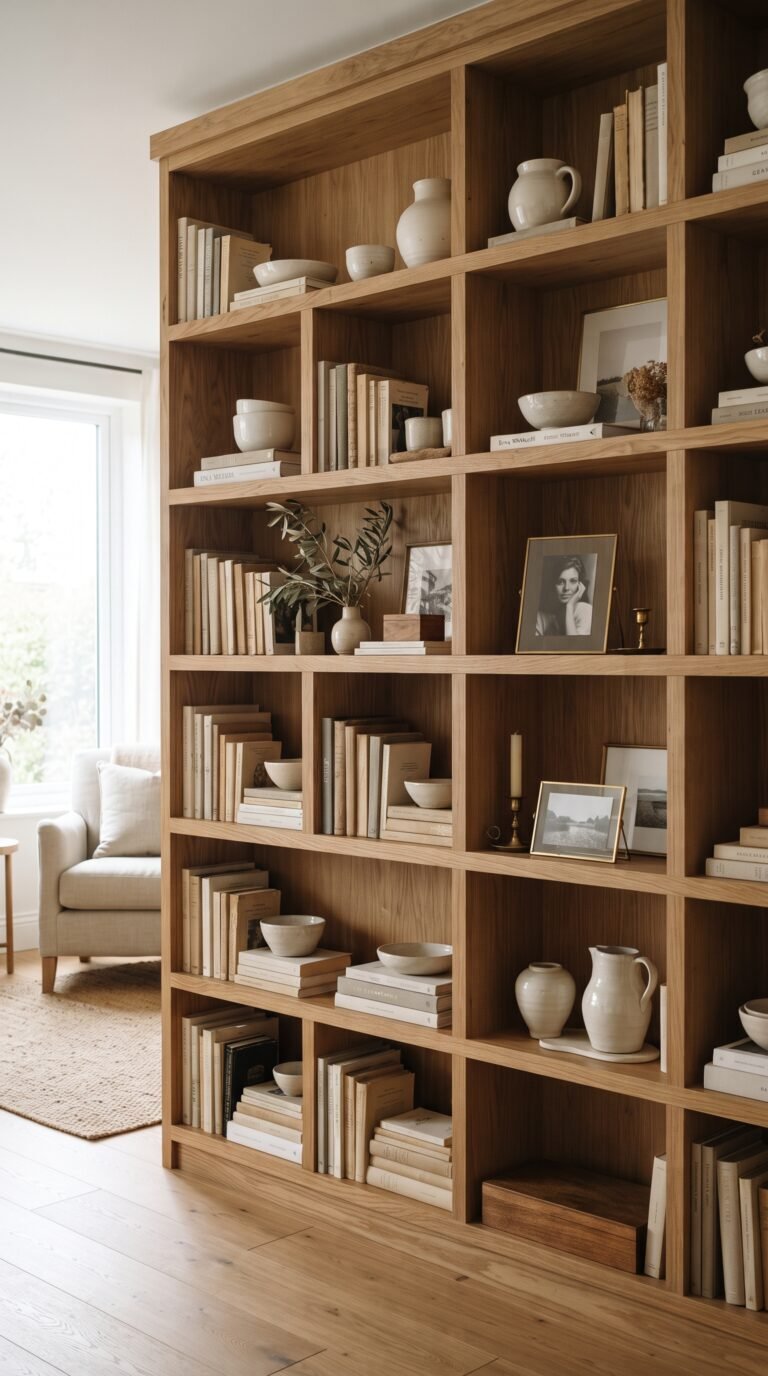
The exception is clutter. Open shelves work only when styled with intentional composition — books organized by color or spine height, decorative objects grouped in threes, plants and ceramics mixed with styled personal items. Chaotic open shelves make a small bedroom feel smaller, not larger.
Choose shelving material that matches or complements the room’s wood tones. Floating shelves in warm oak, walnut, or painted-cream against the walls disappear into the architecture when styled restraintly.
Keep shelves relatively narrow (6-8 inches deep) to avoid them projecting into the room. Deeper shelves add visual weight and reduce the sense of open wall space; narrower shelves hold what you need without competing with the room’s volume.
17. Add a Transparent Chair or Stool

Transparent furniture — clear acrylic chairs, lucite side tables, ghost chairs — provides function without adding visual mass. In small bedrooms where every piece contributes to the sense of crowding, transparent pieces give you the usability you need without the visual cost.
A clear acrylic chair in the corner or beside the bed functions as a landing zone for the throw blanket at night, a place to sit while putting on shoes, or an extra seat when needed. Its transparency means the eye flows through it and reads the floor space as still visible.
Lucite or glass bedside tables offer the same benefit — functional surface with minimal visual presence. The eye registers the lamp or clock on top rather than the table underneath.
Combine transparent pieces with warm wood and soft textiles elsewhere in the room for the full designed effect. Rooms furnished entirely in transparent pieces feel cold and clinical; one or two transparent pieces among warmer materials read as sophisticated layering.
18. Choose a Low Headboard or Skip It Entirely
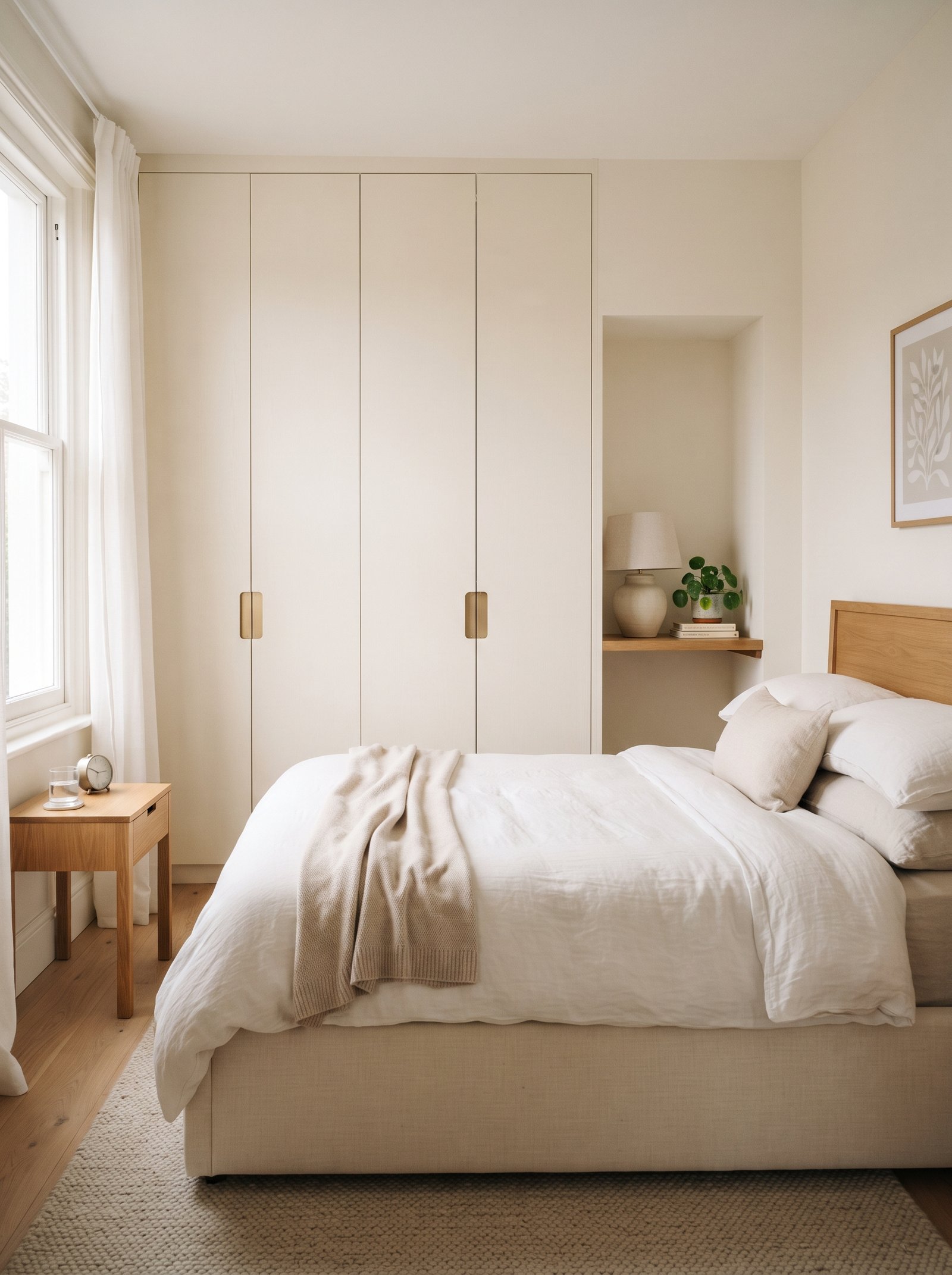
Tall ornate headboards consume vertical visual space in small bedrooms and make ceilings feel lower than they are. A low-profile headboard (24-36 inches tall) or no headboard at all leaves the wall above the bed open, which pulls the eye up and makes the whole room feel taller.
If you want a headboard for sitting-up-in-bed comfort, choose simple upholstered styles in cream, oatmeal, or soft natural fabrics. The low silhouette provides function without competing with the room’s height.
The space above a low headboard becomes available for mirror, art, or a single sconce — any of which adds vertical interest without the mass of a full-height upholstered piece.
Alternatively, mount a textured wall treatment (wooden slats, grasscloth panel, or framed fabric) behind the bed and skip the headboard entirely. The wall treatment becomes the headboard function without any additional furniture piece.
19. Hide Cords and Chargers Entirely
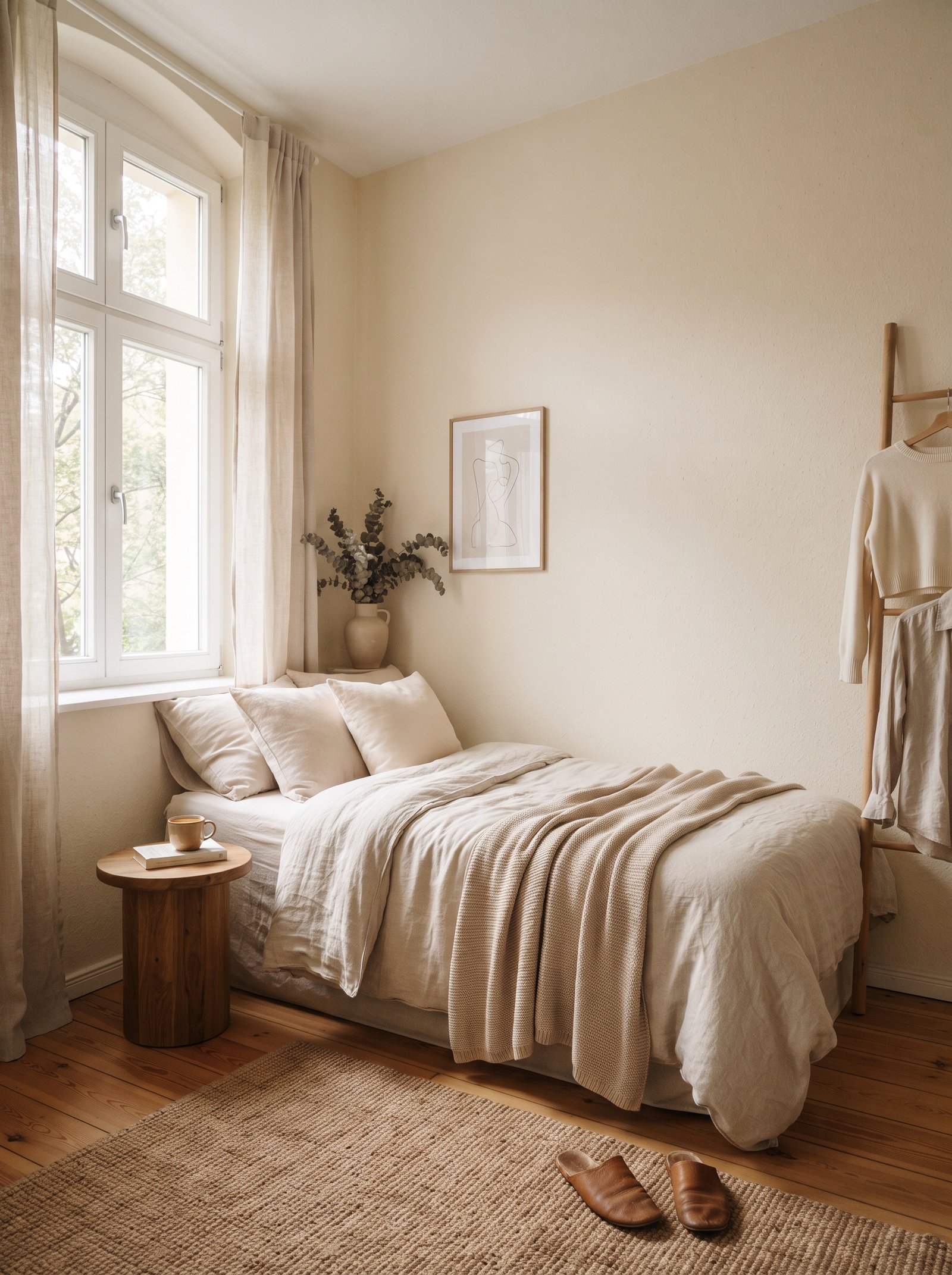
Visible cords add visual chaos that makes small bedrooms feel more cluttered than they are. Running cords through small cable channels, hiding chargers inside drawers, and using wireless charging pads where possible all reduce the room’s visual noise.
Adhesive cable raceways run cords vertically up walls or horizontally along baseboards for a near-invisible wire path. Paint the raceway to match the wall color and the cords disappear completely.
Keep a single lidded box or small basket inside the nightstand drawer for all the small daily items — chargers, headphones, medications, readers. The surface stays clean; the function stays accessible.
Wireless charging pads on nightstands eliminate the cord entirely for phone charging. Even without a wireless pad, pointing cords down behind furniture rather than draped across surfaces reduces visual chaos dramatically.
20. Use a Smaller-Scale Bed Frame
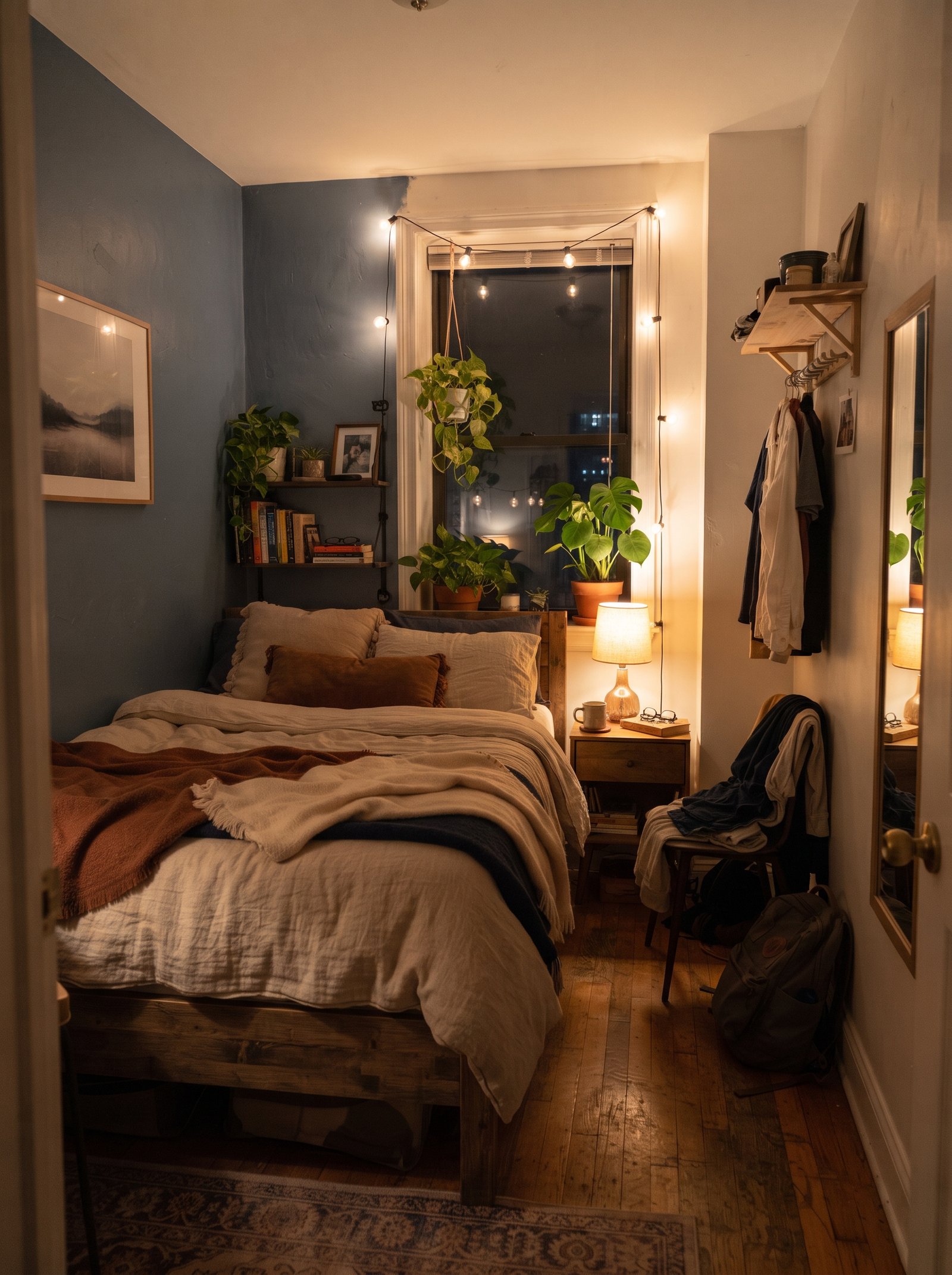
A king bed in a small bedroom overwhelms the scale and reduces the surrounding floor space to almost nothing. A queen or full bed in the same space gives you a reasonable sleeping surface while leaving the room with proportional balance and visible floor space around the bed.
The common mistake is prioritizing bed size over room proportion. A smaller bed in a well-designed room reads as better and feels more spacious than a larger bed in a crowded one. Choose the bed scale that fits the room rather than the room scale that fits the bed.
For couples who want more sleeping surface, a smaller queen or full XL on a frame with built-in storage or a slimmer platform often gives more usable space than a king bed with no room to walk around it.
Position the bed with 18-24 inches of walking space on either side if possible. Beds pushed against walls make the room feel smaller even if the bed scale is correct; proper walking paths around all three sides of the bed read as spacious.
21. Add a Trailing Plant for Height

A trailing plant — pothos, ivy, string of pearls, trailing tradescantia — hanging high or on a tall plant stand draws the eye upward and adds organic texture that softens small rooms. The vertical cascade of green leaves reads as architectural element rather than cluttered decor.
Position the plant where it catches natural light but doesn’t block any usable floor space. A corner above a nightstand, a high shelf, or a wall-mounted plant hanger all work. The trailing vines create the vertical visual pull without any floor footprint.
Low-light trailing plants (pothos, snake plant varieties, zz plants) are especially good for small bedrooms where natural light may be limited. These plants genuinely thrive in low light and look lush with minimal care.
Avoid oversized floor plants in small bedrooms. A large fiddle leaf fig or monstera overwhelms the scale and reduces floor space. Save those for larger rooms where their presence belongs; use smaller trailing plants or tabletop succulents in small bedrooms.
22. Install a Full-Length Mirror on a Closet Door

Mounting a full-length mirror on the inside or outside of a closet door adds reflective surface without consuming any additional floor space. The mirror serves its functional purpose (dressing, outfit checking) while also expanding the perceived size of the room through reflection.
Position the mirror on an outside-facing door if you want it to be part of the room’s design; mount it on the inside of a closet door if you want it hidden except when needed. Both approaches work; the choice depends on how you want the mirror to feature in the room’s styling.
Choose a mirror slightly smaller than the full door so there’s a visible frame of door around it. Mirrors that cover the entire door read as commercial fitting rooms; mirrors with visible door edges read as intentional installation.
If your closet doesn’t have doors (open closet systems or curtain-covered closets), lean a full-length mirror against the wall beside the bed. The leaning mirror adds the same reflective expansion without requiring any mounting.
23. Choose Thin Window Treatments Over Heavy Drapes

Sheer or lightweight linen panels filter daylight beautifully into a small bedroom while still providing privacy. Heavy blackout drapes block all light and visually weigh down the walls; sheer panels maintain the sense of openness while softening the window.
For sleep darkness, add blackout blinds behind the sheer panels. The combination gives you full darkness at night and soft diffused light during the day without compromising either function. The visible layer during daylight hours is the sheer panel, which keeps the room feeling light.
Choose panels in warm neutrals — cream, oatmeal, soft white — that let maximum light through. Dark heavy curtains make small bedrooms feel smaller even when they’re pulled open because the fabric mass is always visible to the eye.
Hang the panels wide enough so they stack beyond the window frame when open. This maximizes window exposure to light during the day and makes the window itself appear larger when the room is being used.
24. Use the Space Under the Bed for Deep Storage
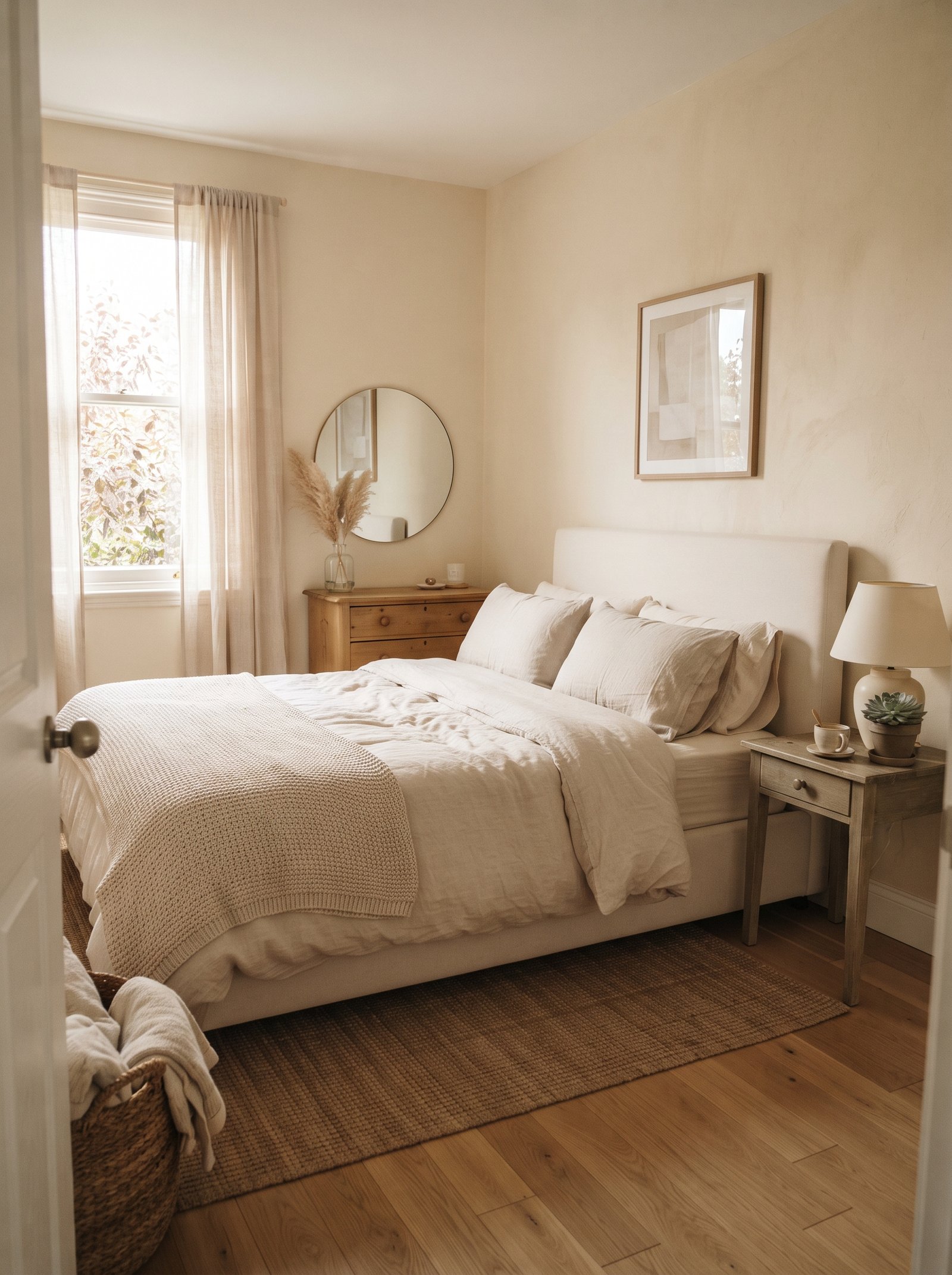
Under-bed storage is one of the most underused resources in small bedrooms. Flat storage boxes, fabric bins with lids, or rolling drawers all slide under raised beds and hold significant amounts of out-of-season clothing, extra bedding, shoes, or anything else that doesn’t need daily access.
Measure the clearance under your bed carefully before buying storage. Standard bed heights clear 6-10 inches; beds on risers clear 10-16 inches. Buy boxes that fit the clearance exactly to maximize storage capacity.
Fabric bins with lids keep contents dust-free and look nicer when visible. Clear plastic bins let you see contents without pulling everything out but look more utility than considered. Choose based on whether the bins will be visible or hidden by a bed skirt or long duvet.
Use the under-bed zone strategically — store things you use infrequently (out-of-season sweaters, extra sheets, holiday decor) rather than daily items. The lift required to access under-bed storage makes it best for rarely-needed storage.
25. Keep the Overall Styling Minimal
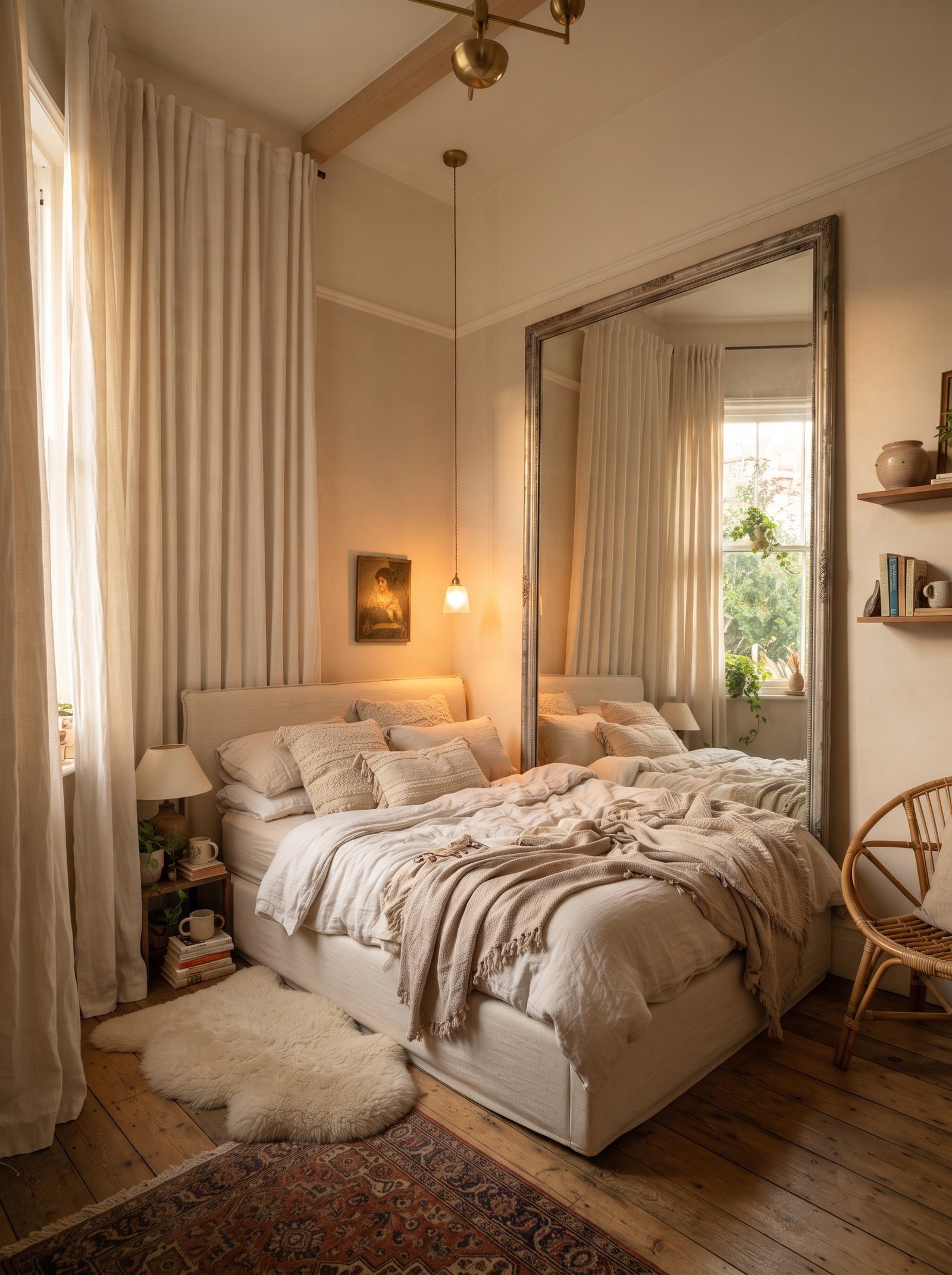
The single biggest mistake in small bedrooms is over-styling. Multiple pillows, decorative pieces on every surface, art stacked on walls, plants in every corner — each addition shrinks the perceived space. Edit ruthlessly; what you remove makes the room feel larger more effectively than what you add.
The rule of thirds applies here: if you look at your bedroom and feel like adding one more thing, remove two things instead. The restraint reads as sophisticated and makes the room feel significantly larger than its actual footprint.
Choose decorative pieces for impact rather than quantity. One beautiful ceramic lamp on each nightstand is more effective than three small items; one large art piece above the bed is better than a gallery wall of small frames.
The minimal approach also makes small bedrooms easier to actually live in — easier to keep tidy, faster to clean, more restful to spend time in. The functional benefits compound the visual ones and make the whole room better across every dimension.
Pulling the Small-Bedroom Expansion Together
Making a small bedroom feel bigger is not about one magical change — it is about layering several small design decisions that compound. Light paint colors, visible floor space, raised furniture, vertical storage, mirror placement, floor-to-ceiling curtains, minimal styling, and simple bedding each contribute to the perceived expansion. Any one of them helps; combining five or six of them transforms the room entirely.
Start with the easiest wins. Repaint the walls light and warm. Rehang curtain rods closer to the ceiling and extend them wider than the window. Edit the furniture down to only what the room truly needs. Add one large mirror positioned to reflect light or a well-styled corner. These four changes alone will transform the perceived size of any small bedroom.
The follow-up decisions depend on your specific room — vertical storage if you need more capacity, bed risers if you need under-bed space, wall-mounted sconces if your nightstands feel crowded, a trailing plant if the room feels sterile. Each additional change builds on the earlier ones and the compound effect becomes dramatic.
Avoid the common traps that shrink small bedrooms: oversized beds for the room scale, heavy dark colors, tall ornate headboards, floor-covering rugs, multiple decorative accents on every surface, and busy patterned bedding. Each of these works against the perception goals; avoiding them is often as important as adding the positive techniques.
For more small-space and bedroom styling that works in real homes rather than magazine shoots, see our guides on small bedroom ideas with real storage, master bedroom boutique hotel decor, sage green bedroom ideas, summer bedroom refresh ideas, and bed styling tricks. Each of those guides pairs beautifully with the small-bedroom expansion strategies here to build a bedroom that feels larger, calmer, and more intentional than its square footage alone would suggest.
Take our 2-minute Decor Style Quiz
Answer 10 quick questions and discover whether you’re Modern Boho, Scandinavian Minimalist, Modern Farmhouse, Mediterranean, Japandi, or Classic Traditional — plus your color palette and 3 articles made for you.
Start the Quiz →Small Bedroom Design FAQs
What is the best paint color to make a small bedroom look bigger?
Warm whites and soft creams like Benjamin Moore White Dove, Farrow & Ball Pointing, or Clare Snow Day. Avoid stark whites which read clinical and dark colors which absorb light. Painting the ceiling the same color as the walls makes the room feel even larger.
What size bed fits in a small bedroom?
For rooms under 100 square feet, choose a full-size bed. For 100-120 square feet, a queen works if the room is at least 10 feet wide. King beds need at least 180 square feet and 12 feet of width to look proportional rather than overwhelming.
Should I use a rug in a small bedroom?
Yes, but keep it sized for the lower two-thirds of the bed only, with 18-24 inches of overhang on the long sides and foot. Wall-to-wall rugs make small bedrooms feel smaller by removing visible floor space.
How do I store things in a small bedroom?
Vertical storage always beats horizontal. Choose tall narrow dressers (48-60 inches tall) over wide low ones. Add floating shelves above dressers. Use under-bed storage boxes for seasonal items. Install wall-mounted sconces to free up nightstand surface.
Our interactive tools can help
Take the style quiz, generate a beige wall color palette, or calculate the perfect pillow stack for your bed — all free, all in under 2 minutes.
Explore Tools →